For two centuries, the Maasai ruled the Rift Valley by fear alone. Every caravan detoured around them. Every neighbouring people built their villages on high ground. This is how they did it — and how it ended.
In 1877, a German traveller named Hildebrandt was invited to join a caravan of two thousand ivory traders heading to Lake Victoria. He declined. A year later he learned why he had been lucky: the caravan had been attacked by Maasai warriors, and very few of the traders escaped with their lives. Around the same time, another explorer was forced to turn back only three days’ march from Mount Kenya when he learned that the Maasai had just destroyed an armed caravan of fifteen hundred men — to the last person. By the 1870s, the Maasai had made the direct route to Lake Victoria so dangerous that European explorers simply accepted it as impassable and sought other ways.
This was not occasional violence. It was the operating condition of the East African interior for the better part of two centuries — a reign of fear so total that it reshaped where people lived, how they farmed, which routes traders took, and which peoples survived. To understand Kenya before the British arrived, you have to begin here: with a pastoral people numbering perhaps a few hundred thousand, who nonetheless dominated an area stretching from the Uasin Gishu plateau in the northwest to central Tanzania in the south, and from the central Rift Valley eastward to the slopes of Mount Kenya.
Origins and the Making of a Warrior Culture
The Maasai are Plains Nilotes — speakers of a language group whose ancestors arrived in East Africa from the north, probably from around the Lake Turkana region, in the first millennium AD. By roughly 1000 AD, the Teso-Maasai branch of the Plains Nilotes had begun to differentiate. The Maasai group spread gradually southeast, eventually occupying the country east of the Rift Valley. Their great period of territorial expansion began around the middle of the seventeenth century and continued through most of the eighteenth.
What made them formidable was a combination of ecology and institution. As pure pastoralists — the IlMaasai proper refused to eat grain or the meat of wild animals, living almost entirely on cattle blood and milk — they were permanently mobile, moving with their herds across the grasslands that other peoples could not defend continuously. Their military organization was built around the age-set system: young men were initiated as moran, warriors, in their mid-teens, and for the next fifteen years or so their only employment was fighting. They were not permitted to marry, eat vegetables, or drink alcohol. They slept in their own warrior camps, the manyattas, and lived as a professional standing army whose sole purpose was the defence and expansion of Maasai territory and cattle holdings.
Maasai cattle theology reinforced this culture of permanent acquisition. According to Maasai belief, God had originally given all the cattle in the world to the Maasai. It followed that any cattle now in the possession of other peoples were descended from herds stolen from the Maasai — and that taking them back was not simply permissible but almost a religious obligation. This was the ideological engine of an economy built on raiding, and it gave Maasai warriors a moral confidence that contemporary observers found almost supernatural.
The Moran: East Africa’s Standing Army
The moran were what made Maasai dominance real on the ground. Every Maasai man of the right age belonged to a named age-set, and the age-sets rotated through a regular cycle of roughly fifteen years. At any given time, one age-set was the active warrior generation — freed entirely from economic activity, fed on meat, blood, and milk, trained for endurance and aggression, and absolutely prohibited from showing fear.
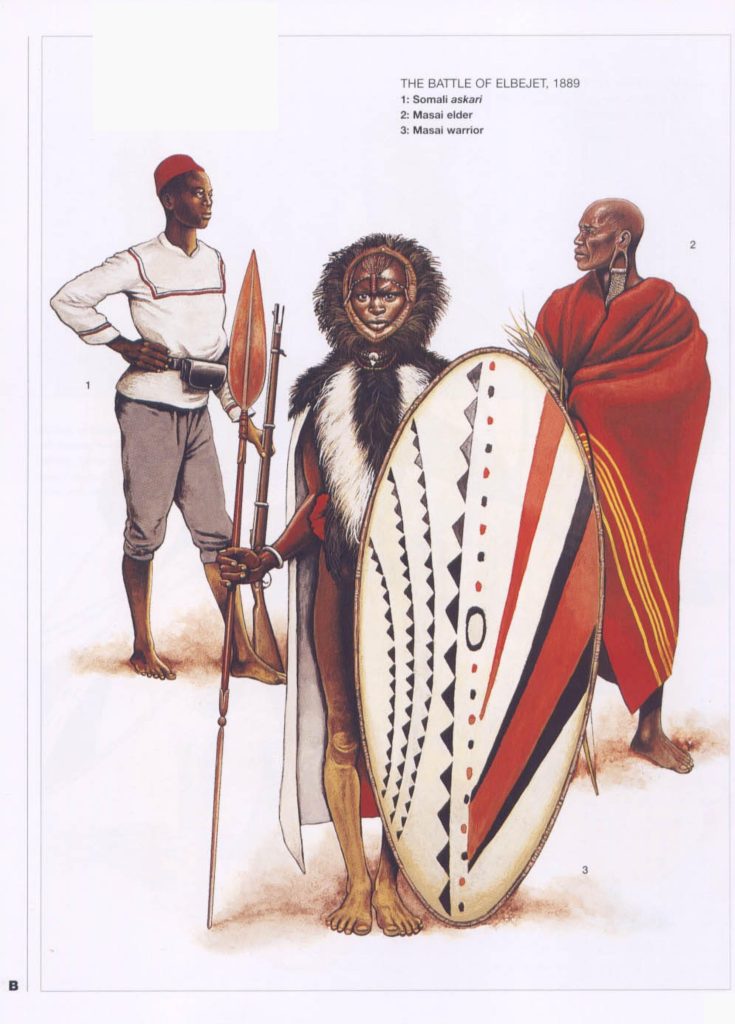
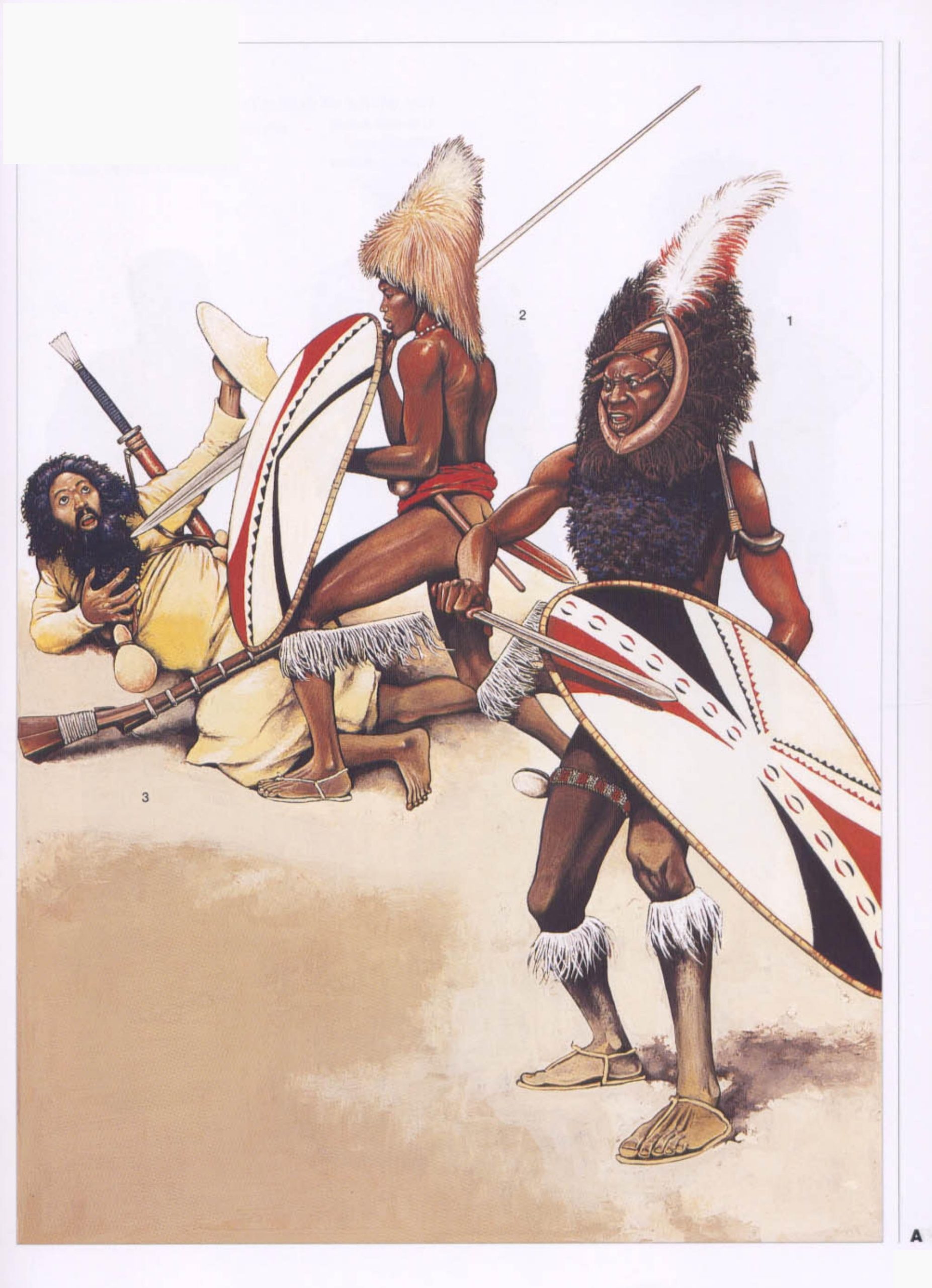
Their weapons were the long-bladed spear, a short sword called the olalem, and a club or knobkerrie. They carried large buffalo-hide shields, painted with patterns that identified their clan and age-set. These shields were thick enough to stop a musket ball at distance — a fact that gave the moran a psychological advantage in their early encounters with Arab and Baluchi traders armed with matchlock muskets. One Maasai warrior famously challenged Count Teleki to use his shield as target practice; he was visibly rattled when the first bullet went straight through it. But before the era of breech-loading rifles, the Maasai confidence in their shields was not unreasonable.
‘Physically they are a splendid people; and for energy, intrepidity and dash they are without their equals in Africa; but they are cruel and remorseless to the last degree.’
— Charles New, missionary, encountering the Maasai in the early 1870s
Their standard battle formation was a wedge — the bravest warriors forming the point at the centre, with rearguard and flank guards on either side, charging straight through the enemy line in what they called the “eagle’s wing.” Unlike most East African armies, they used no drums or musical instruments in battle, relying instead on war-cries and chants. What they also relied on, to a degree unusual even for the region, was sheer psychological dominance. Peoples who had never encountered the Maasai in battle often fled at their approach. Peoples who had fought them and lost did not recover easily.
The Geography of Fear
The practical effect of Maasai dominance on Kenya’s landscape was profound and lasting. The Kikuyu, Kamba, and Chaga were all pushed into the forested highland zones bordering Maasailand — not because the land there was better, but because the forests and steep terrain reduced the Maasai cavalry advantage and made mass cattle raids more difficult. Kikuyu settlements clustered on the ridges; their villages were built defensively. The Nandi, another formidable people, maintained their power by staying in the forested hills around Mount Elgon, where Maasai tactics worked less well.
On the open plains, Maasai rule was essentially unchallenged from the middle of the seventeenth century until the late nineteenth. Arab and Swahili traders, seeking the interior’s ivory, found the direct highland route through Maasailand so dangerous that they preferred the long coastal detours. The first Arab traders to reach the grasslands as far north as Lake Baringo did not arrive until the 1840s — and even then, their passage was only possible because the particular bands who would have stopped them happened to be away raiding elsewhere. Joseph Thomson’s successful crossing of Masailand in 1883 — the first by a European — owed more to luck than courage: he later admitted that most of the most aggressive moran bands had been away raiding when he passed through.
Maasai: A Chronology of Power
Not One Nation but Many
The Maasai were not a single, unified political entity — a fact that Europeans frequently misunderstood and that the Maasai themselves sometimes used strategically. There were sixteen major clans, of which four — the Kaputiei, Loitai, Purko, and Kisongo — were dominant. Within the pastoral Maasai, there were further distinctions between the IlMaasai proper and the Iloikop groups (sometimes called Kwavi), who practised some agriculture alongside herding. Nineteenth-century writers often treated the Iloikop as a separate and inferior people, but the distinction was more about circumstance than identity: any Maasai who lost his cattle and was forced to farm was called Kwavi, and could regain full status by accumulating cattle again.
Political authority among the Maasai was exercised through two kinds of leaders. The beijanis, or civil chiefs, held local authority. More powerful, in a diffuse and spiritual sense, were the hereditary laibons — medicine men and diviners who combined religious authority with the ability to mobilise large coalitions of clans. The greatest of these was Mbatian, who held office from about 1866 to 1890 and came closer than any Maasai figure to exercising authority over the whole nation. But even Mbatian had no formal military command. There was no system of punishment for warriors who ran away, no binding orders from above. What held Maasai armies together was not discipline but culture: the absolute shame of cowardice, enforced by the contempt of one’s peers.
The Art of Maasai Warfare
What the Maasai lacked in centralised command structure they more than compensated for in tactical adaptation. Their experience fighting Arab musket-armed caravans taught them early lessons about firearms that other East African peoples learned only later. In a battle in 1857 in which eight hundred moran defeated a force of Arab and Baluchi matchlock troops, the Maasai strategy was elegant: they appeared to flee at the first volley, drawing the Arabs forward to reload, then wheeled and attacked at close quarters before the muzzle-loaders could be recharged. The tactic worked repeatedly.
When Carl Peters encountered them in 1889 — deliberately provoking an attack near Elbejet — the Maasai adapted again, this time to breech-loading repeating rifles they had never seen before. Within the first day of fighting, Peters noticed them advancing in short rushes from tree to tree, using cover, never bunching into targets. His force held, but only by a narrow margin: he retreated into a forest, was shadowed by Maasai for days, and finally reached safety at an Arab trading post. He later calculated that his only real advantage had been the epidemic of cattle disease — probably introduced by his own caravan — that had weakened the local bands when he arrived. A healthy Maasai force, he believed, would have killed them all.
‘The Maasai knows how to protect himself from the first shot by throwing himself on the ground, or sheltering behind a tree; and long before the muzzle-loader has been made ready for a second discharge, he has come bounding up to finish the matter with a thrust of his lance.’
— Carl Peters, New Light on Dark Africa, 1891
Civil War and the Limits of Dominance
Despite their fearsome external reputation, the Maasai spent much of the nineteenth century fighting themselves. By 1800 the era of major territorial expansion was essentially over. The energy that had once been directed outward turned inward, and the resulting civil wars between the pastoral and Iloikop Maasai factions caused more Maasai casualties than all their external campaigns combined.
The pastoral IlMaasai eventually prevailed over the Iloikop in a series of conflicts stretching through the mid-nineteenth century. But the struggle was ruinous. Entire sub-groups were displaced or destroyed. The Uasin Gishu Maasai — once dominant on the great plateau northwest of the Rift Valley — were broken by an alliance of pastoral Maasai in the 1870s, which was precisely what opened space for the Nandi to expand into their former territory. Maasai dominance, in other words, was always more contested and more fragile than it appeared from the outside.
Even in their external relations, the Maasai were not invincible. The Nandi and Kipsigis were their match in open country. The Kamba, though not aggressive, were capable of defending their borders with bows against Maasai spearmen. South of Mount Kilimanjaro, the Hehe delivered a serious defeat to a Maasai raiding force in the 1880s. The Kikuyu, though frequently raided, held on in the forests and ridges. Masailand’s apparent invulnerability was always partly an illusion sustained by the fact that most peoples had learned to avoid the open plains where the moran were most effective.
The Collapse: Rinderpest, Smallpox, and the Opening of the Interior
What no amount of military skill could defend against was cattle disease. In the late 1880s and early 1890s, a catastrophic sequence of disasters hit the Maasai in rapid succession. Rinderpest — a viral cattle plague probably introduced from Asia via Ethiopia — swept through the herds of the entire region with devastating effect. For the Maasai, whose entire economy, identity, and social structure rested on cattle, the loss was existential. Most herds were wiped out. Smallpox followed, killing large numbers of people already weakened by hunger. Drought compounded the disaster.
When Joseph Thomson had crossed Masailand in 1883, he found it densely populated with kraals and confident warriors. When Peters crossed a few years later, he passed through stretches of country that had been heavily settled in Thomson’s time and now lay empty and deserted. The Maasai population had collapsed. Their military power, though never gone, had been broken as a continental force.
The timing was not accidental from the British point of view. When colonial administrators began extending authority into the Kenyan highlands after 1900, they found Maasai communities still recovering from the catastrophe of the previous decade. Crucially, the British offered what the Maasai desperately needed: assistance in rebuilding their herds, achieved partly by participating as auxiliaries in colonial operations against the Kikuyu and others, and receiving captured cattle as payment. The moran who had closed the interior for two centuries were now helping the British open it. It was a transformation that neither side fully understood at the time.
The Legacy
The Maasai at their peak were not simply warriors. They were the organizing principle of an entire regional geography — the reason the highlands were settled as they were, the reason trade routes ran as they did, the reason the Kikuyu farmed ridges rather than plains. Their dominance reshaped the distribution of dozens of peoples across modern Kenya and Tanzania, and many of those patterns persist in the ethnic and land-use geography of the region today.
When the British arrived and found the Rift Valley grasslands relatively empty of cultivation, they interpreted this as virgin land awaiting development and allocated it to European settlers — one of the defining injustices of colonial Kenya. That emptiness was not natural. It was the product of Maasai dominance, enforced over two centuries, that had kept the plains clear of farmers by threat of raid and destruction. The settlers’ “empty” highlands were, in historical reality, the ecological footprint of the most powerful military culture pre-colonial Kenya ever produced.