
Before the Kikuyu, before the Luo, before the British redrew the map — the Cushitic peoples shaped the languages, customs, and very bones of Kenyan civilisation. Their story has been buried twice: first by conquest, then by scholarship.
When most Kenyans learn about their country’s history, the story begins somewhere familiar: the Kikuyu farming the ridges around Mount Kenya, the Luo migrating south to the shores of Lake Victoria, the British arriving on the coast and eventually building a railway to nowhere. What this narrative skips — quietly, consistently — is the world that existed before all of it. A world built, to a remarkable degree, by the Cushitic peoples of eastern and northern Africa.
The word “Cushitic” will not be familiar to everyone. It refers to a family of languages — and the peoples who spoke them — originating in the Horn of Africa and the Ethiopian highlands. Their descendants still live in Kenya today: the Borana, the Rendille, the Somali, the Orma, the Sakuye, the remnant communities of the Mogogodo and the Dahalo. But Cushitic influence in Kenya runs far deeper than these surviving communities suggest. It runs into the cultural DNA of peoples who no longer think of themselves as Cushitic at all.
A Continent Remade from the North
To understand what the Cushites gave Kenya, you have to go back roughly two thousand years. By the early centuries of the Common Era, two branches of Cushitic-speaking peoples had already spread across vast stretches of what is now Kenya. The Southern Cushites — cattle-keepers and grain farmers — occupied the highland Rift Valley. The Eastern Cushites, ancestors of the Oromo and Somali, ranged across the drier plains stretching from the Ethiopian highlands toward the coast.
These were not marginal or primitive societies. They possessed iron, kept cattle, cultivated grain, and had developed sophisticated social institutions that would prove extraordinarily durable — not because they survived intact, but because they were absorbed so thoroughly by the peoples who displaced them.
The Southern Cushites have left a deep mark on the society, economy, and political structure of the Highland Bantu and Nilotes — a mark so deep that it persists in vocabulary, ritual, and the structure of everyday life.
The Bantu-speaking peoples who arrived from the southwest, and the Nilotic speakers who descended from the north, did not enter an empty land. They entered Cushitic East Africa. And the encounter transformed both sides — though history has remembered only the newcomers.
What the Cushites Gave to Kenya’s “Other” Peoples
Here is a striking fact: male and female circumcision as a coming-of-age initiation — perhaps the single most widely shared cultural practice among Kenya’s communities — appears to have Cushitic origins. It was not, as colonial ethnographers sometimes assumed, an ancient and universal practice across Africa. Among the Highland Nilotic peoples of Kenya, linguistic evidence shows it was borrowed from Cushitic-speaking neighbors in the first millennium BCE, along with an entire system of cycling age-sets and age-grades — those elaborate generational structures that still organise social life among the Kikuyu, the Kalenjin, and many others.
The evidence for this is linguistic. Scholars found that a surprising number of Cushitic loan-words appear not just in the everyday vocabularies of Bantu and Nilotic languages — where borrowing from trade and contact might be expected — but in the most intimate registers of language: words for parts of the human body, words for kinship, words for the most fundamental acts of life. Deep borrowing of this kind points not to casual trade contact but to long, close, formative cohabitation.
The Kikuyu, the Kamba, the Chuka, the Tharaka, the Embu, the Meru — all the Mount Kenya peoples — carry this Cushitic inheritance. Their ancestors settled a region previously occupied by Southern Cushitic communities. The adoption of circumcision, age-grading, and certain cattle-related practices were not inventions but inheritances, absorbed so long ago that they came to feel original.
What Cushitic Peoples Contributed to Kenyan Culture
- Circumcision and initiation rites — adopted by Bantu and Nilotic peoples from Cushitic neighbors
- Cycling age-set and age-grade systems — central to Kikuyu, Kalenjin, and Maasai organisation
- Cattle milking — Rift Cushites may have introduced milking to East African Bantu communities
- Pastoral economy and camel-keeping — foundational to northern Kenyan livelihoods to this day
- Extensive vocabulary — Cushitic loan-words embedded in Swahili, Kikuyu, Kalenjin, and others
- Settlement of the coast hinterland — Oromo expansion pushed Mijikenda and Pokomo south to their present lands
Even the Mijikenda — the “nine towns” peoples of the Kenya coast, ancestors of the Giriama and their kin — owe their presence where they are partly to Cushitic history. When the Oromo expanded southward into the Juba and Shebelle river valleys around the sixteenth century, they set off a chain of migrations that pushed Sabaki-speaking Bantu communities southward along the coast, eventually settling them in the hinterland near Mombasa where they built their famous hilltop kayas. The geography of coastal Kenya was shaped, in part, by Cushitic pressure from the north.
The Hamitic Myth and Its Damage
This is where the story of erasure properly begins — not with British guns, but with British and European ideas.
Nineteenth-century European scholars noticed that many of the most complex political institutions in sub-Saharan Africa seemed to exist among lighter-skinned, pastoralist peoples with features they found aesthetically closer to their own. Rather than conclude that complexity was native to Africa, they invented a theory: that these peoples — whom they called “Hamites,” invoking a dubious Biblical genealogy — were a superior race of conquerors who had imported civilisation southward into a continent incapable of generating it on its own.
The Cushites, as the most prominent of these “Hamitic” peoples in East Africa, were caught in a peculiar double bind. They were simultaneously credited with everything admirable in the region’s history and stripped of agency in their own right. Their achievements were praised, but only as evidence of their racial semi-proximity to Europeans. The actual Cushitic peoples living in northern Kenya — the Borana, Somali, Rendille — were classified by colonial administrators as difficult, ungovernable “desert tribes,” culturally frozen, historically inert.
To these “Hamites” have been attributed any remarkable technological feat, any notable political organisation, any trace of “civilisation” in black Africa — a viewpoint both illogical and prejudiced that must be rejected entirely.
The result was incoherent but consequential. The Cushitic peoples were used as an explanatory device to account for African achievement while simultaneously being marginalised in the actual writing of African history. Their living descendants in northern Kenya were administered as a special case — governed not by the district administration that served the rest of the colony, but under emergency-style regulations that persisted long after independence.
Colonial Kenya and the North as Afterthought
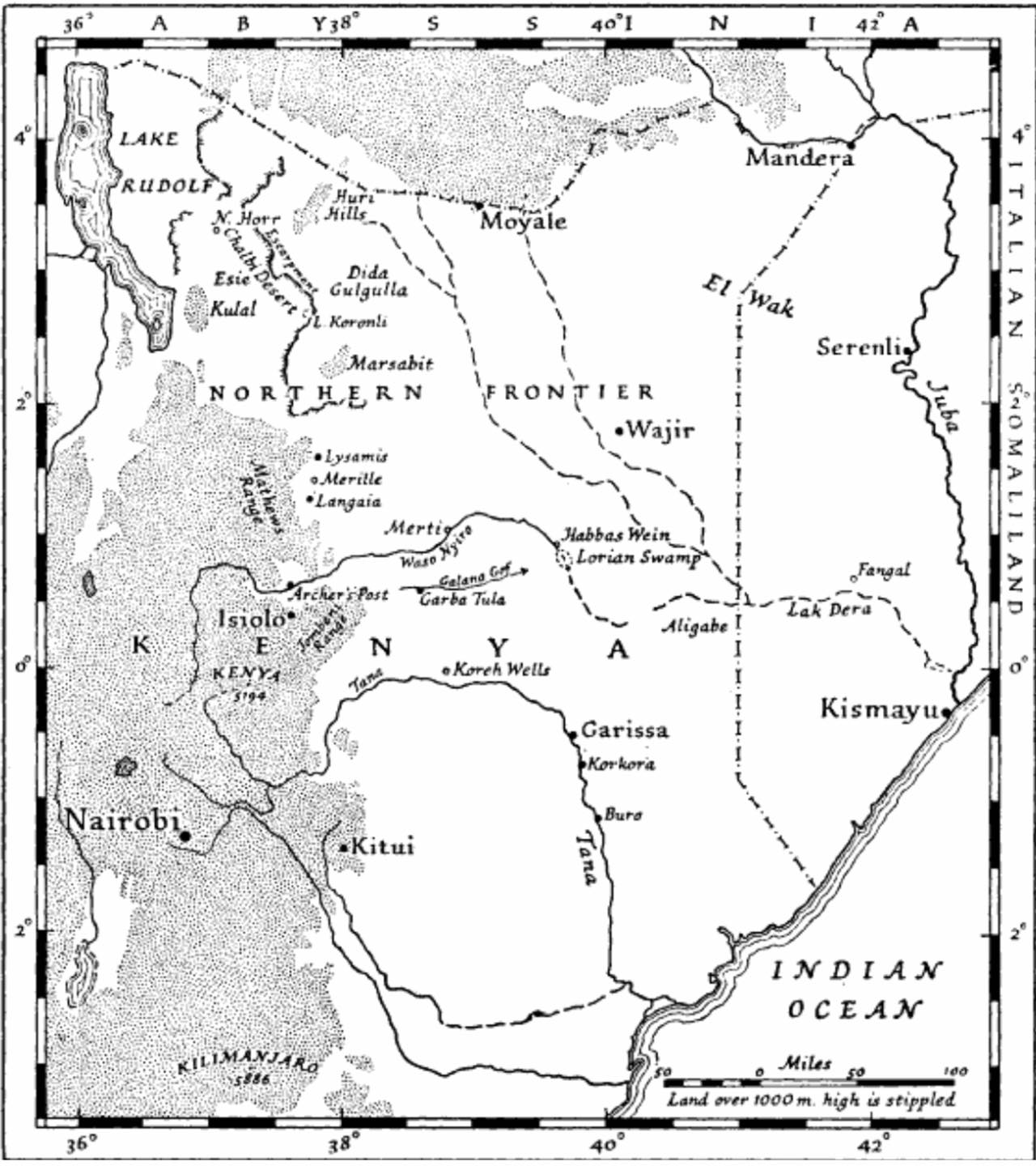
Fazan, a senior colonial administrator who served in Kenya from the early twentieth century, recorded in his memoirs that more than half the land area of the British East Africa Protectorate was occupied by the Northern Province — home to Turkana, Samburu, Borana, and Somali. His account of that vast territory runs to a single paragraph. It was, he wrote, a region where the keeping of peace between tribes was the main preoccupation, where very limited material progress was made, and where the potentialities for development were never fully explored.
That summary captures the colonial attitude precisely. The north was not Kenya’s frontier to be developed; it was Kenya’s margin to be managed. The pastoralists who lived there were stockmen — “keeping camels, donkeys, cattle, sheep and goats” — and little else worth recording. The Somali of Jubaland put up fierce resistance to British rule, and despite several large military expeditions into the region, the British never really established effective control. The response was not greater engagement but lesser: Jubaland was eventually ceded to Italy after World War I and incorporated into Italian Somaliland. Kenya was made smaller, and its northern peoples were made someone else’s problem.
The Somali who remained in Kenya — those living in what became the Northern Frontier District — found themselves on the wrong side of a border drawn not by any demographic or historical logic, but by European convenience. When Kenya became independent in 1963, the new KANU government rejected their bid to join the Somali Republic, and the Northern Frontier District remained Kenyan. A low-level insurgency — the Shifta War — followed. It was treated then, and has been treated since, as a security matter rather than a historical question.
The Mogogodo: A Community Almost Swallowed
If you want to see what the erasure of Cushitic peoples looks like at its most intimate, look at the Mogogodo — or as they call themselves, the Yaaku. Their linguistic ancestors were Eastern Cushitic speakers living in the forests of what is now Laikipia County. By the twentieth century, surrounded by expanding Maasai and Samburu communities, the Yaaku had largely abandoned their language and adopted Maa. They became, to external observers, simply a marginal group of forest-dwelling hunters — and were often dismissed as “Dorobo,” a Maasai term of contempt for people without cattle.
Ogot’s survey of East African history notes the Mogogodo as “linguistic descendants” of an Eastern Cushitic people who inhabited eastern Kenya — a brief, clinical mention that belies the weight of what it describes. A whole community, with its own history and tongue, reduced to a footnote in someone else’s chapter.
The Yaaku language has been the subject of revival efforts in recent decades, but it hovers near extinction. The community that spoke it was absorbed not violently but gravitationally, pulled into a larger cultural orbit until their own language seemed useless to them. This is how most Cushitic erasure in Kenya happened: not by massacre, but by the slow withdrawal of a world in which a Cushitic identity had social meaning.
Why This History Is Still Contested
The historical erasure of Cushitic peoples is not merely an academic problem. It has political dimensions that remain live today.
The Kenyan national narrative — forged in the struggle against British colonialism, centered on the highlands, and organised around the figure of Jomo Kenyatta — was always, at its core, a Bantu and Nilotic story. The communities of the north, whether Borana, Somali, Rendille, or Turkana, were incorporated into an independent Kenya for which they had not campaigned and in which they had little voice. The constitution of 2010 and the devolution of power to county governments was the first serious structural attempt to change this — but counties do not rewrite the historical imagination of a nation.
There is also the specific question of the Cushitic contribution to Kenyan culture. When a Kikuyu elder leads an age-set ceremony, when a Kalenjin community marks the transition of a generation, when circumcision rituals are performed across dozens of Kenyan communities — the Cushitic origin of these practices goes unacknowledged. This is not an argument for credit or grievance. It is simply an observation: Kenyan culture is more Cushitic than most Kenyans know, and acknowledging that would not diminish anyone’s inheritance. It would enrich everyone’s understanding of where they come from.
What Remains
The Cushitic peoples of northern Kenya are not a vanished race. The Borana, whose cattle-herding traditions stretch back millennia, graze their herds across Marsabit and Isiolo. The Rendille of the Kaisut Desert maintain one of East Africa’s most distinctive pastoral cultures, organized around camel-herding in one of the continent’s harshest environments. The Somali of northeastern Kenya are one of the country’s largest communities. The Orma along the Tana River have maintained a distinct identity through centuries of pressure. The Sakuye, the Gabbra, the Dasanach — smaller communities all — persist.
What has not survived, or survives only partially, is their place in the Kenyan story. They appear in the introduction to history textbooks — in chapters about “the peoples of Kenya before colonialism” — and then largely vanish, as the narrative moves south and the Mau Mau rises and Kenyatta is sworn in. The north fades to a kind of scenic background: arid, vast, vaguely majestic, and empty of history.
It was not empty. It was the oldest inhabited part of what we now call Kenya, shaped over thousands of years by peoples whose languages, cattle, rituals, and ideas percolated southward to become the cultural foundation of communities that have since forgotten the source. Recovering that history is not an act of nostalgia. It is an act of accuracy — and perhaps, in a country still learning to hold all its parts together, something more than that.