
Organization, Tactics, and Warfare in the Nineteenth Century
The Maasai of East Africa have long occupied a singular place in the historical imagination as the quintessential warrior people of the region. During the nineteenth century their reputation for martial prowess extended from the Indian Ocean coast to the great lakes, and they were widely regarded by European explorers, Arab traders, and neighbouring African peoples as the dominant military power in the region.1 Yet despite this fearsome reputation, the Maasai did not maintain a standing army in the conventional sense. Instead, their military effectiveness rested on a sophisticated system of age-grades, ritual preparation, and tactical methods that were finely adapted to the environment in which they operated. This article synthesizes the available historical and ethnographic evidence to reconstruct the military organization, weapons, and battlefield tactics of the Maasai during the period roughly from 1840 to the establishment of colonial rule in the 1890s.
Age-Set Organization and the Warrior Class
The foundation of Maasai military power was the institution of the moran — the warrior age-set. Young men were initiated into this status during a circumcision ceremony (emurata) that was held approximately every seven to fifteen years, creating distinct cohorts that would function as a professional warrior class for the next fifteen years or so.2 All men within a given age-set were expected to serve as warriors, and because cattle herding could be performed by boys and elders, the entire age-set was freed from productive labour to concentrate on military activities.3
Each age-set bore a name, and the nineteenth-century sets are well documented: the Tuati I (c. 1836–56), Nyangusi I (c. 1851–71), Laimer (c. 1866–86), Talala (1881–1905), and Tuati II (1896–1917).4 Within each age-set there was a further division into a senior “right-hand” group and a junior “left-hand” group, distinctions that carried practical implications for precedence in camp and on campaign.5
Warriors lived apart from the rest of the community in their own villages, known as manyattas.6 These camps served not only as military bivouacs but as centres of warrior culture where the moran cultivated a distinctive ethos of bravery, physical endurance, and group loyalty. The diet of the moran was deliberately restricted to meat, blood, and milk; other foods, especially vegetables, were believed to make a man “soft” and were forbidden.7 This dietary discipline was reinforced by the consumption of a stimulant drink made from bark and herbs, which contemporary observers described as producing immunity to fear and fatigue — a kind of pre-battle pharmacological preparation.8
Despite the cohesiveness of the warrior class, the Maasai lacked a formal command hierarchy. The highest authorities in Maasai society, the laibons (ritual specialists), wielded great influence but did not exercise direct military command.9 Within the manyatta a group of picked warriors known as embikas acted as a rudimentary military police, maintaining order on the march and in camp.10 In battle the advice of respected elders might be sought, but there was no system of coercive command; warriors fought because their social identity demanded it, and because cowardice would bring lifelong shame among their peers.11
Weapons and Protective Equipment
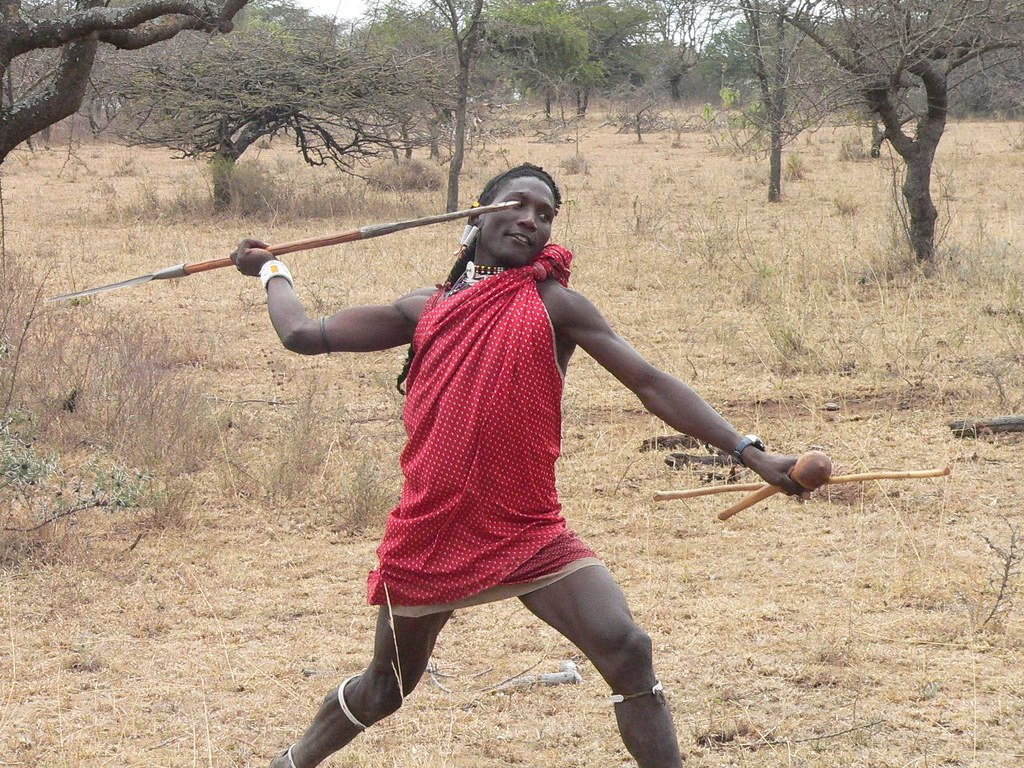
The principal weapon of the moran was the spear (ol-empe). The traditional war spear of the nineteenth century was about 1.7 metres (5½ feet) in length, with a broad, heavy blade designed for a powerful underarm thrust to the abdomen.12 Variations existed between clans: northern Maasai favoured a longer, narrower blade, while southern sections preferred a broader pattern.13 The spear was often reddened with ochre, a substance that also covered the warrior’s body as a cosmetic and symbolic preparation for battle.14
In addition to the spear, warriors carried a short sword (ol-alem), about 45–60 cm (18–24 inches) in length, with a blade that widened towards the tip into a distinctive “spoon” shape.15 These swords were often fabricated by grinding down old European machete blades obtained through trade. A throwing club (rungu) served as a missile weapon, sometimes hurled in a high arc as part of a coordinated attack.16
The Maasai shield (ol-waru) was made from buffalo hide, a material thick and tough enough to stop a musket ball.17 Shields varied in height from 90 cm to 1.5 metres (3 to 5 feet) and were elaborately painted with patterns (sirata) in black, white, red, and grey. The patterns were not merely decorative; they identified the warrior’s clan, age-set, and sometimes individual achievements.18 A distinctive feature was the es segira pattern running vertically down the centre, which was intended to represent cowrie shells.19
Warriors adorned themselves with ostrich-feather headdresses, vulture-feather capes, and leg ornaments made of white goat hair. A lion’s-mane headdress was reserved for men who had killed a lion with a spear, though it was sometimes worn in battle as a mark of prestige.20 The overall effect was deliberately intimidating, intended to enhance the psychological impact of a Maasai charge.
Tactics: The Eagle’s Wing and the Rush to Contact
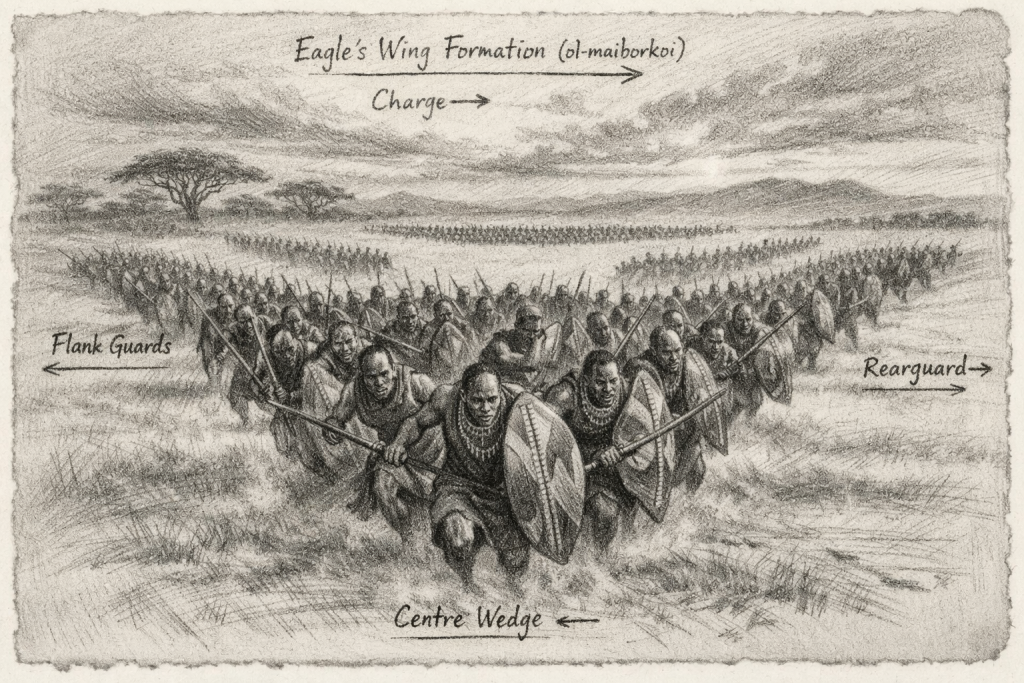
In pitched battle the Maasai employed a formation known as the “eagle’s wing” (ol-maiborkoi). The bravest warriors formed a wedge in the centre, supported by flank guards and a rearguard.21 The entire formation would charge directly at the enemy line, seeking to break it by the sheer shock of the assault before closing to spear-fighting range.22
This tactic proved devastatingly effective against musket-armed opponents. European observers repeatedly noted that the moran had learned to exploit the slow reloading time of muzzle-loading firearms. As the German explorer Carl Peters described it:
“The Masai [sic] knows how to protect himself from the first shot by throwing himself on the ground, or sheltering himself behind a tree; and long before the muzzle-loader has been made ready for a second discharge, he has come bounding up, to finish the matter with a thrust of his lance.”23
When attacking a defensive position or a caravan, the Maasai sometimes used a coordinated two-phase missile assault before the charge. According to one account, warriors would throw clubs in a high arc, forcing the defenders to look upward and become distracted; meanwhile, other warriors would hurl spears in a lower trajectory to strike the distracted foe.24
The charge itself was conducted in silence, without the drums that accompanied many other African armies; the only sounds were chants and war-cries, and sometimes the clanking of iron bells strapped to the thighs of the warriors.25 This silence, combined with the speed of the advance, contributed to the terror that the Maasai inspired.
Maasai tactics were not, however, universally successful. The moran were at a serious disadvantage in broken terrain and forest. Their neighbours who occupied such environments — the Kikuyu in their forest clearings, the Hehe in the mountains of southern Tanzania — were able to resist Maasai incursions effectively.26 In open country, by contrast, the Maasai were masters, and for most of the nineteenth century they successfully dominated the plains of the Rift Valley and the highlands of Kenya.27
Historical Engagements
The Maasai were involved in almost constant low-intensity warfare, primarily in the form of cattle raids against neighbouring peoples.28 Raiding was not merely economic but had a religious dimension: according to Maasai belief, God had originally given all the world’s cattle to the Maasai, so recovering them from other tribes was a sacred duty.29 Raiding parties could be large, sometimes numbering thousands of warriors, and they ranged far beyond Maasailand — as far north as Lake Rudolf and south into the territory of the Hehe.30
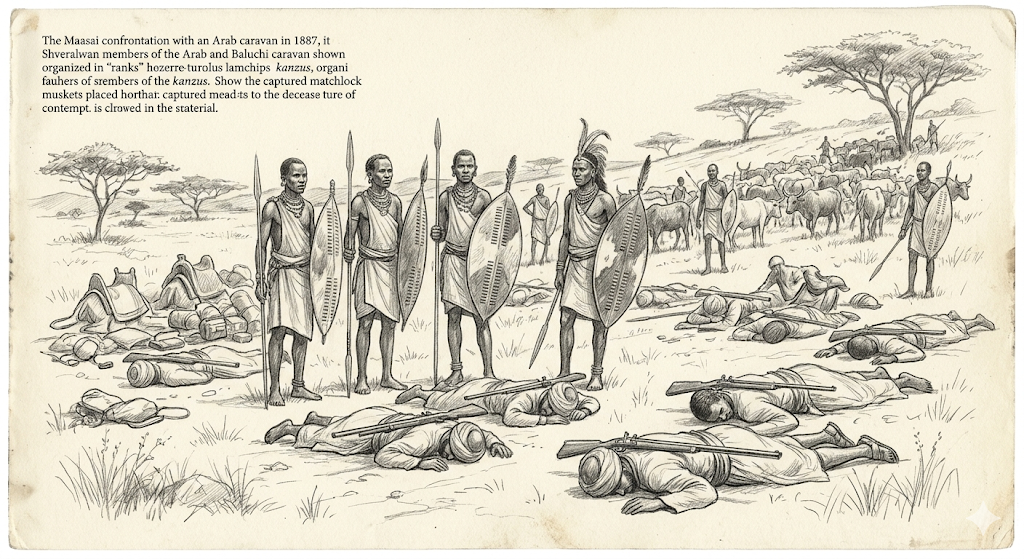
Large-scale encounters with armed caravans were also frequent. In 1857, according to Richard Burton, a force of 800 moran defeated 148 Arab and Baluchi matchlock men, after initially retreating to draw the enemy out of formation.31 The Maasai repeated this pattern against many caravans, and the main trade routes to the interior were often closed by their activity. In 1877, for example, a caravan of 1,500 armed men was destroyed by Laikipiak Maasai; and in 1887 an Arab caravan numbering 2,000 guns was said to have been annihilated, with the dead laid in ranks and their own muskets placed across their shoulders as a gesture of contempt.32
The first major clash with Europeans came in December 1889, when the German Emin Pasha Relief Expedition under Carl Peters attacked the Maasai village of Elbejet. The expedition, armed with modern breech-loading rifles, was initially successful in surprising the village, but the moran counter-attacked fiercely. Peters was forced to conduct a fighting retreat over several days, saving his expedition only after heavy casualties and the expenditure of most of his ammunition.33 Although the encounter was a qualified victory for the Germans, it demonstrated that the Maasai could still inflict serious losses on a well-armed European force.
By the 1890s the Maasai had learned to respect the firepower of European breech-loaders and generally avoided open conflict with colonial powers. Many moran instead entered British service as auxiliaries, fighting alongside the colonial forces against the Kikuyu and others.34 This pragmatic adaptation reflected a recognition that the old methods were no longer sufficient against the new weapons, and it allowed the Maasai to preserve their social organization while accommodating the reality of colonial rule.
Cultural Legacy and Influence
The military reputation of the Maasai extended far beyond their own territory, and their fighting methods were emulated by neighbouring peoples. The Kikuyu, who had suffered from Maasai raids in the eighteenth century, later borrowed numerous military practices, including the division of warriors into right- and left-hand groups, the use of the long Maasai spear, and the adoption of ostrich-feather headdresses and lion’s-mane headdresses.35 As the anthropologist William Lawren observed, the Kikuyu were influenced not by the Maasai as cattle-keepers but by the Maasai as militarists; the borrowing was overwhelmingly of military symbols and organization rather than of pastoral practices.36
Similarly, the Ruga-Ruga warlord Mirambo hired Maasai contingents to fight alongside his Nyamwezi forces in the 1880s, and the Ngoni of southern Tanganyika adapted elements of Maasai tactics.37 The age-set system itself, though not unique to the Maasai, spread widely among the agricultural peoples of the region, often mediated through the military prestige of the moran.38
Conclusion
The martial tradition of the nineteenth-century Maasai was not simply the product of a “warlike” disposition; it was a carefully structured social institution, built on age-grade organization, dietary discipline, and tactical methods honed by generations of conflict. The moran constituted a professional warrior class that dominated the open plains of East Africa for nearly a century, intimidating caravans and neighbouring peoples alike. Their tactics — the silent charge, the wedge formation, the exploitation of slow-loading firearms — were well suited to the environment and gave them a decisive advantage against all but the most technologically advanced opponents.
The encounter with European breech-loading rifles in the late 1880s marked the beginning of the end of Maasai military supremacy, but the legacy of the warrior tradition has endured. The age-set system continues to structure Maasai society, and the image of the moran remains a potent symbol of identity and resistance. The careful study of Maasai warfare, drawing on the accounts of explorers, administrators, and anthropologists, offers a window into one of Africa’s most remarkable martial cultures.
Sources
- Joseph Thomson, Through Masai Land (London: Sampson Low, Marston, Searle & Rivington, 1885), p. 407; Robert L. Tignor, “The Maasai Warriors: Pattern Maintenance and Violence in Colonial Kenya,” Journal of African History 13, no. 2 (1972): 271–90, at p. 272.
- Chris Peers, Warrior Peoples of East Africa 1840–1900 (Oxford: Osprey Publishing, 2005), p. 10; A. C. Hollis, The Masai: Their Language and Folklore (Oxford: Clarendon Press, 1905), pp. 295–307.
- Peers, Warrior Peoples, p. 10; Paul Spencer, The Maasai of Matapato: A Study of Rituals of Rebellion (Manchester: Manchester University Press, 1988), pp. 92–100.
- Peers, Warrior Peoples, p. 11; Hollis, The Masai, p. 302.
- Peers, Warrior Peoples, p. 11; Spencer, Maasai of Matapato, pp. 94–97.
- Spencer, Maasai of Matapato, pp. 101–18; Lotte Hughes, Moving the Maasai: A Colonial Misadventure (Basingstoke: Palgrave Macmillan, 2006), p. 13.
- Peers, Warrior Peoples, p. 11; Spencer, Maasai of Matapato, p. 113.
- Peers, Warrior Peoples, pp. 11–12; Hughes, Moving the Maasai, p. 13.
- Tignor, “Maasai Warriors,” p. 277; Spencer, Maasai of Matapato, p. 14.
- Peers, Warrior Peoples, p. 12; Tignor, “Maasai Warriors,” pp. 286–87.
- Tignor, “Maasai Warriors,” pp. 286–88; Peers, Warrior Peoples, p. 12.
- Peers, Warrior Peoples, pp. 12, 42; Thomson, Through Masai Land, pp. 445–47.
- Peers, Warrior Peoples, p. 42; Thomson, Through Masai Land, p. 447.
- Peers, Warrior Peoples, p. 42; Ludwig von Hohnel, Discovery of Lakes Rudolf and Stefanie (London: Longmans, Green, 1894), p. 90.
- Peers, Warrior Peoples, pp. 42, 44; Mary French-Sheldon, Sultan to Sultan: Adventures in East Africa (Boston: Arena Publishing, 1892), p. 122.
- DITSONG National Museum of Military History, “The Maasai,” online article.
- Peers, Warrior Peoples, p. 42; von Hohnel, Discovery, p. 91.
- Peers, Warrior Peoples, p. 43; Spencer, Maasai of Matapato, pp. 132–35.
- Peers, Warrior Peoples, p. 43.
- Peers, Warrior Peoples, p. 42; Spencer, Maasai of Matapato, p. 114.
- Peers, Warrior Peoples, p. 12; Tignor, “Maasai Warriors,” p. 286.
- Peers, Warrior Peoples, p. 12.
- Carl Peters, New Light on Dark Africa (London: Ward & Downey, 1891), p. 170, quoted in Peers, Warrior Peoples, p. 12.
- DITSONG National Museum of Military History, “The Maasai.”
- Peers, Warrior Peoples, p. 12; Tignor, “Maasai Warriors,” p. 286.
- William L. Lawren, “Masai and Kikuyu: An Historical Analysis of Culture Transmission,” Journal of African History 9, no. 4 (1968): 571–83, at pp. 576–77.
- Tignor, “Maasai Warriors,” p. 272; Hughes, Moving the Maasai, pp. 23–24.
- Tignor, “Maasai Warriors,” pp. 272–73; Spencer, Maasai of Matapato, pp. 37–38.
- Peers, Warrior Peoples, p. 8.
- Peers, Warrior Peoples, p. 9; Tignor, “Maasai Warriors,” p. 273.
- Peers, Warrior Peoples, p. 12; Richard F. Burton, The Lake Regions of Central Africa (London: Longman, Green, Longman and Roberts, 1860), p. 302.
- Peers, Warrior Peoples, p. 9.
- Peers, Warrior Peoples, pp. 9–10; Peters, New Light on Dark Africa, pp. 159–76.
- Tignor, “Maasai Warriors,” p. 280; Hughes, Moving the Maasai, pp. 16–17.
- Lawren, “Masai and Kikuyu,” pp. 579–80.
- Lawren, “Masai and Kikuyu,” p. 582.
- Peers, Warrior Peoples, pp. 20, 27–28.
- Lawren, “Masai and Kikuyu,” p. 579; Spencer, Maasai of Matapato, pp. 2–3.