

Estimated Reading Time: 12 minutes
Key Takeaways
| Era | Land System | Who Controlled It? |
|---|---|---|
| Pre-Colonial | Customary / Communal | The Clan / Community |
| Colonial (1895–1963) | Crown Lands / Native Reserves | The British Crown |
| Independence (1963–2002) | Freehold / Leasehold | Political Elite |
| 2010 Constitution | Public / Community / Private | NLC & Communities |
Land is more than soil in Kenya. It is identity, livelihood, and the ultimate source of political power. The story of who owns it, how it was acquired, and who was displaced is the central thread running through the nation’s history.
From flexible communal systems to colonial conquest, from the politicized settlements after independence to the land injustices of today—this is a history of dispossession, struggle, and the ongoing quest for justice.
This article traces the evolution of land ownership in Kenya across four major eras: pre-colonial, colonial, post-independence, and the contemporary landscape shaped by the 2010 Constitution.
Pre-Colonial Land Tenure – “Land Belongs to the Community”
Before the British arrived, there was no single system of land ownership. Instead, diverse communities managed land through customary systems that were communal, flexible, and deeply tied to social organization. The core principle was simple: land belonged to the community—the living, the dead, and the unborn.
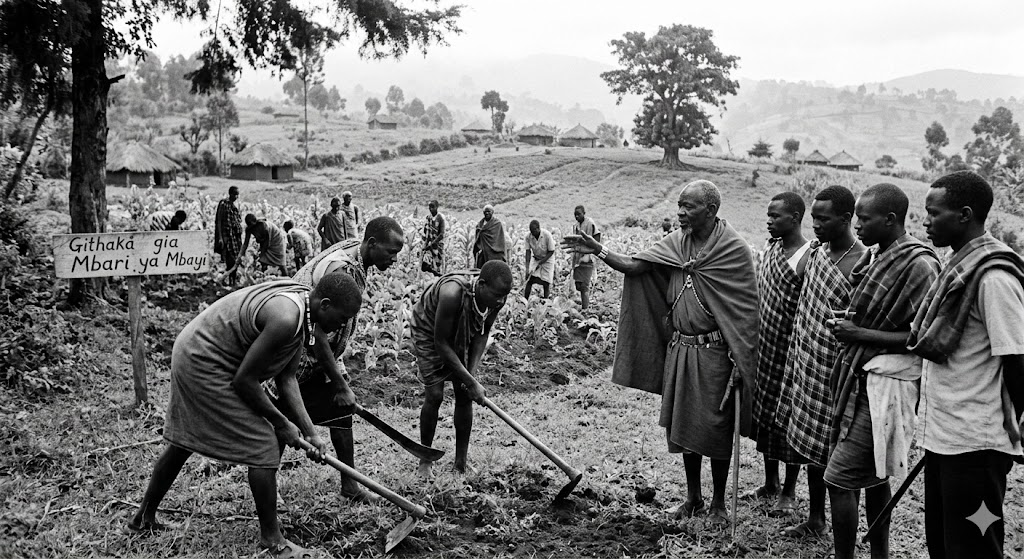
For Agricultural Communities (e.g., Kikuyu, Kamba, Luhya): Land was often held by the clan or sub-clan. Among the Kikuyu, for example, the basic land-holding unit was the mbari (sub-clan), which collectively owned a piece of land known as githaka. An individual family had clear rights to cultivate and live on a portion of this land, but they could not sell it to an outsider. This right was secured by clearing and cultivating the land—an act that established a claim.
The muramati (clan head) acted as a trustee, allocating unused land to newcomers or tenants (ahoi) who could use it in exchange for loyalty or labor. Rights of control were separate from rights of use—a sophisticated understanding of property that colonial administrators failed to grasp.
For deeper context: This communal system among the Kikuyu was not unique. The Kamba people had similar clan-based landholding structures, as explored in our article on The Kamba Clans of Kenya: Structure, Origins, and Enduring Identity. Other communities like the Kipsigis also maintained distinct land management systems tied to their social organization.
For Pastoral Communities (e.g., Maasai, Turkana, Samburu): Land was viewed primarily as a common resource for grazing livestock. The concept of individual ownership of land was alien. Instead, territories were defined by the group’s need for seasonal pastures and water, with access negotiated through complex social and kinship networks.
The Maasai, for instance, followed ancient migration routes dictated by rainfall patterns—a system that worked for centuries until colonial borders and private ranches made it impossible. Their story of land loss is detailed in The Maasai in Transition: History, Land Struggles, and the Rise of Agriculture.
For Hunter-Gatherers (e.g., Ogiek, Waata): Their very existence depended on unrestricted access to vast forest territories. Land was not a commodity to be owned, but a source of life to be protected. This worldview would later put them in direct conflict with the colonial and post-colonial state, which saw forests as timber reserves to be exploited.
Key takeaway: In pre-colonial Kenya, land was not a commodity to be bought and sold. It was a resource held in trust, with access determined by membership in a community, lineage, or clan. This worldview would be shattered by the arrival of the British.
The Colonial Era – The Great Dispossession (1895–1963)
The arrival of British rule fundamentally dismantled these systems. The colonial project in Kenya was built on one central objective: the alienation of the most fertile land for European settlement. This was achieved through a series of legal and military maneuvers that would shape the country’s destiny for generations.
2.1. The Legal Theft: Crown Lands and the “White Highlands”
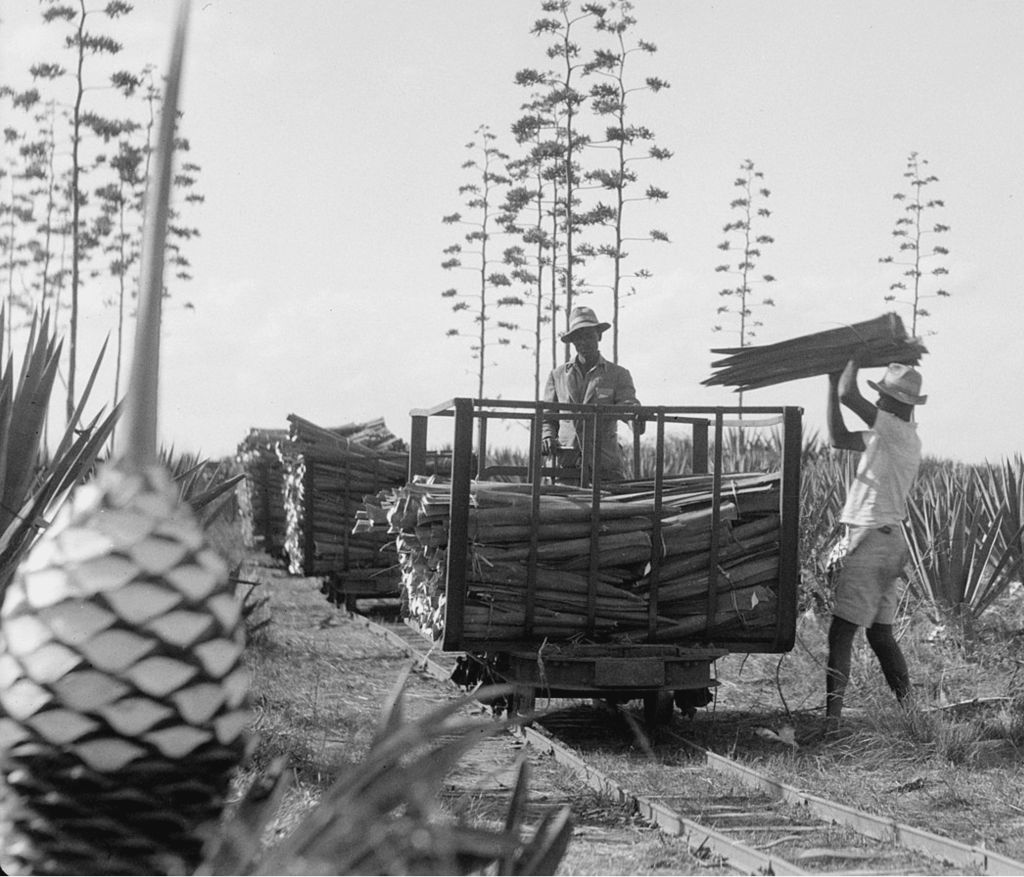
The process began with the construction of the Uganda Railway (1896-1901). As explored in The Rails That Built a Colony: East Africa’s Transport Revolution, this infrastructure project opened the interior to European settlement. To make way for settlers, the colonial state simply declared vast swathes of land “Crown Land”—meaning it belonged to the British Crown.
- The “White Highlands”: The fertile and cool central highlands—land traditionally occupied by the Kikuyu, Maasai, and others—were designated for exclusive European settlement. Africans could not own, lease, or even live on this land without European permission. This history is further examined in Kenya’s White Highlands: Land, Race, and the Economics of Exclusion.
- Native Reserves: The African inhabitants were forcibly moved into designated “Native Reserves,” which were often overcrowded, testse-fly infested, or ecologically marginal. The 1915 Crown Lands Ordinance further entrenched this by declaring that Africans had no legal claim to any land outside these reserves and could be evicted at any time.
The Maasai, for instance, were twice moved (in 1904 and 1911) to make way for settlers, shrinking their territory by over 60%. The prophecy that spoke of “white birds” bringing devastation—detailed in The Maasai Prophecy: How a Vision Foretold Their Fall—had come to pass.
2.2. The Creation of a Landless Class
Within the reserves, the colonial administration attempted to freeze what it saw as “traditional” tenure, failing to understand that these systems were dynamic. As the population grew and land pressure increased, the traditional safety nets of tenancy (ahoi) and land-lending broke down.
The alienation of land created a massive class of landless and squatter Africans, who were forced to work on European farms as laborers (squatters) in the very lands their families had once owned. This economic and social grievance became the fuel for political protest.
2.3. The Swynnerton Plan: Individualization as a Political Tool
The Mau Mau uprising (1952-1960) was, at its heart, a war over land. The freedom fighters, drawn largely from the landless Kikuyu, were fighting to reclaim what had been stolen. For a comprehensive understanding, read Mau Mau Uprising in Kenya 1952-1960.
In response, the British sought to create a loyal class of African smallholders who would have a stake in the system and act as a buffer against future rebellion.
- The Swynnerton Plan of 1954 was introduced in the Central Province. Its goal was to consolidate fragmented land holdings within the Kikuyu reserves, adjudicate ownership, and grant individual freehold titles to “productive” and “loyal” Africans.
- This was a radical shift: it extinguished customary communal rights and replaced them with individual private property. Land could now be bought, sold, and used as collateral. It also systematically excluded women from land ownership, as titles were granted almost exclusively to men.
The plan’s success in Central Province was later extended to other parts of the country, laying the legal groundwork for independent Kenya’s land system.
Related reading: The land question was central to the Mau Mau oath and the dedication of fighters. Learn more in Where Did the Name Mau Mau Come From? and explore the story of one of its most famous leaders in Dedan Kimathi: The Lion of the Aberdares. The brutal tactics used to suppress the uprising, including concentration camps, are documented in The British Concentration Camps in Kenya.
Independence and the “Politics of Land” (1963–2002)
Independence in 1963 brought euphoria but did not bring back the land. The new government, led by Jomo Kenyatta, faced a critical choice: redistribute the “White Highlands” to the landless, or maintain the colonial economic structure. The choice made would define the nation.
3.1. The “Willing Buyer, Willing Seller” Policy
Under pressure from the British government—which demanded compensation for departing white settlers—Kenya adopted a policy of buying out European farms and resettling Africans. This was done through programs like the Million-Acre Settlement Scheme.
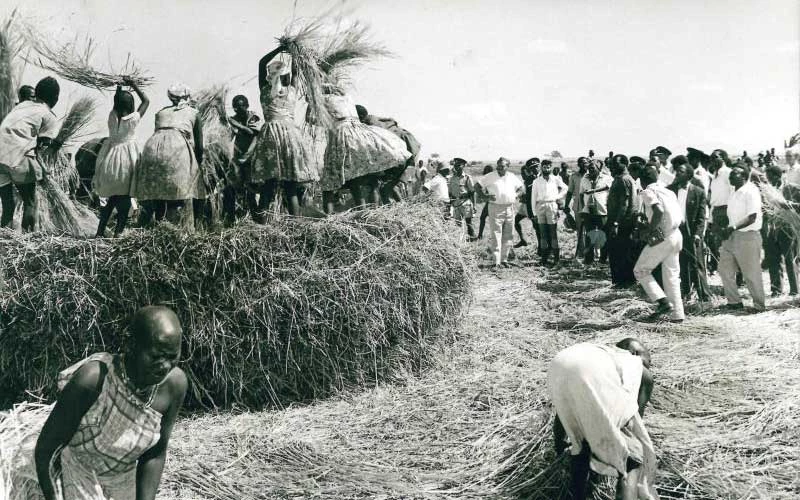
- While this scheme resettled thousands, it was far from a radical redistribution. The best farms were often purchased by politically connected individuals—the new African elite, including Kenyatta himself and his allies—creating a new landed gentry. For a detailed portrait of Kenya’s first president, see Jomo Kenyatta: Power, Nationhood, and the Making of Postcolonial Kenya 1897-1978.
- The political and economic structure of the colonial period was largely preserved, with the landless poor remaining landless. As critics like Bildad Kaggia pointed out, the government prioritized creating an African bourgeoisie over addressing the grievances of the Mau Mau freedom fighters and the poor. This tension is explored in Africanising Capitalism: Kenya’s Gambit to Create a Black Bourgeoisie.
This led to a deep political rift between the “radical” nationalists and Kenyatta’s government. Jaramogi Oginga Odinga, the first Vice President, broke with Kenyatta partly over this issue, advocating for a more equitable distribution of land and wealth. His story is told in Jaramogi Oginga Odinga: The Rebel Vice President and Father of Opposition Politics.
3.2. The Moi Era: Land as a Patronage Tool
Under Daniel arap Moi (1978-2002), the politicization of land deepened. Land—the country’s most valuable asset—became the primary currency of political patronage.
- Vast tracts of government land, forests, and even land set aside for public purposes were illegally allocated to political supporters, a practice that came to be known as “land grabbing.” The most notorious example was the allocation of land in the Karura Forest in Nairobi, which sparked protests led by environmentalist Wangari Maathai. Read her inspiring story in Wangari Maathai: The Tree Mother of Kenya.
- This era also saw the introduction of Group Ranches for pastoralist communities like the Maasai and Samburu. While intended to secure communal land rights under a legal title, these were often poorly implemented, leading to internal conflict, elite capture, and eventual subdivision into individual plots, which further eroded communal livelihoods.
The figure most associated with the opaque land deals of this period was Nicholas Biwott, whose complex legacy is examined in Nicholas Biwott: The Rise and Fall of Kenya’s Total Man.
3.3. The Land Clashes of the 1990s
The 1990s saw the emergence of “ethnic clashes” in the Rift Valley, Coast, and other regions. While often portrayed as spontaneous tribal conflicts, these were frequently politically instigated, using land grievances as a weapon to displace communities and create voting blocs.
The Shifta War in the 1960s had already demonstrated how land and identity in the Northern Frontier District could ignite conflict. Learn more in The Shifta War: Kenya’s Forgotten Border Conflict 1963-1968. The 1990s clashes were a continuation of this pattern: land as a weapon.
The Struggle for Justice – The 2010 Constitution and Beyond
By the 2000s, Kenya’s land question had become a powder keg. Grievances over historical injustices, illegal allocations, and land clashes were a primary driver of conflict, most explosively during the 2007/2008 Post-Election Violence.
As documented in Why Are Kenya’s Youth Protesting? Understanding the Roots of Change, the underlying causes often trace back to economic marginalization—and land is central to that story. The violence claimed over 1,100 lives and displaced 600,000 people, forcing the nation to confront its unresolved land question.
4.1. The 2010 Constitution: A New Dawn?
In response to these deep-seated problems, the 2010 Constitution of Kenya introduced transformative principles to tackle the land question head-on. It established a new framework based on justice, equity, and sustainable development.
The Constitution classifies land into three categories:
| Land Category | What It Includes | Who Manages It? |
|---|---|---|
| Public Land | National parks, forests, roads, government buildings | National Land Commission |
| Community Land | Grazing areas, shrines, ancestral lands held by communities | Community members / County governments |
| Private Land | Freehold or leasehold land held by individuals/corporations | Individual owners |
This was a major victory for pastoralist communities like the Rendille, Turkana, and Maasai, as it constitutionally recognized their ancestral lands for the first time. For insight into the lives of these communities, see Rendille: Camel Nomads of Northern Kenya and Fighting for Land and Identity: Turkana Resistance to Colonial Rule.
Crucially, the Constitution established the National Land Commission (NLC) , an independent body mandated to:
- Manage public land on behalf of the people.
- Investigate present and historical land injustices and recommend reparations.
- Monitor land use planning and ensure accountability.
4.2. Community Land Act (2016)
Building on the Constitution, the Community Land Act of 2016 provided a framework for registering and managing community land. This was supposed to protect communities from land grabbing by giving them legal recognition and governance structures.
However, implementation has been slow. Many communities remain unaware of their rights, and powerful interests continue to encroach on communal lands.
4.3. The Unfinished Business
While the 2010 Constitution provides a powerful legal and policy framework, implementation has been slow and fraught with political resistance.
- Political Interference: The NLC has faced consistent challenges, including underfunding, political interference, and legal battles with the executive over its powers. The question of who controls land—the NLC or the Ministry of Lands—remains contested.
- Historical Injustices: Investigations into historical injustices are complex and risk reopening old wounds. Powerful families and political elites with illegally acquired land have fought to block any restitution.
- Community Land Delayed: Community land legislation has been delayed, leaving many communities—especially hunter-gatherers like the Ogiek and Sengwer—vulnerable to eviction and land grabbing.
- Women’s Land Rights: Despite constitutional guarantees of equality, women still face immense barriers to land ownership. Customary law often prevails over constitutional law, leaving widows and daughters dispossessed. The evolution of women’s roles in public life is explored in The Evolution of Women’s Participation in Kenyan Politics.
Contemporary Land Issues
5.1. Land Grabbing in the 21st Century
Despite constitutional safeguards, land grabbing continues. Recent scandals include:
- Dagoretti Land Saga: Public land reserved for schools and markets allocated to private developers.
- Coast Region: Massive tracts of historical land remain contested between squatters and title holders with dubious claims.
- Forest Encroachments: The Mau Forest Complex—Kenya’s largest water tower—has faced ongoing encroachment, threatening both the environment and communities who depend on it.

The coastal city of Mombasa has its own complex land history, intertwined with its identity as an ancient trading port. Learn more in The History of Mombasa. Similarly, the history of Nairobi reveals how a colonial rail depot became a metropolis built on contested land—see The History of Nairobi.
5.2. The Rise of Land Buying Companies
The collapse of trust in government land allocation has led to the proliferation of private land buying companies. While some are legitimate, many have defrauded ordinary Kenyans of billions, selling land they don’t own or land with contested titles.
5.3. Evictions and Internally Displaced Persons
Evictions continue across Kenya, from the Nairobi slums to the Tana River Delta. The patterns of displacement echo earlier moments in Kenya’s history, such as the creation of reserves during the colonial era. For a visual journey through Nairobi’s past, see Nairobi in the 1950s: A City of Contrasts During the Emergency Era.
Conclusion: A Journey from the Mbari to the Constitution
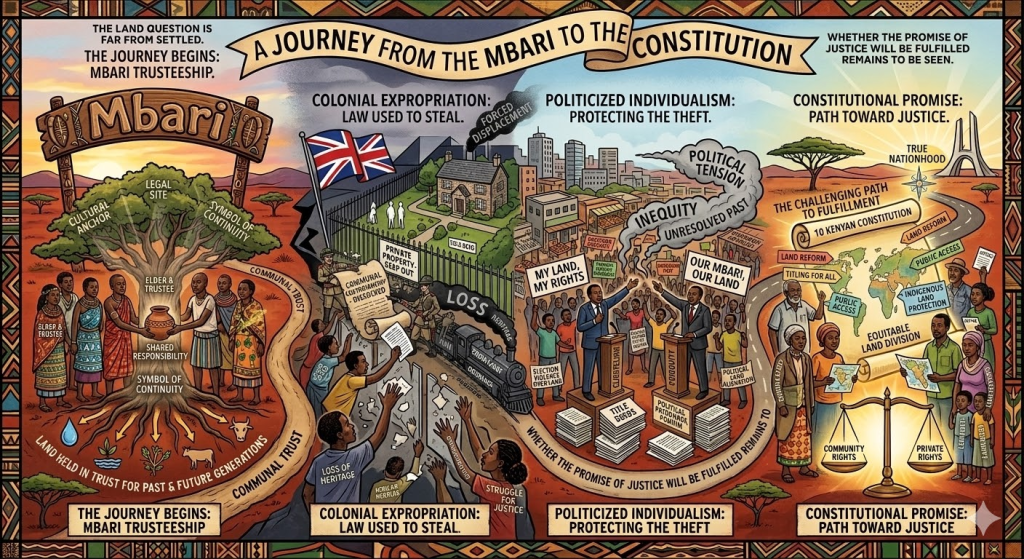
The history of land ownership in Kenya is a journey from communal trusteeship, through colonial expropriation, to politicized individualism. It is a history where law was used first to steal, then to protect the gains of the theft, and finally, in 2010, to try and forge a path toward justice.
The land question is far from settled. The tension between private property rights, the rights of communities to their ancestral lands, and the public interest in equitable and sustainable development continues to define Kenya’s political and social landscape.
The spirit of the mbari, where land was held in trust for past and future generations, still echoes in the demands of communities fighting for their heritage today. Whether the constitutional promise of justice will be fulfilled remains to be seen.
As we continue to explore Kenya’s complex history, one thing is clear: until the land question is resolved, Kenya’s journey toward true nationhood will remain incomplete.
Further Reading on Kenyan History
| Article | Link |
|---|---|
| The History of Political Parties in Kenya | Read |
| Kenya’s White Highlands: Land, Race, and the Economics of Exclusion | Read |
| Africanising Capitalism: Kenya’s Gambit to Create a Black Bourgeoisie | Read |
| The Shifta War: Kenya’s Forgotten Border Conflict | Read |
| The Maasai in Transition | Read |
| The History of Nairobi | Read |
| The History of Mombasa | Read |
| Kenya’s Colonial Administration 1920-1963 | Read |
Comments Section Discussion Questions
- Does your family have a story about land that was lost or acquired during the colonial or post-colonial period? Share it below.
- Do you think the 2010 Constitution can truly resolve historical land injustices, or is it too late?
- Should the government revisit the “willing buyer, willing seller” policy of the 1960s and compensate those who were left out?
- What role should communities play in managing “community land” today?
