
Part 1: The Myth of the “Empty Wilderness”
Before the first European explorer set foot in what would become Kenya, before the first game licence was issued or the first national park gazetted, the land was not an empty wilderness waiting to be discovered. It was a lived-in landscape, shaped and sustained by the people who called it home for millennia.
The prevailing narrative—that Africans were either indifferent to wildlife or actively destructive until Europeans taught them to conserve—is one of colonialism’s most enduring falsehoods. As John Mbaria and Mordecai Ogada argue in The Big Conservation Lie, this narrative serves a specific purpose: to justify the exclusion of local people from their own ancestral lands and to position Western conservationists as the sole saviours of Africa’s wildlife.¹
The truth is far more complex—and far more impressive. Long before the arrival of missionaries, settlers, and game wardens, Kenyan communities had developed sophisticated systems of resource management that allowed wildlife, livestock, and people to coexist for centuries.
The Spiritual Foundation of Conservation
At the heart of indigenous conservation was a worldview fundamentally different from the Western paradigm. Nature was not a collection of “resources” to be exploited or even “managed.” It was a community of beings—some human, some not—all interconnected and all deserving of respect.
As L.S.B. Leakey documented in his exhaustive study of Gikuyu customs, land ownership carried with it profound responsibilities. An estate owner, he wrote, “had the absolute right to prohibit all felling of trees in certain areas, either for fuel or for any other purpose. This was in order to create timber reserves, which could be used at a later date.”² More powerfully still, some landowners used deathbed curses to ensure their forests would never be cleared. The 1,063-hectare Karura Forest in Nairobi—today celebrated as one of the city’s most important “lungs”—owes its very existence to four Gikuyu landowners: Tharuga, Gaciĩ, Wang’endo, and Hinga, who placed curses on the land before 1900. City Park, another Nairobi green space, was preserved because a man named Kĩrongo “by his own wish, was buried there when he died.”³

These were not passive actors in an untouched wilderness. They were deliberate, active conservationists whose methods—spiritual sanctions, customary law, and intergenerational stewardship—proved remarkably effective.
Totems, Taboos, and Moral Beings
Across Kenya’s ethnic communities, wildlife featured prominently in cultural and spiritual life—not as something separate from humanity, but as part of a shared moral universe.
Among the Samburu of northern Kenya, elephants are regarded not as animals to be owned or exploited, but as moral beings in their own right. As researcher Onesmus Kahindi documented, when Samburu encounter an elephant skeleton, they show it the same respect they would show a human corpse. They place a green twig or stone on the skull, or smear it with ochre, and speak a blessing: “My child, my brother, my sister, I have seen you. Sleep in peace.”⁴
This is not mere superstition. It is a deeply embedded ethical framework that regulates human behaviour toward other species. To claim ownership of an elephant, in Samburu thinking, would be immoral—a form of slavery imposed on a being that deserves autonomy and respect. As Kahindi notes, “The people regard elephants as moral beings capable of hurting and being hurt. As a result, elephants attain a higher moral status in the Samburu society than any other animal, including livestock.”⁵
Such beliefs had practical consequences. Hunting was strictly regulated by custom. An animal could not be killed without cause, and even then, only for survival—never for sport. In pastoralist cultures, wildlife were often viewed as “second cattle,” not to be hunted except during times of drought when livestock were scarce.⁶
Sacred Groves and Spiritual Sanctuaries
Forests, rivers, and mountains were not just physical features of the landscape. They were spiritual territories, inhabited by ancestors and spirits, and protected by elaborate systems of taboo and ritual.
Among the Gikuyu, the Mugumo tree was sacred—a place where prayers were offered and ceremonies conducted. To cut such a tree was unthinkable. As Leakey recorded, before any tree could be felled, a landowner would perform a ritual of propitiation, offering honey beer and addressing the tree’s spirits directly: “I have come to cut you down, O tree, but I am not going to destroy the whole of the spirits which are in you. See, I have prepared a new home for them.”⁷ A branch would be leaned against the tree overnight, symbolically relocating the spirits before the axe was lifted.
This was not merely ceremony. It was a mechanism of restraint—a cultural check on human greed and short-term thinking. By embedding conservation in spiritual practice, communities ensured that respect for nature was not a matter of individual choice but of collective obligation, enforced by belief and sanctioned by the supernatural.
The Forest as Ancestor
In Othaya, Nyeri County, the 265-acre Karima Forest was once home to twenty-six streams of crystal-clear water. The forest was also the burial place of Mbaire, the original settler in the area, and his wife Nyakaguku. For generations, their descendants maintained the forest as a sacred trust.

But as the late Kariuki Thuku—a passionate advocate for indigenous conservation—documented, the desecration of Mbaire’s grave and the destruction of the forest by colonial authorities (to deny hideouts to Mau Mau fighters) broke the spiritual bond. The exotic eucalyptus trees planted by the former Othaya Town Council consumed up to 200 litres of water each per day. Today, only six of the original streams still flow.⁸
Mzee Kiuri Kimaru, an eighty-five-year-old elder who witnessed this destruction, told a reporter: “We have lost twenty streams here, and this is not the end.”⁹ His lament speaks to a deeper truth: when you sever a people’s spiritual connection to their land, you do not just lose trees and water. You lose an entire way of being in the world—one that sustained both people and wildlife for centuries.
The Living Legacy
Despite the onslaught of colonialism, Christianity, and Western education, elements of indigenous conservation ethics survive. The Kaya Forests of the Coast, the Loita Forest of Narok, the Mukogodo Forest of Laikipia—all remain relatively well-preserved, managed by councils of elders who still wield traditional authority.
In Meru, the Njuri Ncheke Council of Elders continues to oversee sacred sites and forests. As Dr. John Waithaka notes, “From childhood, people were taught to respect nature and the world around them.”¹⁰ This was not “awareness” delivered through donor-funded workshops. It was lived experience, passed down through generations in stories, songs, and rituals.
The irony is profound. The very communities that Western conservationists have spent decades trying to “educate” about the value of wildlife are the ones whose ancestors preserved it. The very forests that NGOs now “protect” with fences and armed guards were saved by curses and taboos. The very people pushed off their land to create national parks are the ones who kept that land wild in the first place.
As Mbaria and Ogada put it: “To their credit, the Samburu have retained this perception and set of beliefs to date. Poaching, law enforcement, and conservation endeavours by different NGOs that have pitched tent in Samburu country over the last forty years have not changed it in any major way.”¹¹
Notes for This Section
- 1 Mbaria & Ogada, The Big Conservation Lie, Chapter 3.
- 2 L.S.B. Leakey, The Southern Kikuyu Before 1903, quoted in Mbaria & Ogada, Chapter 3.
- 3 Mbaria & Ogada, Chapter 3.
- 4 Kahindi, “Cultural Perception of the Elephant by the Samburu of Northern Kenya,” MSc thesis, University of Strathclyde, quoted in Mbaria & Ogada, Chapter 3.
- 5 Ibid.
- 6 Waithaka, “Historical Factors that Shaped Wildlife Conservation in Kenya,” The George Wright Forum 29, no. 1 (2012).
- 7 Leakey, op. cit.
- 8 Mbaria, “Our Land is Dying,” Daily Nation, 2007, quoted in Mbaria & Ogada, Chapter 3.
- 9 Ibid.
- 10 Waithaka, op. cit.
- 11 Mbaria & Ogada, Chapter 3.
Part Two: The Colonial Template – Hunting Grounds to Fortress Conservation (c. 1900–1963)
The Arrival of the “White Hunter”
When the British began to establish control over what would become the Kenya Colony, they brought with them a very specific set of ideas about wildlife—and about the people who lived alongside it. The vast herds of elephant, lion, buffalo, and antelope that roamed the savannahs were not, in European eyes, part of a living landscape shaped by centuries of human interaction. They were a “sportsman’s paradise,” a hunting ground for an emerging class of gentleman adventurers.
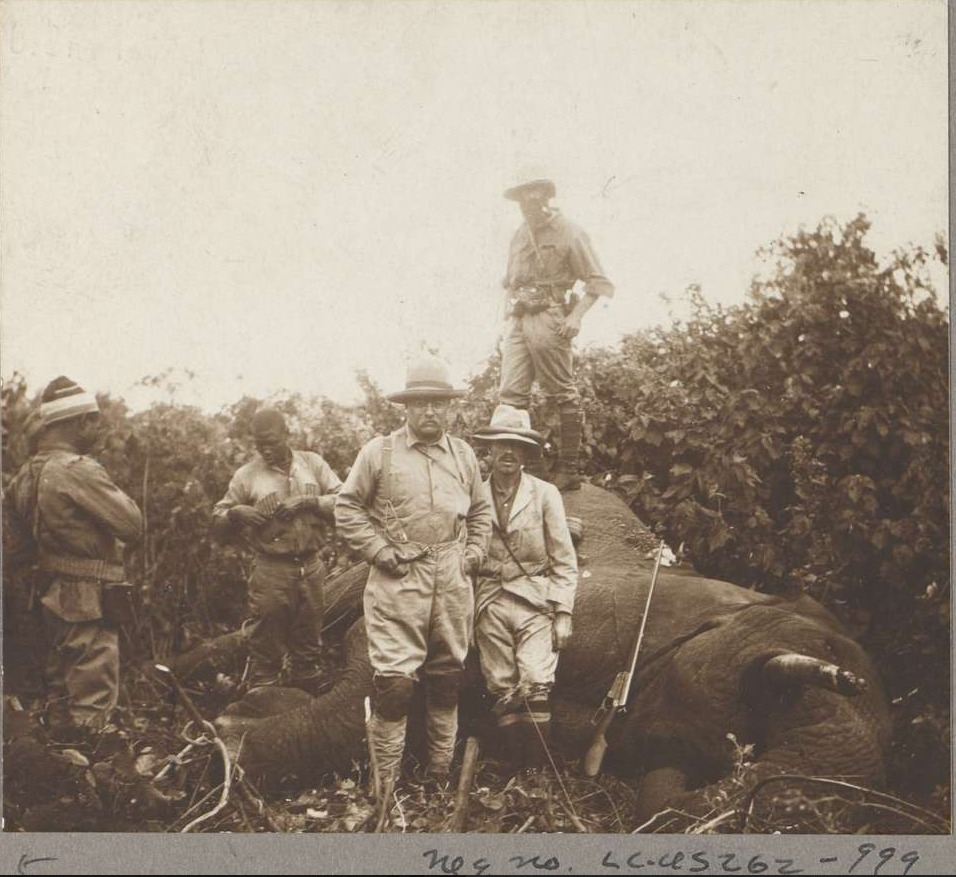
As Edward Steinhart documents in Black Poachers, White Hunters, there were deliberate attempts to “recreate on African soil, with African prey, the practices and values of nineteenth century European hunts complete with their class-ridden meanings and messages.”¹ The crucial difference was that in Africa, the class divide was instantly replaced by a racial one. Nobility in the conservation and use of wildlife was no longer conferred by lineage, but by skin colour.
This was not merely a matter of personal recreation. It was a project of remaking the land itself—and the relationship of its original inhabitants to that land.
The Legal Framework of Exclusion
The colonial state rapidly constructed a legal architecture that criminalised African hunting while enshrining European access to wildlife. Game laws were passed that made it illegal for Africans to hunt even for subsistence, while hunting licences for Europeans were readily available. The message was unambiguous: wildlife belonged to the Crown and to the settlers, not to the people who had lived alongside it for millennia.
As John Mbaria and Mordecai Ogada note, this legal regime had a profound psychological effect. “By the time the colonial machinery was firmly in place,” they write, “Christianity had destroyed, to a great degree, the age-old philosophy and practice that many communities had relied on to preserve the greatest diversity of life on earth.”² The African was no longer a steward of the land; he was a poacher on his own ancestral territory.
Land Alienation and the Creation of “Wilderness”
The creation of game reserves and national parks was not a neutral act of conservation. It was an act of dispossession. Land that had been grazed, hunted, and lived upon for generations was suddenly declared “empty” and set aside for wildlife and European recreation.
The Maasai were among the hardest hit. As Lotte Hughes documents in Moving the Maasai, the community’s traditional territory once stretched from Mount Kilimanjaro across the Rift Valley to Laikipia and Baringo.³ Through a series of treaties—negotiated under duress and repeatedly broken—the Maasai were pushed into smaller and smaller reserves, losing some of their most fertile grazing lands. These lands were then repurposed for European settlement and, in many cases, for wildlife conservation.
The irony was lost on no one but the colonial administrators themselves. The Maasai, who had coexisted with wildlife for centuries, were now to be excluded from their own lands in the name of protecting the very animals they had always lived alongside. As Collett argues, “It is only with the advent of imposed conservation restrictions that conflicts between Maasai and wildlife land use have arisen.”⁴
The Grogan Concession: Commerce Masquerading as Conservation
Nowhere were the contradictions of colonial conservation more starkly revealed than in the saga of the Lembus Forest. As David Anderson meticulously documents, in 1904, the colonial administration—eager to encourage investment—granted a massive forestry concession to a small group of businessmen headed by Ewart Grogan, a flamboyant and well-connected adventurer.⁵
The concession was granted on terms so favourable that the Forest Department was effectively sidelined. Grogan and his company, Equator Sawmills Ltd., were allowed to extract timber at royalty rates less than half those paid by other sawmillers in Kenya. They were not required to provide working plans or submit to meaningful oversight. For decades, the company operated with impunity, “picking the eyes out of the forest” while the Forest Department fought a losing battle to assert any control.⁶
The Forest Department’s frustration was not merely about lost revenue—though that was substantial. It was about the very principle of conservation. As the Conservator of Forests wrote in 1925, the manner in which the concession was being worked was causing “irreparable damage” to the forest ecosystem.⁷ Yet the colonial government, mindful of Grogan’s political connections and the broader goal of encouraging European investment, repeatedly refused to terminate the lease.
The Lembus saga reveals a fundamental truth about colonial conservation: it was never simply about protecting nature. It was about who had the power to exploit nature, and on what terms. Conservation and commercial exploitation were not opposites; they were two sides of the same colonial coin.
The Coryndon Definition: Creating “Right-Holders”
The same year that Grogan’s final lease was signed, 1916, the colonial government took a step that would have far-reaching consequences. Faced with protests from Africans who had been living in the Lembus Forest for generations, Governor Sir Robert Coryndon issued a formal “Definition of Native Rights.”⁸
The Coryndon Definition was an attempt to regularise the status of African residents in the forest—to determine who had legitimate claims to live, graze, and cultivate there. But in practice, it created more problems than it solved. The Definition listed 485 Tugen families and 11 Dorobo families as legitimate “right-holders,” with rights that were to pass down to their descendants in perpetuity.⁹
To the Forest Department and the timber company, this was a nightmare. It meant that the forest would never be under their exclusive control. To the Tugen, however, the Coryndon Definition became a charter of rights—a guarantee of their place in the forest that they would defend tenaciously for decades to come.
As Anderson notes, the Definition effectively transformed the forest “from being a zone of ethnic indeterminance” into “the rightful home of a clearly defined section of the Tugen.”¹⁰ Other Tugen and Elgeyo who had made periodic use of the forest were now legally excluded. The stage was set for a conflict that would simmer for the rest of the colonial period.
The Creation of National Parks
The post-Second World War period saw a rapid expansion of the national park system. Nairobi National Park was gazetted in 1946, followed by Tsavo, Mount Kenya, and the Aberdares. These parks were modelled on the American and European ideal of wilderness—landscapes from which humans were to be entirely excluded.

The creation of Amboseli National Park was particularly contentious. As Mbaria and Ogada recount, the Maasai had agreed in 1950 to lease fifty square kilometres of land for campsites. But within a decade, they were pushed entirely out of the park’s core areas. Promises of alternative water points were made—and broken.¹¹
By 1969, income from Amboseli accounted for 70 percent of the Kajiado County Council’s annual budget. Yet the Maasai themselves saw little of this revenue. When the council attempted to carve out another 500 square kilometres of Maasai land for exclusive wildlife use, the government responded not by addressing Maasai grievances, but by nationalising the park entirely. To this day, revenues from Amboseli go directly to the central government.¹²
The Intellectual Architecture of Exclusion
The physical dispossession of land was accompanied by an intellectual project: the creation of a narrative in which Africans were not the victims of conservation, but its enemies.
As Megan Vaughan argues in Curing Their Ills, European colonialists “perceived and constructed ‘Africa’ and the African environment through a peculiar cultural lens” that emphasised European control and African chaos.¹³ The “wild” was simultaneously romanticised and feared—and Africans were seen as part of that wildness, a threat to the orderly management of nature.
This narrative was reinforced by generations of explorers, hunters, and conservationists. From the travelogues of the nineteenth century to the wildlife documentaries of the twentieth, the message was consistent: Africa’s wildlife existed despite Africans, not because of them. The role of indigenous communities in shaping and sustaining wildlife populations was systematically erased.
As the Routledge Companion to Animal-Human History notes, the image of the Serengeti as “untouched nature” was largely mythical—”a product of human agency no less than the Rhine Valley.”¹⁴ But the myth served a purpose. It justified the expulsion of the Ikoma, Ikizu, and Nata from the Serengeti. It underwrote the creation of national parks across the continent. And it positioned the white conservationist as the saviour of a pristine wilderness that Africans were incapable of protecting.
The Seeds of Future Conflict
By the time Kenya approached independence in 1963, the template for conservation had been firmly established. Wildlife was to be protected in parks and reserves from which Africans were excluded. The benefits of conservation—tourism revenue, hunting licences, timber concessions—flowed to Europeans and, to a lesser extent, the state. The costs—displacement, loss of grazing, crop damage, and human-wildlife conflict—were borne by local communities.
The Tugen of Lembus continued to assert their rights under the Coryndon Definition. The Maasai of Amboseli continued to demand access to water and pasture. The Forest Department continued to battle the timber companies. Every conflict that would explode in the post-independence era had its roots in these colonial arrangements.
As Anderson concludes, the failures of colonial conservation left a “powerful and undesirable legacy” that independent African governments would struggle to overcome.¹⁵ The question was not whether these conflicts would resurface, but when—and in what form.
Notes for This Section
- 1 Steinhart, Black Poachers, White Hunters, quoted in Mbaria & Ogada, Chapter 1.
- 2 Mbaria & Ogada, Chapter 3.
- 3 Hughes, Moving the Maasai, cited in Mbaria & Ogada, Chapter 2.
- 4 Collett, quoted in Homewood & Rodgers, Maasailand Ecology, Chapter 4.
- 5 Anderson, “Managing the forest: the conservation history of Lembus, Kenya,” in Conservation in Africa, p. 252.
- 6 Anderson, p. 254.
- 7 Conservator of Forests to Senior Commissioner/Kerio, 31 July 1925, Kenya National Archives, quoted in Anderson, p. 254.
- 8 Governor Coryndon, “Definition of Native Rights,” 12 December 1923, KNA PC/NKU/2/1/31, quoted in Anderson, p. 258.
- 9 Anderson, p. 259.
- 10 Anderson, p. 259.
- 11 Mbaria & Ogada, Chapter 2.
- 12 Mbaria & Ogada, Chapter 2.
- 13 Vaughan, Curing Their Ills, quoted in Mbaria & Ogada, Chapter 1.
- 14 Steinkrüger, “Wildlife conservation as cultural memory,” in The Routledge Companion to Animal-Human History, p. 10.
- 15 Anderson, p. 264.
Part Three: Independence, Displacement, and the Rise of the ‘Fortress’ (1963–1980s)
The Unfinished Promise
When Kenya achieved independence in 1963, there was hope among many communities that the new dispensation would bring a different relationship with the land—and with the wildlife that inhabited it. The slogans of uhuru (freedom) and harambee (pulling together) seemed to promise a future in which the injustices of the colonial era would be addressed, and the dispossessed would finally have their voices heard.
For the communities living alongside wildlife, that hope was quickly dashed. The new African government, led by Jomo Kenyatta, largely inherited the colonial conservation apparatus—its laws, its policies, and its underlying philosophy. National parks remained islands of exclusion. The benefits of tourism flowed to the state and to a small elite, while local communities continued to bear the costs.
As Mbaria and Ogada observe, “the wave of independence that swept across Africa in the latter half of the twentieth century ushered in indigenous governments composed of local elites who had learned well at the feet of the colonial governments. They took avarice, selfishness, cruelty, discrimination, and general graft to unprecedented levels.”¹ The one place the colonizers never moved out of—and the natives never sought for themselves—was the biodiversity sector.
Amboseli: A Case Study in Broken Promises
The story of Amboseli encapsulates the tragedy of post-independence conservation. As detailed in The Big Conservation Lie, the Maasai of Amboseli had been promised that if they vacated the core areas of the park, alternative water points would be constructed for them. The colonial authorities made the promise; the independent Kenyan government inherited it—and then ignored it.²
In the early 1960s, Amboseli was transferred from the Royal National Parks to the jurisdiction of the Kajiado County Council. The Maasai were cajoled—and often arm-twisted—into ceding more and more of their pastureland. Tourism skyrocketed. By 1969, income from Amboseli accounted for 70 percent of the Kajiado Council’s annual budget.³
But the Maasai themselves saw almost none of this money. When the council, hungry for more revenue, attempted to carve out another 500 square kilometres of Maasai land for exclusive wildlife use, the community finally protested. Their protests were ignored. The government then took the ultimate step: it nationalised the park entirely, removing it from local control. To this day, all revenues from Amboseli go directly to the central government in Nairobi.⁴
As one Maasai elder put it during a demonstration against an IUCN project in Loita Forest decades later: “The British moved us from Nairobi and Nakuru, but we shall fight current attempts to move us from Naimina Enkiyio.”⁵ The sentiment captured the bitter continuity between colonial and post-colonial dispossession.
The Shifta War and the Criminalisation of the North
The first decade of independence was also marked by the Shifta War (1963–68), a conflict that would have profound consequences for Kenya’s Somali population and for the vast northern rangelands. Somali irredentists, supported by the newly independent Somali Republic, fought a guerrilla war to secede from Kenya and join a “Greater Somalia.”
The Kenyan government’s response was brutal and sweeping. A state of emergency was declared. Collective punishment was imposed on Somali communities. Livestock was confiscated. Movement was severely restricted. And the entire Northern Frontier District (NFD) was placed under a military administration that would last for decades.⁶
As Keren Weitzberg documents, the Shifta War left a legacy of deep mistrust between the Somali community and the Kenyan state. It also cemented the north’s status as a “forbidden zone”—an area to be controlled and contained, not developed or engaged with.⁷ This had obvious implications for conservation. The vast rangelands of the north, with their rich wildlife populations, remained under military-style administration, isolated from the rest of the country and from any meaningful participation by local communities.
The Hunting Ban of 1977
In 1977, President Jomo Kenyatta issued a presidential directive banning all hunting in Kenya. The move was widely celebrated internationally as a bold conservation measure. Hunting safaris—long a staple of the Kenyan tourism industry—were outlawed overnight.
But the ban had unintended consequences. As Mbaria and Ogada argue, by removing any legal avenue for communities to derive value from wildlife, the hunting ban inadvertently fueled resentment. Wildlife, which had once been a resource that could provide meat or income, became purely a liability—a source of crop damage, livestock predation, and human danger, with no compensating benefits.⁸
The ban also created a double standard that persists to this day. While poor Kenyans who killed an animal for food were branded poachers and subject to harsh penalties, wealthy foreigners—and the white ranchers who hosted them—continued to kill wildlife under the guise of “culling” or “cropping.” As we shall see, this double standard would become a major source of conflict in the decades to come.
The Poaching Crisis and the Rise of Militarised Conservation
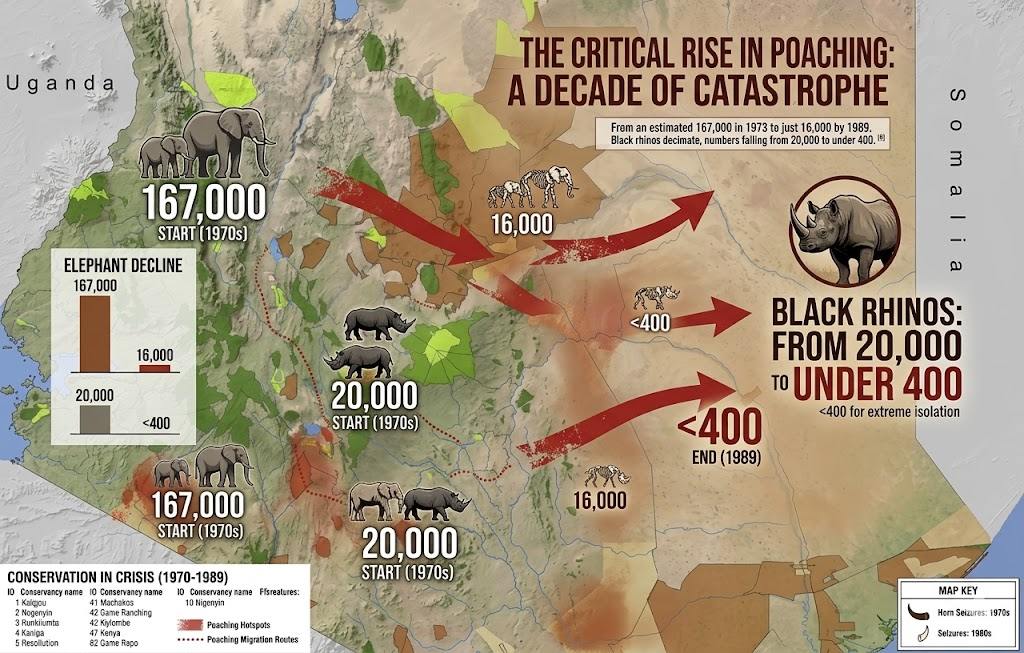
The 1970s and 1980s saw a catastrophic rise in poaching across Kenya. Elephant populations plummeted, from an estimated 167,000 in 1973 to just 16,000 by 1989. Black rhinos were decimated, their numbers falling from 20,000 to under 400.⁹
The causes were complex: the collapse of traditional controls, the availability of automatic weapons leftover from regional conflicts, and the insatiable international demand for ivory. But the response was simple: militarisation.
In 1989, Richard Leakey was appointed director of the newly formed Kenya Wildlife Service (KWS). A charismatic and controversial figure, Leakey launched an aggressive anti-poaching campaign. He recruited new rangers, equipped them with modern weapons, and gave them shoot-to-kill authority. He burned twelve tons of ivory in a spectacular bonfire that captured the world’s imagination.¹⁰
Leakey’s approach was wildly popular in the West. He was hailed as a hero, a man who had saved the elephant from extinction. Funding poured in from international donors. The image of the KWS as a paramilitary force—green-uniformed rangers in fast vehicles, taking the fight to the poachers—was cemented in the public mind.
But as Mbaria and Ogada note, this narrative conveniently ignored the deeper issues. “No one questions the effects Leakey’s fortress conservation approach and its reliance on boots and guns has had on the conservation crisis Kenya is going through today,” they write.¹¹ The underlying causes of poaching—poverty, marginalisation, the alienation of communities from wildlife—remained unaddressed. The militarised approach treated symptoms, not causes.
The Intellectual Vacuum
The Leakey era also had a profound effect on conservation science and policy in Kenya. Leakey himself had no formal scientific training—he was a high school dropout who had made his name as a palaeoanthropologist through family connections and sheer force of personality. He had, as Mbaria and Ogada put it, “an instinctive distrust of any science he couldn’t immediately understand and discount.”¹²
Under his leadership, science within the KWS atrophied. Researchers were sidelined. The institution developed no research agenda of its own. To this day, the KWS has no research laboratory—only a forensics lab. Its staff who are styled as “scientists” are largely confined to clerical work, processing permits for foreign researchers whose work defines the conservation agenda.¹³
This intellectual vacuum had predictable consequences. Kenya arrived at international conservation meetings—such as the Convention on International Trade in Endangered Species (CITES)—with no scientific data to back its positions. It relied instead on political horse-trading and the support of international animal welfare groups. This strategy worked for a time, but it was unsustainable. As Mbaria and Ogada observe, “The precarious nature of Kenya’s position is always lost in the noisy victory celebrations.”¹⁴
The Double Standard
Throughout this period, a glaring double standard persisted. While Africans who killed wildlife for food were branded poachers and shot on sight, white ranchers continued to kill wildlife under the rubric of “management.”
The Wildlife Pilot Cropping Project, launched in 1991, was a case in point. Under this scheme, ranchers who could prove they hosted “excess” animals were given annual quotas to kill zebras, antelopes, and buffaloes. They then sold hunting safaris to wealthy clients and offloaded the skins and meat.¹⁵
The project was, in Mbaria and Ogada’s words, “deliberately designed to be faulty from the word go.”¹⁶ It was supposed to run for five years, then be evaluated. It ran for thirteen years without any meaningful evaluation. The quotas were based on dubious science. The killing was often unprofessional, with animals wounded and left to die slowly. And the benefits flowed almost exclusively to white ranchers, while neighbouring African communities—who also hosted wildlife—received nothing.
When the scheme was finally exposed in the media and shut down in 2003, it left a legacy of bitterness. The message to local communities was unmistakable: conservation was a game rigged in favour of the powerful. If you were white and wealthy, you could kill wildlife and call it “management.” If you were black and poor, you were a poacher.
The Seeds of Resistance
But even as the fortress model tightened its grip, resistance was building. The Tugen of Lembus continued to assert their rights under the Coryndon Definition. The Maasai of Loita fought off an IUCN project they saw as a land grab. In the forests of Karima and Giitune, elders began to reclaim their sacred sites.
And in the cities, a new generation of Kenyan conservationists was beginning to ask uncomfortable questions. Why did all the heroes of conservation have white skin? Why did foreign researchers dominate the field? Why did local communities bear the costs while others reaped the benefits?
These questions would not go away. They would simmer beneath the surface for decades, eventually erupting in the controversies of the twenty-first century—the battle over the Wildlife Act, the exposé of the elephant-naming schemes, and the growing realisation that the “big conservation lie” could not be sustained forever.
Notes for This Section
- 1 Mbaria & Ogada, The Big Conservation Lie, Chapter 1.
- 2 Mbaria & Ogada, Chapter 2.
- 3 Mbaria & Ogada, Chapter 2.
- 4 Mbaria & Ogada, Chapter 2.
- 5 Mbaria, “Maasai Reject IUCN Project in Loita Forest,” The EastAfrican, 2004, quoted in Mbaria & Ogada, Chapter 2.
- 6 Weitzberg, “The Unaccountable Census: Colonial Enumeration and Its Implications for the Somali People of Kenya,” Journal of African History 56, no. 3 (2015): 409-28.
- 7 Weitzberg, p. 418.
- 8 Mbaria & Ogada, Chapter 5.
- 9 Mbaria & Ogada, Chapter 1.
- 10 Leakey, Wildlife Wars, cited in Mbaria & Ogada, Chapter 1.
- 11 Mbaria & Ogada, Chapter 1.
- 12 Mbaria & Ogada, Chapter 6.
- 13 Mbaria & Ogada, Chapter 6.
- 14 Mbaria & Ogada, Chapter 6.
- 15 Mbaria & Ogada, Chapter 2.
- 16 Mbaria & Ogada, Chapter 2.
Part Four: The Leakey Era – Militarisation and the ‘War on Poachers’ (1989–1990s)
The Making of a Hero
In 1989, Richard Leakey was appointed director of the newly formed Kenya Wildlife Service. He stepped into a moment of crisis. Poaching had reached catastrophic levels. Elephant populations had crashed from an estimated 167,000 in 1973 to just 16,000. Black rhinos had been decimated, their numbers falling from 20,000 to under 400.¹ The wildlife that defined Kenya’s image—and its tourism industry—was disappearing at an alarming rate.
Leakey’s response was swift, dramatic, and brilliantly stage-managed. He recruited and trained a new cadre of rangers, equipped them with modern weapons, and gave them shoot-to-kill authority. He cracked down on corruption within the wildlife department. And in a stroke of pure genius, he arranged for the burning of twelve tons of ivory—a bonfire that lit up television screens around the world and cemented his reputation as the man who saved the elephant.²
The international reaction was euphoric. Leakey was hailed as a hero, a visionary, a man willing to risk his life for the cause. Funding poured in from donors around the world. The World Bank provided millions under the Protected Area Wildlife Service (PAWS) programme. The image of the Kenya Wildlife Service as a lean, mean, anti-poaching machine—green-uniformed rangers in fast vehicles, helicopters overhead, taking the fight to the poachers—was seared into the global imagination.
As Mbaria and Ogada note, Leakey’s charisma and connections were central to this success. “Using his substantial international reputation, Richard Leakey had managed to secure significant funding from the World Bank,” they write. “He partly used the cash in a grand reconstruction programme that included putting up a modern complex at the KWS head office, building up the wildlife agency’s fleet of vehicles, and sprucing its image.”³
The Cult of Personality
But the Leakey phenomenon was about more than funding and operations. It was about the creation of a myth—the myth of the white saviour, the man who came not to conquer but to protect, the hero who stood between Africa’s wildlife and the darkness of African greed.
This myth had deep roots. As Jan-Erik Steinkrüger argues in his analysis of wildlife conservation as cultural memory, the narrative of the selfless white conservationist sacrificing everything for the animals is one of the most persistent themes in Western popular culture. From George Adamson to Dian Fossey, the formula is consistent: a white protagonist, a threatened species, and a cast of local Africans who are either obstacles to be overcome or grateful recipients of the hero’s largesse.⁴
Leakey fit this template perfectly. He was telegenic, articulate, and supremely confident. He understood the power of symbols—the ivory bonfire, the war on poachers, the dramatic resignation when he felt his authority was being undermined. He cultivated relationships with journalists, filmmakers, and donors. He wrote books with titles like Wildlife Wars: My Fight to Save Africa’s Natural Treasures, which presented his personal story as the story of conservation itself.⁵
As Mbaria and Ogada observe, this self-aggrandisement went largely unquestioned. “The way Leakey went about narrating his story seemed to suggest if he had not done what he said he did, there would not be anything left to conserve,” they write. “Leakey’s life story is coloured by an extraordinary degree of personal hubris and gross overestimations of his own importance in the conservation arena.”⁶
The Unseen Costs
Beneath the glossy surface of the Leakey narrative, however, lay a more troubling reality. The militarised approach to conservation—”fortress conservation,” as it came to be known—treated the symptoms of poaching while ignoring its causes.
Communities living alongside wildlife remained marginalised and impoverished. They received almost none of the revenue generated by tourism. They continued to suffer crop damage, livestock predation, and the constant threat of injury or death from wild animals. And they watched as armed rangers—often from other parts of the country—patrolled lands that had once been theirs, treating them with suspicion and sometimes brutality.
As Mbaria and Ogada argue, this approach was fundamentally unsustainable. “No one questions the effects Leakey’s fortress conservation approach and its reliance on boots and guns has had on the conservation crisis Kenya is going through today,” they write.⁷ The underlying resentments were merely suppressed, not resolved. They would resurface, again and again, in the decades to come.
The Leakey Legacy: Science and Its Discontents
Leakey’s impact on conservation science in Kenya was equally problematic. Despite his family’s scientific pedigree, Leakey himself had no formal scientific training—he was a high school dropout. As Mbaria and Ogada put it, he had “an instinctive distrust of any science he couldn’t immediately understand and discount.”⁸
Under his leadership, science within the KWS atrophied. Researchers were sidelined. The institution developed no research agenda of its own. To cover this obvious gap, Leakey performed a quick window-dressing exercise, appointing the vocal and ambitious Dr. Paula Kahumbu as “scientific advisor to the director”—essentially a gatekeeper position designed to rebuff those who felt science could contribute to the KWS’s mission.⁹
The consequences of this neglect are still felt today. The KWS has no research laboratory—only a forensics lab. Its staff who are styled as “scientists” are largely confined to clerical work, processing permits for foreign researchers whose work defines the conservation agenda. As Mbaria and Ogada note, “They are also regular attendees at conservation conferences worldwide at which they never give presentations or contributions to the scientific programs, which is not surprising considering that 99 percent of them obtained their advanced degrees within the intellectual straitjacket that is the KWS.”¹⁰
This intellectual vacuum has left Kenya dependent on foreign researchers and foreign-funded NGOs to define its conservation priorities. As we shall see in later sections, this dependence has had profound consequences for policy, practice, and the very meaning of conservation in Kenya.
The Myth of Sustainability
Leakey’s tenure also entrenched a model of conservation funding that was deeply problematic. The World Bank’s PAWS programme provided generous funding, but it came with strings attached. Leakey used the money to pay hefty salaries to a select group of senior staff, purchase aircraft and vehicles, and build a modern headquarters. But when the programme ended, the KWS was left with ongoing maintenance costs and salary obligations it could not meet.¹¹
As one former KWS director later complained, this was part of a deliberate pattern: the wildlife agency was systematically weakened so that “privatisation appears to be the only viable option.”¹² The seeds of the NGO takeover of Kenyan conservation—the proliferation of well-funded foreign organisations and the corresponding decline of state capacity—were sown during this period.
The Ouster and the Aftermath
Leakey’s first tenure at the KWS ended in 1994, after a plane crash that cost him both his legs. He returned for a second stint in 1998, but was ousted after just four months—reportedly for opposing plans to allow mining in national parks.¹³
His successors—David Western, Nehemiah Rotich, Joe Kioko, Evans Mukolwe, Michael Wamithi—each had their moments of promise, but none could replicate Leakey’s international profile or fundraising ability. The KWS lurched from crisis to crisis, its budget shrinking, its morale plummeting, its scientific capacity non-existent.
The exception was Dr. Julius Kipng’etich, who served from 2005 to 2012. Under his leadership, internally generated revenues grew from $15 million to $46 million. The KWS’s vehicle fleet, aircraft fleet, staff housing, and public image all improved dramatically.¹⁴
But Kipng’etich’s success was, as Mbaria and Ogada note, a “lucky shot in the dark.” There was no discernible structure or process by which he was selected. The powers that be “didn’t care enough about Kenya’s conservation sector to have such a process, and they stumbled on the right person who then tackled the job with skill and commitment.”¹⁵
When Kipng’etich departed in 2012, the confusion and paralysis that immediately followed was “damning evidence that his appointment was a stroke of luck and not the result of a successful and objective recruitment process.”¹⁶ Since then, poaching has surged, the KWS has been plagued by allegations of internal complicity, and the organisation has struggled to regain its footing.
The Hero and the System
Richard Leakey remains a beloved figure in international conservation circles. He has been honoured with awards, invited to testify before the US Senate, and celebrated in books and documentaries. His image adorns the websites of countless conservation organisations.
But as Mbaria and Ogada argue, this adulation has obscured a more complex truth. “The common narrative refuses to point out that as the world glorified Leakey and fellow white conservationists, the comradeship that communities living in wildlife-dominated areas had with the animals waned.”¹⁷
The hero narrative—the lone white saviour, the dramatic gesture, the war on poachers—has distracted attention from the deeper work of building relationships, sharing benefits, and empowering local communities. It has created a system in which charisma and connections matter more than science, in which foreign donors set the agenda, and in which the voices of those who actually live with wildlife are systematically excluded.
The Leakey era may have saved the elephant—for a time. But it also entrenched a model of conservation that has proven deeply flawed. The question now is whether Kenya can move beyond the hero narrative and build something more durable.
Notes for This Section
- 1 Mbaria & Ogada, The Big Conservation Lie, Chapter 1.
- 2 Leakey, Wildlife Wars, cited in Mbaria & Ogada, Chapter 1.
- 3 Mbaria & Ogada, Chapter 2.
- 4 Steinkrüger, “Wildlife conservation as cultural memory,” in The Routledge Companion to Animal-Human History, pp. 8-12.
- 5 Leakey, Wildlife Wars.
- 6 Mbaria & Ogada, Chapter 1.
- 7 Mbaria & Ogada, Chapter 1.
- 8 Mbaria & Ogada, Chapter 6.
- 9 Mbaria & Ogada, Chapter 6.
- 10 Mbaria & Ogada, Chapter 6.
- 11 Mbaria & Ogada, Chapter 2.
- 12 Nehemiah Rotich, quoted in Mbaria & Ogada, Chapter 2.
- 13 Mbaria & Ogada, Chapter 1.
- 14 Mbaria & Ogada, Chapter 5.
- 15 Mbaria & Ogada, Chapter 5.
- 16 Mbaria & Ogada, Chapter 5.
- 17 Mbaria & Ogada, Chapter 1.
Part Five: The Great Deception – Community Conservation, NGOs, and the ‘Green Man’s Burden’ (1990s–Present)
The Global Turn to Community
By the 1990s, it was becoming impossible to ignore the failures of fortress conservation. Across Africa, parks managed through exclusion and armed enforcement were under siege. Poaching continued. Local resentment simmered. And the fundamental contradiction—that the people who bore the costs of conservation received none of its benefits—remained unresolved.
The global conservation community responded with a new orthodoxy: community-based conservation. The central idea was simple and seductive. If local communities could be made to see wildlife as an asset rather than a liability, they would become its protectors rather than its enemies. The solution was to share benefits—tourism revenue, jobs, development projects—and to involve communities in management decisions.
The 2003 World Parks Congress in Durban gave this new approach its official blessing. The theme was “Benefits Beyond Boundaries.” Governments, NGOs, and donors were urged to “remove the obstacles to, and enhance the opportunities for, public–private–community partnerships in protected area management and funding.”¹
In Kenya, this new orthodoxy arrived with the force of revelation. It promised to resolve the conflicts that had plagued conservation since the colonial era. It offered a way to reconcile the needs of wildlife with the aspirations of communities. And it opened the door to a massive influx of donor funding.
The NGO Takeover
But as Mbaria and Ogada argue, the community conservation model did not empower communities. It empowered NGOs.
The proliferation of conservation NGOs in Kenya since the 1990s has been staggering. International giants like the African Wildlife Foundation (AWF), the World Wide Fund for Nature (WWF), The Nature Conservancy (TNC), and the International Fund for Animal Welfare (IFAW) have established major programmes. Regional bodies like the East African Wildlife Society and Nature Kenya have expanded their reach. And a host of smaller, single-species organisations—Save the Elephants, the Amboseli Trust for Elephants, the David Sheldrick Wildlife Trust, Space for Giants—have carved out their own niches.²
These organisations operate with budgets that dwarf those of the Kenya Wildlife Service. They employ highly paid expatriate staff. They command the attention of donors, media, and policymakers. And they have, in many respects, taken over the functions of the state.
As Mbaria and Ogada note, this has created a fundamental accountability deficit. “Who are NGOs accountable to?” they ask. “Owing to the fact that African states do not directly fund them, states do not have a way of monitoring NGOs’ operations.”³ The result is a system in which unelected, unaccountable organisations wield enormous influence over Kenya’s most valuable resources.
The African Wildlife Foundation: A Case Study
The African Wildlife Foundation illustrates the contradictions of the NGO model. Founded in 1961 by a group of wealthy American big-game hunters, the AWF was initially called the African Wildlife Leadership Foundation. Its founders were explicit about their anxieties: they feared that with independence, untrained Africans would take over wildlife management and “disaster” would follow.⁴
Russell Train, the AWF’s founder, wrote candidly about his concerns. “The replacement of European staff by untrained, unqualified men spells disaster for the game,” he argued.⁵ This paternalistic vision—Africans as incapable custodians, Europeans as indispensable saviours—has shaped the AWF’s approach for six decades.
The AWF now operates with an annual budget of over $20 million. It runs programmes across the continent. It has trained thousands of wildlife managers at the Mweka College in Tanzania. But as Mbaria and Ogada observe, “African conservational thinking continues to reap the fruits of the seeds sown so generously by its founders half a century ago.”⁶ The underlying assumption—that Africans need to be trained, guided, and supervised by Western experts—remains intact.
The Northern Rangelands Trust: A New Form of Control
Nowhere is the NGO model more consequential—or more controversial—than in the Northern Rangelands Trust (NRT). Founded in 2004, the NRT has grown into one of the most powerful conservation organisations in Kenya. It claims to represent thirty-three community conservancies covering 44,000 square kilometres—over seven percent of Kenya’s total land mass.⁷
The NRT’s stated mission is to “build resilient community conservancies that transform lives, secure peace and conserve natural resources.”⁸ It has attracted funding from a constellation of international donors, including USAID, the UK Department for International Development, and The Nature Conservancy. It has forged partnerships with luxury tourism operators and with corporations like Tullow Oil.
But critics argue that the NRT represents a new form of land control—a “green grab” dressed up in the language of community empowerment. The conservancy model, they contend, is not about giving communities control over their land. It is about securing vast tracts of territory for wildlife, tourism, and—increasingly—resource extraction, while offering communities token benefits in return.
As one observer put it, the NRT’s approach is “to secure as much land as possible under the guise of wildlife conservation.”⁹ The fact that this land overlaps with newly discovered oil, gas, and mineral reserves has not gone unnoticed. A map of NRT conservancies superimposed on a map of Kenya’s oil exploration blocks reveals a striking—and, to some, deeply suspicious—coincidence.¹⁰
The Eland Downs Disaster
The contradictions of the NGO-conservancy model were brutally exposed in 2011, when The Nature Conservancy and the AWF collaborated to purchase the Eland Downs ranch in Laikipia. The ranch had been owned by former president Daniel arap Moi, who had acquired it under unclear circumstances. When Moi put it up for sale, TNC saw an opportunity to secure land and a foothold in Kenya.
Unable to purchase the land directly, TNC turned to the AWF as a proxy. The deal was concluded with remarkable speed. What the NGOs did not anticipate was that Samburu herders were already using the land to graze their livestock. When AWF officials arrived to survey their acquisition, they found it occupied by people unwilling to move.¹¹
The political machine swung into action. The land was offered to the Kenya Wildlife Service. A brief ceremony at Harambee House was arranged, and Laikipia National Park was born. The KWS then moved to take control with its characteristic approach: “boots on the ground, huts aflame, and gunfire in the air.”¹²
At least two people were confirmed dead. There were allegations of beatings and rape. Human rights activists leapt into the fray. Four years later, the legal and public relations fallout continued. The NGOs’ carefully cultivated image—as altruistic saviours of wildlife—had been irreparably tarnished.
As Mbaria and Ogada conclude, the Eland Downs saga demonstrated that “the political machine at the AWF swings into action” when its interests are threatened—but that the interests of local communities count for little.¹³
The Manipulation of Communities
Throughout northern Kenya, the NGO model has systematically undermined traditional governance structures. Conservancies are created through hurried, externally driven processes that bypass established channels of community dialogue. Group ranch committees are formed, grazing plans are imposed, and local people are told that this is the price of development.
The result, as one critic put it, is “the deliberate destabilising and dismantling of traditional order and norms that have existed for centuries.”¹⁴ Communities that once managed their land collectively, through complex systems of customary law and reciprocal grazing agreements, are now expected to conform to models designed in Nairobi or Washington.
The benefits, when they come, are carefully calibrated to placate without empowering. Boreholes are drilled. Schools are built. Clinics are opened. But the fundamental decisions—about land use, about revenue distribution, about who benefits—remain firmly in the hands of the NGOs and their partners.
As John Mbaria wrote in a searing essay, this is “the bribery of boreholes.”¹⁵ It is a system designed not to transform communities, but to pacify them—to ensure that they accept the enclosure of their land and the exclusion of their livestock without open rebellion.
The Elephant-Naming Economy
The commodification of wildlife reaches its most surreal extreme in the elephant-naming programmes run by conservation NGOs. The Amboseli Trust for Elephants offers donors the opportunity to name an elephant calf—for a donation of $2,500. “The calf you name will be named by you only and the name will stay with that calf for life,” the trust’s website promises.¹⁶
The David Sheldrick Wildlife Trust runs a similar programme, allowing donors to “adopt” orphaned elephant calves. The experience is carefully orchestrated: visitors watch the calves being fed, touch them through restraining ropes, and are then invited to make a donation. The coup de grâce is the knowledge that they can adopt and name a calf, receiving regular updates and photographs.¹⁷
What neither organisation advertises is that the same calf may be adopted by multiple donors—a practical necessity given the limited number of orphans and the seemingly unlimited demand. As Mbaria and Ogada note, “The intricacy of this task becomes apparent when one considers that there are regular status and health updates, Christmas cards, birthday cards, and photographs that have to be sent to donors all over the world on the correct dates and using the correct names for the calves.”¹⁸
This is conservation as high-end retail. It generates substantial revenue, burnishes the organisations’ images, and provides donors with a satisfying sense of personal connection. But it does nothing to address the fundamental challenges facing elephant conservation—habitat loss, human-wildlife conflict, or the underlying drivers of poaching.
The Problem with “Awareness”
A central theme of the NGO approach is “awareness”—the assumption that local people destroy wildlife because they do not understand its value, and that if only they could be educated, they would become its protectors.
This assumption, as Mbaria and Ogada argue, is both patronising and wrong. “The exogenous (and sometimes racist subtext) in awareness campaigns or conservation education efforts as practiced in Kenya and much of Africa is inescapable,” they write.¹⁹
The Maasai did not need to be taught to appreciate wildlife. They had lived alongside it for centuries. The Samburu did not need to be told that elephants are valuable. They had always regarded them as moral beings. The Tugen did not need workshops on forest conservation. They had preserved their forests through curses and customary law.
The problem was not lack of awareness. It was lack of power—and lack of benefit. Communities that received nothing from wildlife had no incentive to protect it. The solution was not more education. It was genuine partnership and genuine sharing of benefits.
The Capture of Science
The NGO model has also captured conservation science. As discussed in the previous section, the Kenya Wildlife Service’s scientific capacity has atrophied. The research that shapes conservation policy is overwhelmingly conducted by foreign scientists, funded by foreign donors, and published in foreign journals.
The consequences of this dependence are profound. Research priorities are set not by Kenya’s needs, but by the interests of international funders. The focus is on charismatic megafauna—elephants, lions, rhinos—rather than on broader ecosystem dynamics or the human dimensions of conservation. And local scientists, when they are involved at all, are relegated to supporting roles.
The case of the Hirola antelope is illustrative. This critically endangered species, endemic to eastern Kenya, has become the focus of an intense conservation effort led by the Northern Rangelands Trust. The NRT’s proposed solution is to enclose the remaining animals in a predator-proof fence.²⁰
But as Abdullahi Hussein Ali, a young Kenyan conservation biologist, has pointed out, this approach is based on questionable science. The reasons for the Hirola’s decline are poorly understood. If the problem is disease, fencing will only exacerbate it. If it is habitat loss, limiting the remaining habitat makes no sense.²¹
Ali’s own research—focusing on indigenous knowledge, habitat variables, and community engagement—offers a more promising approach. But his work has been met with resistance from the NRT, and he has been told that his project will fail.²²
The message is unmistakable: conservation science in Kenya is not a neutral pursuit of knowledge. It is a battleground over who gets to define the problems—and who gets to control the resources.
The Legitimacy Question
The NGO model rests on a fundamental legitimacy claim: that these organisations speak for the voiceless—for the elephants, the lions, the forests. They present themselves as defenders of a global heritage against local destruction.
But as Mbaria and Ogada ask, who elected them? Who holds them accountable? Who decides what “conservation” means, and whose interests it serves?
The answers are unsettling. The NGOs are accountable to their donors, not to communities. They are answerable to their boards, not to the people whose lives they shape. They operate in a space that is nominally civil society but functions, in practice, as a parallel system of governance.
As one scholar put it, NGOs in Africa “sustain an artificial, false economy that is not grounded locally.”²³ They push huge amounts of cash into the pockets of corrupted local partners while taking most of the cash back to their own bank accounts. They generate situational reports on every aspect of African societies, which are then used to craft ever smarter schemes of maintaining the prevailing stranglehold.
The result is a system in which the very people who should be the subjects of conservation—the communities who live with wildlife—become its objects. They are studied, educated, and managed. They are offered boreholes and schools in exchange for their land. But they are never truly empowered.
The Unanswered Question
The rise of the NGO model has transformed conservation in Kenya. It has brought money, attention, and a global constituency. It has funded research, supported anti-poaching efforts, and built a network of conservancies that covers millions of acres.
But it has not resolved the fundamental contradiction at the heart of conservation: that those who bear the costs receive none of the benefits. If anything, it has deepened that contradiction, by creating a class of well-funded organisations whose interests are aligned with donors, not with communities.
The question that remains unanswered—and that the NGO model systematically evades—is the one posed by the Samburu woman at the riverbank. Who does conservation serve? And at whose expense?
Notes for This Section
- 1 World Parks Congress, Durban, 2003, quoted in Mbaria & Ogada, The Big Conservation Lie, Chapter 2.
- 2 Mbaria & Ogada, Chapter 2.
- 3 Mbaria & Ogada, Chapter 2.
- 4 Mbaria & Ogada, Chapter 2.
- 5 Russell Train, quoted in Mbaria & Ogada, Chapter 2.
- 6 Mbaria & Ogada, Chapter 2.
- 7 Northern Rangelands Trust, “State of the Conservancies Report,” 2011, cited in Mbaria & Ogada, Chapter 2.
- 8 NRT website, quoted in Mbaria & Ogada, Chapter 2.
- 9 Mbaria & Ogada, Chapter 2.
- 10 Mbaria & Ogada, Chapter 7.
- 11 Mbaria & Ogada, Chapter 2.
- 12 Mbaria & Ogada, Chapter 2.
- 13 Mbaria & Ogada, Chapter 2.
- 14 Mbaria & Ogada, Chapter 2.
- 15 Mbaria, unpublished essay, quoted in Mbaria & Ogada, Chapter 2.
- 16 Amboseli Trust for Elephants website, quoted in Mbaria & Ogada, Chapter 4.
- 17 Mbaria & Ogada, Chapter 4.
- 18 Mbaria & Ogada, Chapter 4.
- 19 Mbaria & Ogada, Epilogue.
- 20 Mbaria & Ogada, Chapter 6.
- 21 Mbaria & Ogada, Chapter 6.
- 22 Mbaria & Ogada, Chapter 6.
- 23 Ghelleh, “NGOs in Africa: Assets or Liabilities?” quoted in Mbaria & Ogada, Chapter 2.
Part Six: The Unresolved Questions – Land, Resources, and the Future
The Samburu Woman’s Question
We began this history with an image: a Samburu woman, emaciated and stooped, dipping a jerrican into the crocodile-infested Ewaso Nyiro River. She risked her life for muddy water, while a few hundred metres away, journalists sponsored by a luxury hotel chain clambered over rocks, drank imported wine, and admired the view.
That image encapsulates the unresolved question at the heart of Kenyan conservation. Who does this enterprise serve? And at whose expense?
For more than a century, the answer has been consistent. Conservation has served the interests of the state, the tourism industry, and an international constituency of wildlife lovers. It has been funded by donors, managed by NGOs, and celebrated in a global media that venerates the white saviour and erases the African steward.
The costs have been borne by communities like the Samburu woman’s—people displaced from their land, denied access to water and pasture, left to navigate a landscape teeming with dangerous animals from which they derive no benefit. They have been killed by elephants, mauled by lions, and impoverished by the loss of grazing. And when they have protested, they have been labelled poachers, squatters, or threats to conservation.
The question that remains unanswered—and that the entire apparatus of modern conservation seems designed to evade—is whether this arrangement can continue. And if not, what comes next?
The Mineral Question
The most explosive unresolved question concerns the relationship between conservation and resource extraction. As documented in The Big Conservation Lie, the overlap between wildlife conservancies and newly discovered mineral, oil, and gas reserves is striking—and deeply suspicious.
A map of the Northern Rangelands Trust’s conservancies, superimposed on a map of Kenya’s oil exploration blocks, reveals a remarkable coincidence. The NRT controls vast tracts of land in precisely the areas where oil has been discovered—Turkana, Samburu, Laikipia.¹
This is not, of course, proof of conspiracy. But it raises questions that demand answers. What role have conservation organisations played in securing these lands? Who benefits from their control? And what happens to the communities who live there when the oil begins to flow?
The case of Turkana is instructive. Oil was discovered there by Tullow Oil, a British company, in 2012. The discovery came decades after Richard Leakey established the Turkana Basin Institute—a research centre that hosts foreign scientists and, according to its own website, collects “geological information of the areas east and west of Lake Turkana.”²
As Mbaria and Ogada note, this has raised suspicions that “relevant scientists had been prospecting for oil long before Tullow Oil made public its oil discoveries there.”³ Tullow’s own annual reports acknowledge partnerships with the National Museums of Kenya and the Turkana Basin Institute. Minutes from a 2014 stakeholders’ meeting show Leakey himself in attendance, discussing the environmental impacts of oil exploration.⁴
The pattern is repeated across the country. In Kwale, titanium mining proceeds in an area of high biodiversity. In Kitui, coal deposits lie beneath the Mui Basin. In Isiolo and Meru, iron ore has been discovered. And in nearly every case, the lands in question have been the focus of conservation attention for decades.⁵
The question is not whether conservation organisations are actively colluding with extractive industries. The evidence for that is circumstantial at best. The question is whether the conservation model—with its focus on securing vast tracts of land, controlling access, and marginalising local communities—has inadvertently created the conditions for resource extraction to proceed with minimal local resistance.
The Demographic Question
Another unresolved question concerns the relationship between conservation and population. Across the arid and semi-arid lands of northern Kenya, human populations are growing. Traditional pastoralist livelihoods are under pressure. And conservation organisations respond with programmes promoting “alternative livelihoods”—beekeeping, beadwork, tourism—that are designed to reduce dependence on livestock and, by extension, on land.
But as Mbaria and Ogada argue, this approach evades the deeper question. “Land, for Norton-Griffiths, has little other value apart from the economic,” they write, referring to the economist who has championed the “economic approach” to conservation. “Evidently, he cannot bring himself to accept that the other values people (and particularly African societies) place on land (e.g., religious and spiritual values and comradeship with animals) could be viable justification for creating and maintaining space for wildlife.”⁶
The demographic question is real. More people, more livestock, and more pressure on limited resources are facts that cannot be wished away. But the conservation establishment’s answer—to transform pastoralists into something else, to move them off the land and into “alternative livelihoods”—is a choice, not a necessity. It is a choice that reflects a particular set of values: that wildlife is more important than people, that tourism is more valuable than pastoralism, and that the preferences of international donors should trump the aspirations of local communities.
The Question of Ownership
At the core of all these unresolved questions lies a more fundamental one: who owns wildlife?
The law is clear. Wildlife in Kenya belongs to the state, held in trust for the people. But in practice, ownership has been claimed by a bewildering array of actors—the Kenya Wildlife Service, international NGOs, private conservancies, tourism operators, and, increasingly, foreign donors who fund the entire enterprise.
Local communities, who have lived with wildlife for centuries, have no ownership rights at all. They cannot benefit from wildlife on their land without navigating a labyrinth of permits, regulations, and partnerships. They cannot protect themselves from wildlife without risking prosecution. They cannot even access the revenue generated by tourism in their own areas without the intervention of NGOs who control the flow of funds.
As Mbaria and Ogada put it, “the monetary value of our wildlife is shifting from tourist earnings to donor funds.”⁷ Donor funds are “monies earned from selling ideas around a species or habitat.” They do not require the consent or participation of local communities. They flow directly to the organisations that craft the most compelling narratives, raise the most money, and command the most attention.
The result is a system in which the very people who should be the primary beneficiaries of conservation are reduced to bit players in a drama written and directed by others.
The Question of Knowledge
A parallel question concerns who owns conservation knowledge. As discussed in Part Four, the scientific capacity of Kenyan institutions has atrophied. Research is dominated by foreign scientists, funded by foreign donors, and published in foreign journals. Local researchers, when they are involved, are typically relegated to data collection or permit processing.
This is not merely a matter of professional pride. It has profound consequences for policy. When decisions about wildlife management are based on research conducted by outsiders, with little input from local communities or even local scientists, the resulting policies are inevitably shaped by external priorities.
The case of the Hirola antelope, discussed in Part Five, is emblematic. A critically endangered species, endemic to Kenya, becomes the focus of a conservation effort led by an international NGO. The proposed solution—a predator-proof fence—is based on assumptions that local researchers question. But those researchers lack the funding, the institutional support, and the political connections to advance an alternative approach.⁸
The question is not whether foreign researchers have valuable contributions to make. They do. The question is whether a system that excludes local voices can ever produce conservation that is truly sustainable—or truly just.
The Question of Violence
Throughout this history, violence has been a constant presence. Colonial violence, as communities were displaced from their land. Military violence, as the state waged war on poachers. Structural violence, as communities were impoverished by conservation policies that denied them access to resources.
The shoot-to-kill policy of the Kenya Wildlife Service has claimed hundreds of lives. The eviction of communities from protected areas has left thousands destitute. The destruction of crops and livestock by wildlife—compensated, if at all, at levels that bear no relation to the loss—has pushed families into poverty.
And then there is the violence of representation: the endless stream of images depicting Africans as threats to wildlife, as poachers, as obstacles to conservation. The Samburu woman at the riverbank is not a victim of violence in the conventional sense. But the erasure of her existence—the fact that her daily struggle for survival is invisible to those who celebrate the beauty of the landscape she inhabits—is a form of symbolic violence that makes all the other violences possible.
As Mbaria and Ogada write, “the image of the white man taking to the wild, devoting his life to saving wild animals, and engaging in sensually captivating adventures has forever been used to drive the point home that as the planet experiences immense destruction of species, habitats, and ecosystems, it is only white people who really care.”⁹
This narrative is not just inaccurate. It is a justification for dispossession.
The Question of the Future
So what comes next?
The answer is not simple. The conservation establishment is deeply entrenched, with decades of accumulated power, funding, and institutional momentum. The NGOs that dominate the sector are accountable to donors, not to communities. The narratives that sustain them—the heroic white saviour, the endangered species, the crisis that demands immediate action—are deeply embedded in global popular culture.
But there are signs of change. A new generation of Kenyan conservationists is asking hard questions. Researchers like Abdullahi Hussein Ali are challenging the assumptions that have guided conservation for decades. Communities are organising, demanding a voice in decisions that affect their lives. And the 2010 Constitution, with its emphasis on devolution and community rights, provides a legal framework for a different kind of conservation.
The way forward will require several shifts.
First, a shift in ownership. Wildlife must be recognised not as state property or donor asset, but as the heritage of the communities that have lived alongside it for centuries. This means genuine benefit-sharing, genuine participation in decision-making, and genuine respect for customary rights.
Second, a shift in knowledge. Conservation science must be democratised. Local researchers must be supported. Indigenous knowledge must be valued, not dismissed as folklore. The questions that guide research must be shaped by local needs, not donor priorities.
Third, a shift in narrative. The story of conservation must be rewritten—not as a tale of heroic white saviours rescuing wildlife from destructive Africans, but as a complex history of coexistence, dispossession, and ongoing struggle. The Samburu woman must become the subject of the story, not its invisible background.
And finally, a shift in power. The NGOs that currently dominate conservation must be held accountable. Their tax exemptions, their privileged access, their control over land and resources must be subject to genuine scrutiny. The communities they claim to serve must have the power to say no.
The Hamlet’s Choice
In his essay “The Hamlet,” John Mbaria tells a parable of a community that allowed itself to be destroyed—that traded its gods, its land, its way of life for the promises of strangers. The story ends with a haunting reflection:
As the hamlet allowed itself to be destroyed, its people believed that the gods that had kept them in natural bondage were no more; their place had been taken forever by the gods of silver and gold, roads, concrete, money, stocks, foreign assistance, and sex.
And as the hamlet died, the strangers continued to demand that its people thank them for it.¹⁰
The hamlet is Kenya. The strangers are the conservationists, the donors, the NGOs, the tourists—all those who have profited from the country’s wildlife while its own people have borne the costs.
The question the hamlet faces—the question Kenya faces—is whether it can reclaim its own story. Whether it can remember its own gods. Whether it can find a way to live with wildlife that is not based on dispossession and dependency.
The answer is not certain. But the question can no longer be avoided.
Notes for This Section
- 1 Mbaria & Ogada, The Big Conservation Lie, Chapter 7. The authors include a map overlay that visually demonstrates this overlap.
- 2 Turkana Basin Institute website, quoted in Mbaria & Ogada, Chapter 7.
- 3 Mbaria & Ogada, Chapter 7.
- 4 Minutes of stakeholders’ meeting, February 2014, cited in Mbaria & Ogada, Chapter 7.
- 5 Mbaria & Ogada, Chapter 7.
- 6 Mbaria & Ogada, Chapter 1.
- 7 Mbaria & Ogada, Chapter 1.
- 8 Mbaria & Ogada, Chapter 6.
- 9 Mbaria & Ogada, Chapter 1.
- 10 Mbaria, “The Hamlet,” 2011, quoted in Mbaria & Ogada, Chapter 3.
Conclusion: Who Will Speak for the Land?
The Weight of History
The history of wildlife conservation in Kenya is not a simple story. It is not a triumphant narrative of preservation, nor a straightforward tale of exploitation. It is a complex, contested, and deeply contradictory record of human relationships with the non-human world—and with each other.
We began with an image: a Samburu woman, emaciated and stooped, dipping a jerrican into a crocodile-infested river. That image has haunted this narrative, as it should. For it captures, in a single frame, the central contradiction that has defined conservation in Kenya for more than a century.
The woman’s ancestors lived alongside wildlife for generations. They developed sophisticated systems of resource management—taboos, totems, sacred groves, and spiritual sanctions—that allowed both people and animals to thrive. They did not need to be taught to value wildlife. They valued it as part of a cosmos in which humans were participants, not masters.
Then came the colonisers. They brought with them a different set of values: wildlife as resource, land as commodity, conservation as exclusion. They created game reserves and national parks from which Africans were expelled. They wrote laws that criminalised African hunting while enshrining European access. They built an intellectual apparatus—scientific, legal, narrative—that erased African stewardship and positioned the white hunter, and later the white conservationist, as the saviour of Africa’s wildlife.
Independence changed the flag but not the system. The new African elite inherited the colonial conservation apparatus and, for the most part, perpetuated it. National parks remained islands of exclusion. Tourism revenue flowed to the state and a small elite, while communities bore the costs. The Shifta War militarised the north. The hunting ban criminalised subsistence use while leaving a loophole for wealthy ranchers. The Leakey era entrenched fortress conservation and sidelined science.
And then came the NGOs. The turn to “community conservation” promised a new beginning—a way to reconcile the needs of wildlife with the aspirations of communities. But in practice, it created a new form of control. International organisations, accountable to donors rather than to communities, took over the functions of the state. They carved out vast conservancies, brokered deals with extractive industries, and offered boreholes and schools in exchange for land. They told communities what to value, how to live, and whom to thank.
Throughout this history, one question has remained constant—and unanswered. Who does conservation serve?
The Architecture of Erasure
The answer, we have seen, is complex. Conservation has served many masters: the colonial state, the tourism industry, international donors, the NGOs that channel their funds, and a global constituency of wildlife lovers who consume images of Africa’s animals from afar.
What it has not served—what it has consistently failed to serve—is the Samburu woman at the riverbank. The communities who live with wildlife, who bear its costs, who risk their lives for water and pasture, have been systematically excluded from the benefits.
This exclusion is not accidental. It is built into the very architecture of conservation. The laws that vest ownership of wildlife in the state. The policies that prioritise tourism over pastoralism. The funding models that reward narrative over substance. The research agendas that ignore local knowledge. The conservation narratives that erase African agency and celebrate white saviours.
As John Livingston, the great Canadian ecophilosopher, wrote: “The overwhelming thrust of the ‘environmental’ movement is dedicated not to the interest of Nature, but to the security and sustainability of the advancement of the human enterprise.”¹ In Kenya, that human enterprise has been, for the most part, a foreign one.
The Unasked Questions
There are questions that the conservation establishment has consistently avoided. Questions that must now be asked.
What if the communities who lived with wildlife for centuries have more to teach us about coexistence than all the NGOs put together? What if the sacred groves and spiritual sanctions of indigenous conservation were not primitive superstitions, but sophisticated systems of resource management? What if the problem is not that Africans do not value wildlife, but that they have been systematically prevented from benefiting from it?
What if the vast conservancies of northern Kenya are not empowering communities, but securing land for future resource extraction? What if the elephant-naming programmes are not conservation, but high-end retail—a way of extracting value from wildlife that leaves local people with nothing? What if the “awareness campaigns” are not education, but erasure—a systematic denial of the knowledge that communities already possess?
What if the entire enterprise—the parks, the NGOs, the donor conferences, the celebrity endorsements, the ivory bonfires—has been, from the beginning, a way of taking land and resources from the people who need them most and giving them to those who need them least?
These are uncomfortable questions. They challenge the narratives that have sustained conservation for a century. They threaten careers, funding streams, and institutional identities. They demand that we look at the Samburu woman not as a problem to be solved, but as a person with rights, knowledge, and a claim to the land she inhabits.
The Way Forward
There is no simple path forward. The conservation establishment is deeply entrenched. The narratives that sustain it are globally powerful. The interests arrayed against change—tourism operators, NGOs, donors, and the state—are formidable.
But change is possible. It begins with recognition: that the Samburu woman is not an obstacle to conservation, but its subject. That the knowledge she carries—passed down through generations—is not folklore to be overwritten, but wisdom to be honoured. That the land she walks is not a resource to be managed, but a home to be respected.
It requires a shift in ownership. Wildlife must be recognised as the heritage of the communities that have lived alongside it for centuries. This means genuine benefit-sharing, genuine participation in decision-making, and genuine respect for customary rights. It means that when a community says no to a conservancy, no must mean no.
It requires a shift in knowledge. Conservation science must be democratised. Local researchers must be supported. Indigenous knowledge must be valued, not dismissed. The questions that guide research must be shaped by local needs, not donor priorities. The Hirola antelope must be studied by Kenyans, for Kenyans—not by foreigners passing through.
It requires a shift in narrative. The story of conservation must be rewritten. Not as a tale of heroic white saviours, but as a complex history of coexistence, dispossession, and ongoing struggle. The Samburu woman must become the protagonist, not the backdrop. The elders of Karima and Loita must be heard, not silenced.
And it requires a shift in power. The NGOs that dominate conservation must be held accountable. Their tax exemptions, their privileged access, their control over land and resources must be subject to genuine scrutiny. The communities they claim to serve must have the power to say no—and to make it stick.
The Hamlet’s Hope
In John Mbaria’s parable, the hamlet died. Its people forgot their gods, traded their land, and thanked the strangers who destroyed them. The story is a warning.
But it is not prophecy. The hamlet can choose differently. The elders of Karima are reclaiming their sacred sites. The Maasai of Loita are defending their forest. The Samburu are maintaining their beliefs about elephants. A new generation of Kenyan conservationists is asking hard questions and demanding change.
The question is whether these efforts can coalesce into something larger. Whether the communities who have borne the costs of conservation can organise to claim its benefits. Whether the state can be pressured to enforce accountability. Whether the donors can be persuaded to listen.
And whether the Samburu woman—and all those like her—can finally become the subjects of their own history.
A Final Thought
As John Livingston wrote, “The defence of wildlife arises from an individual’s emotional attachment and experience with wild nature.”² That attachment cannot be manufactured by NGOs or imposed by donors. It arises from living on the land, from knowing its creatures, from sharing a world.
The Samburu woman has that attachment. Her ancestors had it. Her children, if they are allowed to remain on their land, will have it too.
The task of conservation is not to teach her to value wildlife. It is to ensure that she can continue to do so—on her own terms, for her own reasons, and with her own voice.
Whether that task can be accomplished is the question that will determine the future of wildlife in Kenya—and the future of the people who have lived alongside it for millennia.
Notes for the Conclusion
- 1 Livingston, Rogue Primate, p. 214.
- 2 Livingston, The Fallacy of Wildlife Conservation, p. 98.
