
Key Milestones at a Glance
| Era | Key Developments | Strategic Context |
|---|---|---|
| WWII (1939–1945) | Kilindini Harbour becomes British Eastern Fleet base; SS Khedive Ismail tragedy | Imperial defence against Japan |
| 1950s | Royal East African Navy (REAN) established | Colonial coordination |
| 1964 | Kenya Navy formally inaugurated | Post-independence sovereignty |
| 1967–1972 | First Kenyan officers trained; indigenisation of command | Nation-building |
| 1970s–1980s | Acquisition of missile boats; fleet modernisation | Cold War; regional deterrence |
| 2011–2012 | Operation Linda Nchi; amphibious assault on Kismayu | Counter-terrorism |
| 2014–Present | Maritime border dispute with Somalia; Blue Economy focus | Resource security |
Introduction: The Silent Service
For much of Kenya’s history, the navy has been the quietest of the armed services. It operates beyond the horizon, its work unseen by most citizens. Yet the sea has always been central to Kenya’s story—as a gateway for trade, a conduit for conquest, and a source of both wealth and vulnerability.
From the dhows that plied the monsoon winds for centuries to the container ships that now dock at Kilindini, the Indian Ocean has connected Kenya to the world. Protecting that connection has been the mission of the Kenya Navy for sixty years.
This article traces that mission from its origins in the colonial era, through the navy’s formal establishment in 1964, to its modern role as a respected regional force engaged in counter-piracy, peacekeeping, and the defence of Kenya’s maritime sovereignty.
Part One: The Maritime Inheritance – Before the Navy
1.1. The Strategic Harbour
Long before there was a Kenya Navy, the waters off the East African coast were a stage for imperial competition. Mombasa’s Kilindini Harbour—one of the finest natural deep-water harbours on the African coast—was coveted by successive powers: the Portuguese, who built Fort Jesus in the 1590s; the Omani Arabs, who displaced them; and finally the British, who established dominance in the late nineteenth century.
As Major Sir Humphrey Leggett noted in a 1940 broadcast, Kilindini was “by far the finest harbour anywhere on the east coast of Africa from the Red Sea to Delagoa Bay.” This strategic asset would prove critical during the Second World War.
1.2. World War II: The Fleet at Kilindini
When Japan entered the war in December 1941, the Royal Navy’s Eastern Fleet was driven from its base in Singapore. A new base was needed—and Kilindini was chosen.
From early 1942 until the threat to Colombo had passed, Kilindini Harbour became the temporary base of the British Eastern Fleet. The harbour’s defences were reinforced with indicator loops, gun emplacements, and a command post, remnants of which can still be traced today. Mombasa was no longer a colonial backwater; it was a front-line naval base.
For deeper context: The strategic importance of Mombasa’s harbour echoes earlier struggles for control of the coast, explored in The History of Mombasa.
1.3. The SS Khedive Ismail Tragedy
The war’s most devastating maritime tragedy involving East African forces occurred not in Kenyan waters, but in the Maldives. On 12 February 1944, the troopship SS Khedive Ismail was torpedoed by a Japanese submarine, sinking within two minutes.
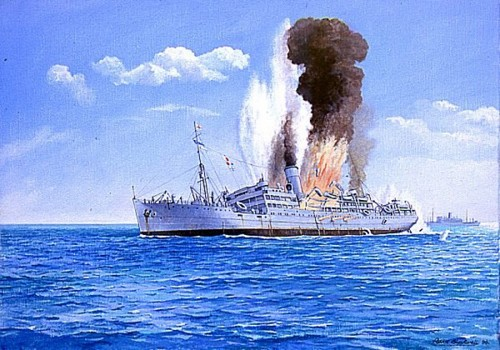
Aboard were 996 officers and men of the East African Artillery’s 301st Field Regiment—soldiers from Kenya, Uganda, and Tanganyika on their way to fight in Burma. Only 144 survived. The sinking remains Britain’s third-worst maritime disaster of the war, and the worst loss of women service personnel in its history, with 77 nursing sisters and Wrens losing their lives.
Veteran journalist Kamau Kaniaru, writing in The Standard, observed: “To this day, Gunners Abare Songa and his colleagues… have no known graves, many entombed in the wreck of the Khedive Ismail, some 12,000 feet below the surface. Such is the cruelty of war.” The tragedy is commemorated at the Commonwealth War Graves Cemetery on Ngong Road, but remains largely forgotten in Kenya’s popular memory.
1.4. The Royal East African Navy
In 1953, as Britain consolidated its colonial administration, the Royal East African Navy (REAN) was established, covering Kenya Colony, Tanganyika, and Zanzibar. It was a modest force, intended primarily for coastal patrol and harbour defence.
When the REAN was disbanded in 1962, its responsibilities were temporarily transferred to the East African Railways and Harbours Corporation—an indication of how closely naval affairs were still tied to commercial shipping. The independent states were expected to establish their own navies when ready.
Part Two: Birth of a Navy – The First Decade (1964–1972)
2.1. Inauguration
On 12 December 1964, exactly one year after Kenya’s independence, President Jomo Kenyatta formally inaugurated the Kenya Navy at a ceremony in Mombasa. He described the moment as “completing Kenya’s pattern of defence”—the final piece of the new nation’s military architecture.
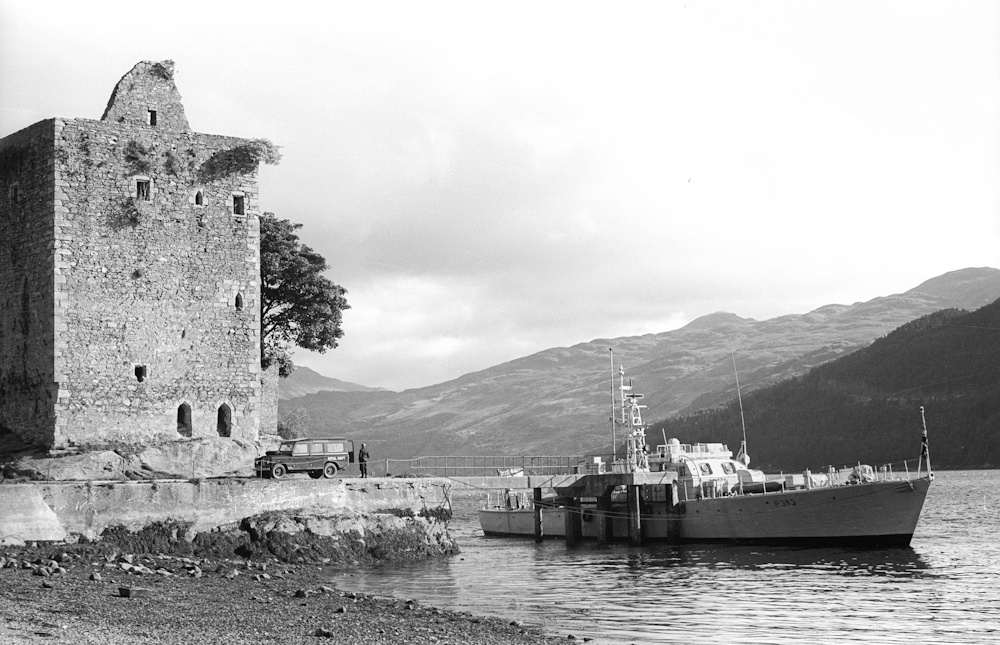
The navy began with modest assets: a handful of vessels transferred or loaned by the Royal Navy, including a training ship, HMS Aberford, renamed KNS Nyati. Personnel were initially seconded British officers, and the first Kenyan cadets were sent to the Royal Naval College in Dartmouth, England, for training.
2.2. First Ships, First Steps
In 1967, three new patrol vessels were delivered from British shipyards, replacing the aging Nyati. That same year, the first ten Kenyan midshipmen reported for duty after completing their UK training. The navy was slowly becoming Kenyan.
The force was small—just 650 men in 1983—and its capabilities limited. Its primary mission was patrolling coastal waters to deter smuggling and poaching. The vessels were too small to effectively patrol the 200-nautical-mile exclusive economic zone, particularly during the monsoon season. Navigation was complicated by poorly charted coral reefs and shifting coastal contours.
2.3. Kenyanisation of Command
A milestone came on 1 November 1972, when Major James Collins J. Kimaro assumed command of the Kenya Navy, replacing the last seconded British officer. Kimaro, promoted to lieutenant colonel by President Kenyatta, was the first Kenyan commander of the navy. The Royal Navy Training Team’s service was terminated by the end of that year.
Tragically, Kimaro died in a road accident in 1978. He was succeeded by Major General Eliud Mbilu, who commanded until 1988.
Part Three: Building a Fleet – The Missile Era (1970s–1990s)
3.1. The Brooke Marine Boats
In the mid-1970s, the navy acquired four patrol craft from British shipbuilder Brooke Marine. Delivered between 1974 and 1976, these vessels—the Madaraka class—were initially armed with light guns, but in 1983 they were refitted to carry Israeli-made Gabriel surface-to-surface missiles. This transformed them from simple patrol boats into genuine fast attack craft.
One of these vessels, KNS Mamba, remains in service today, though its missile system is no longer functional.
3.2. The Vosper Thornycroft Missile Boats
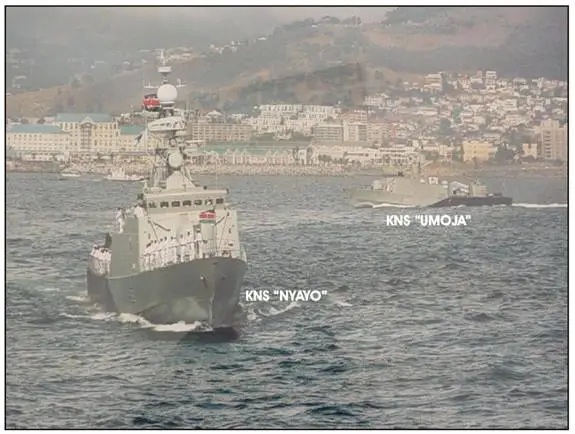
A significant leap came in 1987 with the delivery of two missile boats from Vosper Thornycroft in the UK. The Nyayo class—KNS Nyayo and KNS Umoja—were 56-metre vessels armed with four Otomat surface-to-surface missiles, a 76mm gun, and anti-aircraft guns. They were formidable warships by any regional standard.
In the 1990s, the navy added two Shupavu class large patrol boats, built in Spain and armed with 76mm and 30mm guns. These vessels, while capable, suffered from range and sea-keeping issues that limited deep-water operations.
3.3. Amphibious Capability
In 1993, the navy took delivery of two landing ships, KNS Galana and KNS Tana, built in Spain. These unarmed logistics vessels gave Kenya a modest amphibious capability—a capability that would prove crucial two decades later.
3.4. The Anglo-Leasing Scandal
Not all procurement went smoothly. In 2003, the navy ordered an offshore patrol vessel, KNS Jasiri, from the Spanish shipbuilder Astilleros Gondan through a company called Euromarine. The cost was Sh4.1 billion (approximately $52 million)—a sum military analysts said was nearly three times what a comparable vessel should have cost.
The contract was one of the infamous “Anglo-Leasing” projects exposed by anti-corruption czar John Githongo. Payments were frozen, and the vessel’s delivery was delayed for years amid contractual disputes. When KNS Jasiri finally arrived in August 2012, it was the largest vessel in the fleet: 85 metres long, 1,400 tonnes displacement, capable of operating at the extremities of Kenya’s continental shelf.
Part Four: Into Action – Operations and Peacekeeping
4.1. Early Missions
Beyond its military role, the navy has long provided humanitarian assistance. Navy divers have been called upon for numerous rescue and recovery missions:
- 1980: Recovered a civilian vehicle from Chinga Dam in Nyeri.
- 1981: Salvaged a National Youth Service vehicle at Garissa Bridge.
- 1985: Searched for weapons in Rongai Dam, Nakuru.
- 1986: Salvaged a Tanzanian dhow at Shelly Beach.
- April 1994: The MV Mtongwe ferry sank with over 270 passengers; navy divers were tasked with recovering bodies.
4.2. The Somali Intervention: Operation Linda Nchi
In October 2011, following a series of cross-border attacks by al-Shabaab militants, Kenyan forces entered southern Somalia in an operation codenamed Linda Nchi (“Protect the Country”). The navy played a critical role.
The 370-tonne KNS Harambee II (a former French patrol vessel donated in 2011) became the first Kenyan unit to cross into Somali waters. Its mission was not without drama: on its maiden voyage from France, the ship had suffered power failures and radio incompatibility issues. But in October 2011, it performed.
The climax came in September 2012. For weeks, Kenyan warships shelled the port city of Kismayu, al-Shabaab’s last major stronghold. On 28 September, an amphibious assault was launched. Five vessels—KNS Nyayo, KNS Umoja, KNS Galana, KNS Shujaa, and the flagship KNS Jasiri—transported troops, vehicles, and supplies. Hours later, al-Shabaab announced they had abandoned the city. The operation was a turning point in the regional fight against terrorism.
As President Ruto noted at the navy’s 60th anniversary, “the amphibious landing in Kismayu under Operation Sledgehammer… liberated the city.”
4.3. Counter-Piracy and Regional Security
The Somali piracy crisis of the 2000s and 2010s brought new challenges. The Kenya Navy patrolled extensively, escorted merchant vessels, and participated in international counter-piracy efforts. The United States, through Naval Special Warfare Group 4, assisted in creating a new Kenyan Special Boat Unit (KSBU) based at Manda Bay, training over 200 personnel in small craft operations.
By 2009, the navy was operating four 25-foot Defender-class response craft from a forward base in Kiunga, just six kilometres from the Somali border. In February 2007 alone, they conducted over 200 boardings in Somali coastal waters.
Part Five: Modernisation and Challenges (2010–Present)
5.1. Fleet Renewal
The 2010s saw significant fleet modernisation. In 2011, KNS Nyayo and KNS Umoja underwent a two-and-a-half-year refit at Fincantieri’s shipyard in Italy. The refit replaced a third of their structures and rebuilt their hulls—but controversially, their surface-to-surface missile systems were removed, reducing them to patrol vessel configuration.
In 2015, the US Navy donated four 10-metre Metal Shark RHIBs. Today, the fleet includes the flagship KNS Jasiri, two Shupavu-class patrol boats, two Nyayo-class vessels, two Galana-class landing ships, and numerous smaller craft.
5.2. The Kenya-Somalia Maritime Dispute
Since 2014, Kenya has been locked in a contentious maritime border dispute with Somalia. At stake is a potentially resource-rich area of the Indian Ocean, believed to contain oil and gas deposits.
The dispute traces its roots to the colonial era, with competing claims over the alignment of the maritime boundary. In 2021, the International Court of Justice ruled largely in Somalia’s favour—a decision Kenya rejected, citing the court’s lack of jurisdiction.
The dispute has strained bilateral relations and complicated regional counter-terrorism cooperation. As a Kenyatta University thesis notes, “the discovery of oil, gas, fisheries, and other valuable minerals in the contested maritime area has intensified the dispute.” The resolution, many argue, lies in bilateral negotiation rather than international adjudication.
5.3. The Blue Economy Vision
In recent years, the Kenyan government has embraced the concept of the Blue Economy—the sustainable use of ocean resources for economic growth. President Ruto has emphasised the navy’s role in this vision:
“Your role in this initiative amplifies our commitment to Kenya’s transformation, particularly in developing our Blue Economy, which holds immense untapped potential. By investing in maritime infrastructure and enhancing its security, we not only improve our naval capabilities but also create opportunities for wealth generation and job creation.”
This represents a significant evolution in thinking: from seeing the navy purely as a defensive force to recognising it as an enabler of economic development.
Part Six: The Human Element – Commanders, Crews, and Culture
6.1. Commanders
The Kenya Navy has had fourteen commanders since 1964, a testament to institutional stability. The current commander is Major General Paul Owuor Otieno, who assumed command in May 2024.
Notable commanders include:
- Major General Eliud Mbilu (1978–1988): Oversaw a decade of growth.
- Major General Samson Mwathethe (2006–2011): Later became Chief of Defence Forces.
- Major General Levi Mghalu (2015–2020): Led during the Kismayu operation aftermath.
6.2. A Unique Tradition
The Kenya Navy has an unusual tradition: it uses army ranks despite wearing naval uniforms. Officers hold ranks like Major General and Brigadier rather than admiral or commodore. This reflects the navy’s origins as the junior service within a land-oriented defence force.
6.3. The 60th Anniversary
In December 2024, President Ruto led celebrations for the Kenya Navy’s 60th anniversary at the Mtongwe Naval Base. He praised the service’s “exemplary professionalism, dedication, and courage” and paid tribute to fallen heroes who “paid the ultimate price for the peace we enjoy today.”
The event featured military displays, recognition of outstanding officers, and a sail-past of naval vessels—a rare public glimpse of the service that usually operates beyond the horizon.
Conclusion: The Blue Water Future
From a handful of second-hand vessels and British officers in 1964, the Kenya Navy has grown into the best-equipped naval force on the East African coast. It has fought pirates, liberated cities, rescued civilians, and guarded Kenya’s maritime sovereignty for six decades.
Yet challenges remain. The fleet is small for a country with such an extensive coastline and exclusive economic zone. The maritime dispute with Somalia remains unresolved. Piracy and illegal fishing persist. And the Blue Economy vision, however promising, requires sustained investment and political will.
As Harriet Mboce and Robert McCabe observe, Kenya has evolved from a “sea-blind” country to one where “the maritime domain is becoming increasingly important.” The navy has been central to that evolution.
The waters off Kenya’s coast have witnessed centuries of history—Persian traders, Portuguese conquerors, British fleets, Japanese submarines, Somali pirates. Through it all, the sea has remained both opportunity and threat. For sixty years, the Kenya Navy has been the nation’s shield upon those waters.
The next sixty years will demand even more.
Further Reading on Kenyan History
| Article | Link |
|---|---|
| The History of Mombasa | Read |
| A History of the Northern Frontier District | Read |
| Kenya’s Colonial Administration 1920-1963 | Read |
| The Shifta War: Kenya’s Forgotten Border Conflict | Read |
| The Somali People of Kenya | Read |
Comments Section Discussion Questions
- Why do you think the sinking of the SS Khedive Ismail has been largely forgotten in Kenya’s popular memory? Should it be commemorated more prominently?
- Does the Kenya-Somalia maritime dispute require a bilateral solution, or should Kenya accept the ICJ ruling?
- How can the “Blue Economy” vision be realised while ensuring adequate maritime security?
- Should the Kenya Navy adopt traditional naval ranks (admiral, commodore) or retain its current army-style ranks?
Share this article:
[Twitter] [Facebook] [LinkedIn] [WhatsApp]
Last Updated: March 2026
Sources
Wikipedia, “Kenya Navy” [Various contributors]
Pulse Kenya, “Kenya Navy at 60: Rich history, successful operations & President Ruto’s praises” (2024)
The Standard, “Reliving the last days of Kenyan troops killed by Japanese submarine” (2017)
GlobalSecurity.org, “Kenya Navy” [various pages]
GlobalSecurity.org, “Kenya Navy – Modernization”
Indicator Loops, “Royal Navy Harbour Defences – Kilindini Harbour, Mombasa”
Daily Nation, “A look into Kenya Navy history ahead of sail-past” (2020)
Coventry University, “Kenya: From ‘Sea-Blind’ to ‘Sea-Vision'” (2020)
The Star, “Kenya Navy @60: Ruto to grace celebrations in Mombasa” (2024)
Kenyatta University, “Blue Economy Resources and Maritime Border Dispute between Kenya and Somalia 1963-2022” (2025)
