
Between roughly 1830 and 1880, a series of wars tore through the heart of the Maasai world. These were not raids on neighbouring peoples. They were internal — Maasai fighting Maasai, section against section, pastoral against agropastoral — and they were fought with a ferocity that astonished early European observers who arrived expecting to find a unified and invincible nation. By the time the dust settled, several entire Maasai sub-groups had been destroyed or permanently scattered. The geography of the East African interior had been remade. And the door to the highlands — which Maasai power had kept firmly shut for two centuries — had been pushed open.
The Iloikop Wars are among the least known and most consequential events in 19th-century East African history. They did not appear in British colonial records, because the British had not yet arrived when most of them were fought. They left no written documents, because the Maasai had none. What survives is oral tradition, the testimony of Swahili and Arab traders who witnessed their effects, and the deductions of later historians piecing together a picture from fragments. But what emerges from those fragments is clear: the Iloikop Wars shaped the world the British stepped into, and they explain much of what happened next.
Who Were the Iloikop?
The first thing to understand about the Iloikop Wars is that the name “Iloikop” is itself contested, and was used differently by different people at different times. In the 19th century, Swahili traders and early European travellers used the term — sometimes rendered as Kwavi, a corruption of a Maasai word — to describe Maasai groups who practised some degree of agriculture or mixed farming alongside cattle herding. The pastoral Maasai used it as a term of mild contempt: a “real” Maasai was a pure pastoralist, and any Maasai who farmed was diminished in status.
But this distinction was more fluid than it sounded. The Maasai themselves recognised that cattle loss — through disease, drought, or raiding — could force any family to cultivate as a survival strategy. A man who farmed was Iloikop. A man who rebuilt his herds was IlMaasai again. The identity moved with the cattle. What the 19th-century wars crystallised was a hardening of this distinction into something more permanent and more violent: certain Maasai sections became associated with agropastoralism as a permanent characteristic, and the fully pastoral sections came to treat them not as temporary unfortunates but as a different and inferior people.
The main Iloikop groups involved in the 19th-century conflicts were:
- The Laikipiak — the largest and most powerful, dominating the Laikipia plateau north of Mount Kenya. They were the dominant force in the region for much of the mid-19th century and the last to be defeated.
- The Uasin Gishu Maasai — occupying the great plateau northwest of the Rift Valley in what is now western Kenya. They were among the first to be broken.
- The Loosekelai — a smaller group based around Lake Naivasha and the central Rift.
- The Siria — occupying areas near Lake Victoria’s eastern shore and the Kericho highlands.
- The Loogolala — a section based further south, destroyed early in the conflict period.
Against them stood the pastoral IlMaasai sections — primarily the Purko, based in the southern Rift Valley and what is now northern Tanzania, and the Kisongo further south. These were the most powerful and most purely pastoral Maasai groups, and it was they who ultimately prevailed.
The World Before the Wars
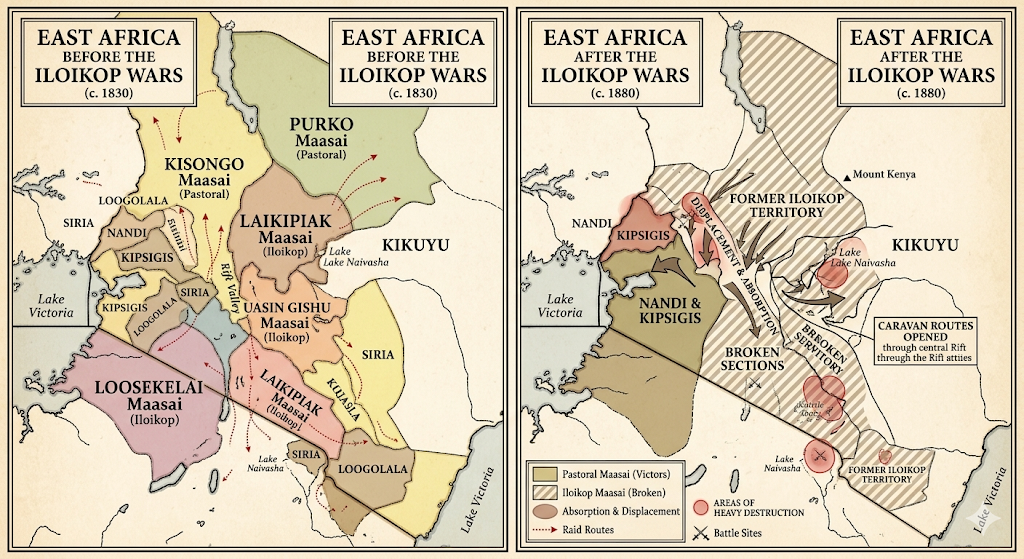
To understand what the Iloikop Wars destroyed, it helps to understand what existed before them. As the Maasai at their peak article on this site describes, by 1800 the Maasai exercised dominance over an enormous swathe of East Africa — from the Uasin Gishu plateau in the northwest to central Tanzania in the south, from the central Rift Valley east to the slopes of Mount Kenya. This dominance was real but always contested. Different Maasai sections held different territories, and the boundaries between them were maintained by negotiation, marriage alliance, and periodic conflict.
The Laikipia plateau — the high, fertile grassland north of Mount Kenya — was Laikipiak territory, and the Laikipiak were formidable. Their cattle herds were among the largest in the region. Their warriors were organised on the standard Maasai age-set model, and their fighting capacity was by all accounts comparable to the Purko and Kisongo in the south. They controlled the crucial trade routes between the interior and the coast, extracting tribute from Arab and Swahili caravans attempting to pass through their territory. Early missionaries and explorers who visited the region in the 1840s and 1850s described the Laikipiak as a major power — not a peripheral group but a central force in the politics of the East African interior.
The Uasin Gishu Maasai, further west, occupied the plateau that now bears their name — the rolling grassland around present-day Eldoret. They had expanded there by pushing aside earlier Kalenjin inhabitants, and they were the westernmost extension of Maasai power. To their south and east were the Loosekelai and other Iloikop groups, occupying the fertile central Rift.
This was a world in which Maasai power was real and widespread — but distributed across multiple competing sections, none of whom could speak for all the others, and all of whom were capable of war against their neighbours as well as their enemies.
The Causes: Cattle, Drought, and Ideology
The wars did not have a single cause. Historical scholarship — particularly the work of Richard Waller and John Berntsen, the two historians who have written most carefully about 19th-century Maasai history — identifies several overlapping pressures that combined to make large-scale conflict almost inevitable.
Competition for grazing
The most immediate cause was ecological. The first half of the 19th century brought a series of droughts to the East African interior, and drought meant competition for the limited good grazing land that remained productive. The Laikipia plateau and the Uasin Gishu were among the most reliable high-altitude grasslands in the region — precisely the areas where the Iloikop groups were most concentrated. As the pastoral sections pressed northward and westward seeking pasture, the pressure on these territories intensified.
Cattle raiding, always a feature of Maasai life, increased in scale and frequency. What had been periodic raids became sustained campaigns. The logic of cattle raiding in times of scarcity is compounding: you raid to replace lost cattle; your victims raid to replace what you took from them; the cycle escalates. When the resources being contested are the grazing lands themselves, the escalation eventually becomes existential.
Ideological hardening
Alongside the ecological pressure came a sharpening of ideological distinctions. The pastoral Maasai sections, led by their laibons — hereditary spiritual leaders who also played a political coordinating role — developed an increasingly rigid distinction between “true” Maasai and Iloikop. This was not purely cynical: it reflected genuine cultural differences in economy and practice. But it served the interests of the pastoral sections, because it provided a moral framework for treating Iloikop cattle as legitimate targets. If the Iloikop were not proper Maasai, their cattle were not really theirs — and taking them was not the same as raiding a kinsman.
The great laibon Supeet, who held authority among the pastoral Maasai in the mid-19th century, is credited in Maasai oral tradition with actively encouraging the wars against the Iloikop on precisely these grounds. His authority gave the campaigns a quasi-religious legitimacy they might otherwise have lacked.
The dynamics of the age-set system
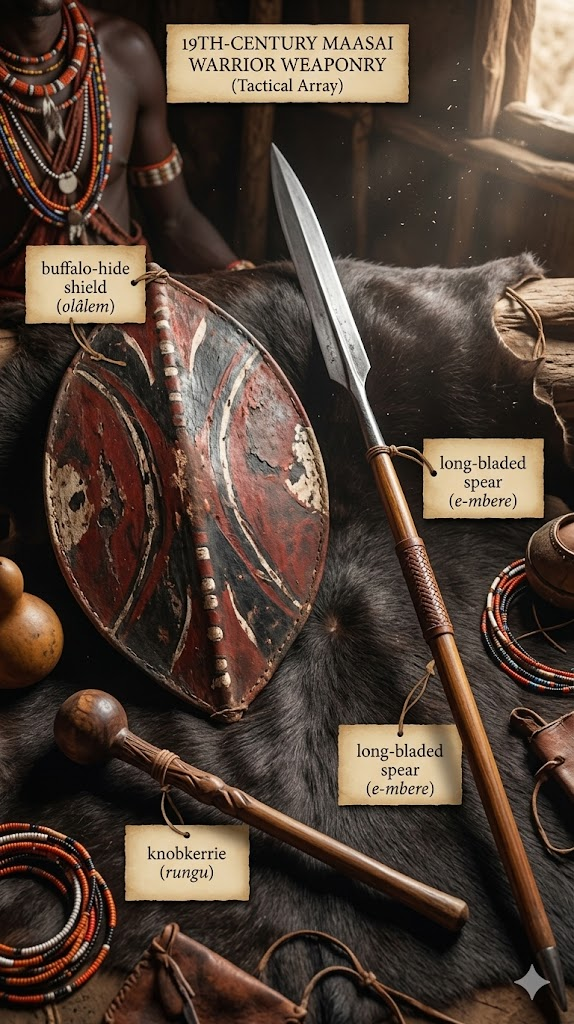
The Maasai age-set system also played a role. Young warriors — the moran — were by definition prohibited from marrying, settling, or accumulating wealth until their age-set was retired from warrior status. Their only legitimate activity was raiding and fighting. In periods of external peace, this energy had to go somewhere. Internal conflict was partly a structural outlet for a system that had been designed to produce and maintain a professional warrior class.
The Wars: A Timeline of Destruction
The Iloikop Wars were not a single conflict but a series of campaigns fought over roughly half a century, with overlapping causes, shifting alliances, and no clear moment of beginning or end. What follows is the best reconstruction available from oral tradition and indirect historical evidence.
The early phase: c.1830–1850
The earliest major conflicts involved the Loogolala and Loosekelai sections of the Iloikop, who occupied the central Rift Valley around Lake Naivasha and the Kedong Valley. These were among the smaller Iloikop groups, and they were the first to be broken. Purko warriors, pressing northward from their strongholds in the southern Rift, raided the Loosekelai repeatedly through the 1830s and 1840s.
The survivors of the Loosekelai were partly absorbed into the Purko and partly displaced northward, joining the Laikipiak on the plateau above. This displacement itself increased pressure on Laikipiak territory and resources, setting the stage for the later, larger conflicts. The Loogolala suffered a similar fate: their section was essentially destroyed as a coherent group, the survivors scattering and being absorbed by larger sections on both sides of the conflict.
The destruction of the Uasin Gishu Maasai: c.1850–1875
The most geographically significant of the Iloikop conflicts was the destruction of the Uasin Gishu Maasai, the section that had occupied the great plateau northwest of the Rift Valley. This was not a quick defeat. The Uasin Gishu were a substantial group with large herds and capable warriors, and they resisted Purko and allied pressure for a generation.
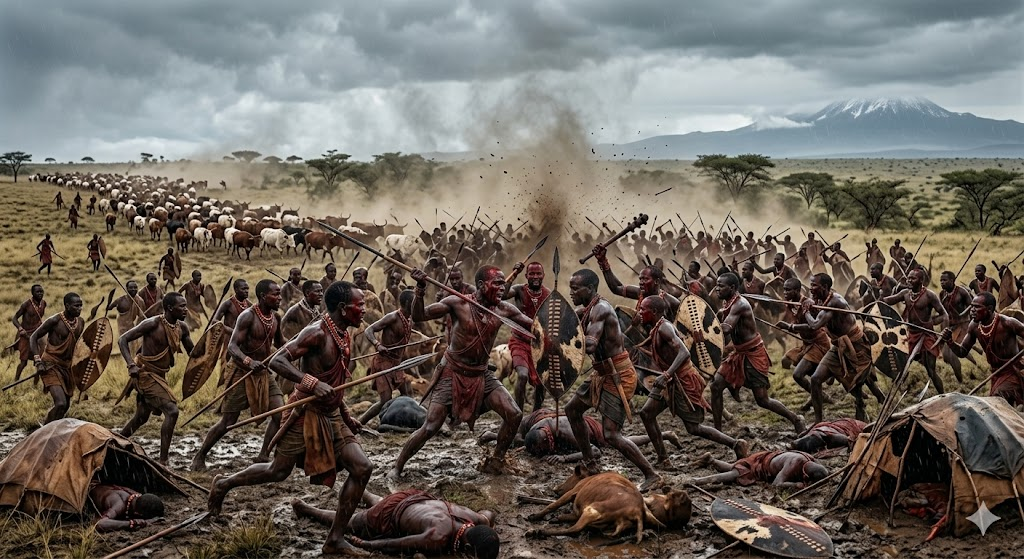
The decisive campaigns appear to have taken place in the 1870s, when a coalition of pastoral Maasai sections — primarily Purko but also the Damat and others — launched sustained attacks on the Uasin Gishu plateau. The Uasin Gishu, by this point already weakened by earlier raiding and cattle loss, could not hold. Their herds were taken. Their population scattered.
What happened to the Uasin Gishu survivors matters for Kenyan history. Many fled westward and northward, into areas adjacent to Nandi, Kipsigis, and Tugen territory. Some were absorbed into those communities. Others remained as displaced Maasai groups on the margins of the plateau that had been their homeland. The vacuum left by their defeat was precisely what allowed the Nandi and Kipsigis to expand onto the Uasin Gishu plateau — a territorial gain that would shape the political geography of western Kenya for the next century.
The defeat of the Laikipiak: c.1875–1884
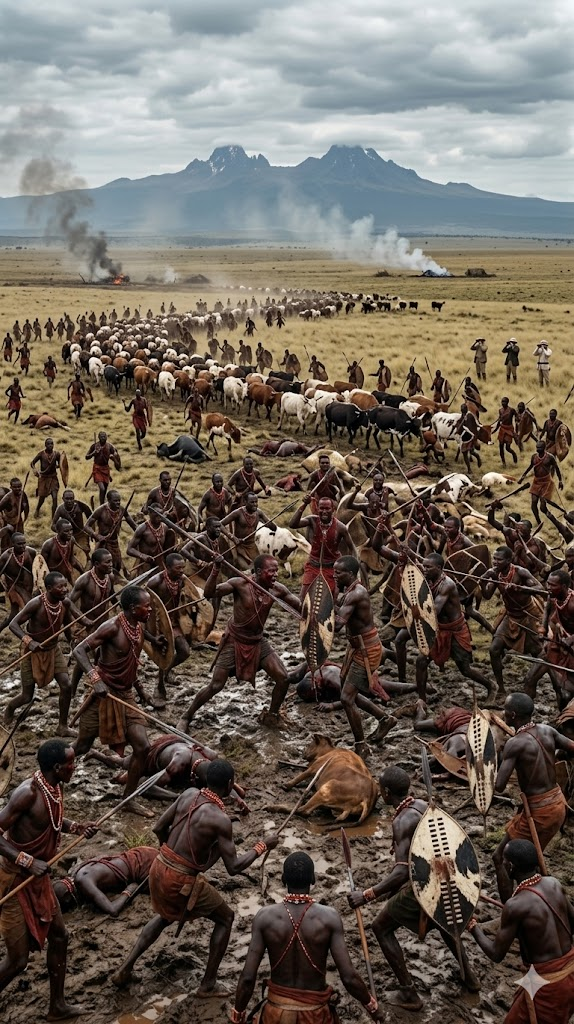
The final and most consequential phase of the Iloikop Wars was the destruction of the Laikipiak — the most powerful of the Iloikop groups, dominant on the Laikipia plateau for most of the 19th century. Their defeat was the pivotal event of the entire conflict, and it is the campaign that oral tradition records most vividly.
The war against the Laikipiak involved a coalition of pastoral Maasai sections — Purko, Kisongo, and Damat among them — acting in loose coordination under the spiritual authority of the laibon Mbatian, who had succeeded Supeet and held the greatest authority of any single Maasai leader in the 19th century. The Laikipiak fought back hard. The conflict stretched over several years, with major engagements on the plateau and in the Rift Valley below.
The decisive battle — recorded in oral tradition as having taken place somewhere on the Laikipia plateau itself, though the exact location is disputed — ended in Laikipiak defeat. The survivors were driven off the plateau entirely. Some fled north toward Mount Kenya, some east toward the foothills, some south toward the Rift. Their cattle — the largest herds on the plateau — were taken by the victorious pastoral sections. As a coherent territorial group, the Laikipiak Maasai ceased to exist.
The Laikipia plateau itself was not, however, immediately occupied by the victorious Maasai. The conflict had been so destructive that even the winners lacked the population to resettle the plateau fully. It remained, for years afterward, a sparsely populated grassland — a fact that British colonial surveyors noted when they arrived in the 1890s and used to justify declaring it “empty” land available for European farming.
Consequences: How the Wars Remade East Africa
The Iloikop Wars had consequences that rippled through the entire region, some of them direct and immediate, others playing out over decades.
The opening of the interior
The most immediate consequence was geographical. While the pastoral Maasai won the Iloikop Wars, they won at enormous cost. The population of fighting-age warriors had been significantly depleted. The attention and energy of the surviving sections was turned inward — consolidating gains, rebuilding herds, managing the political aftermath of a long and destructive conflict.
This created a window. The Laikipia plateau, the Uasin Gishu, and the central Rift Valley — all previously too dangerous for outsiders to enter — became accessible. Arab and Swahili caravans that had previously been forced to take the long coastal routes began to push into the interior through corridors that Maasai power had previously closed. The first sustained caravan traffic to Lake Victoria’s eastern shore dates from the 1870s — precisely the period when the Iloikop Wars were at their most destructive.
This in turn is what made it possible for Joseph Thomson to cross Masailand in 1883. The Maasai he encountered were not the terror of the pre-war decades. They were a people in the aftermath of civil war, still formidable individually but structurally weakened as a coordinated force.
The displacement of the Kalenjin
The collapse of the Uasin Gishu Maasai had direct consequences for the Nandi and Kipsigis peoples. These Kalenjin communities had been pushed into the highland margins by Maasai expansion in earlier centuries. The defeat of the Uasin Gishu removed the dominant force on the plateau, and the Nandi in particular expanded rapidly westward and northwestward, occupying the territory the Uasin Gishu had held. By the time the British arrived, the Nandi were the power on the plateau — not the Maasai — which is why it was the Nandi who led the most sustained armed resistance to the railway’s construction in the 1890s.
The Kikuyu boundary
The defeat of the Laikipiak had similarly significant effects on the Kikuyu. With the Laikipiak removed from the Laikipia plateau, the immediate pressure on Kikuyu settlements in the foothills of Mount Kenya from the north was reduced. Kikuyu farmers cautiously extended their cultivation northward and westward through the 1880s — into areas they had not been able to farm while the Laikipiak were dominant. Some historians argue that the rapid Kikuyu expansion in the decade before colonial arrival was directly enabled by the Laikipiak defeat.
The rinderpest and what came after
Then, before the pastoral Maasai could fully consolidate their victory, came the rinderpest. The cattle plague of the late 1880s and early 1890s did not discriminate between winners and losers of the Iloikop Wars. The Purko and Kisongo, whose herds had been rebuilt on the cattle taken from the Laikipiak and Uasin Gishu, lost those herds just as quickly as everyone else. The smallpox epidemic that followed, and the drought that compounded it, left the entire Maasai world — pastoral and agropastoral alike — devastated.
When the British colonial administration extended its authority into the Kenyan highlands after 1895, it found a people whose military dominance had been broken first by civil war and then by disease. The colonial land policies that followed — particularly the two Maasai Moves of 1904 and 1911, which displaced the surviving Maasai from the Rift Valley into reserves — were made possible precisely because the Iloikop Wars had already destroyed the foundation of Maasai power.
What the Wars Meant for Maasai Identity
The Iloikop Wars left a complicated legacy within Maasai society itself. The pastoral IlMaasai who won carried forward a mythology of purity and superiority — the idea that true Maasai were pastoralists, that agriculture was a fall from grace, that the Iloikop had been justly defeated because they had compromised their identity. This mythology survived long into the colonial period and shaped how Maasai elders and intellectuals represented their history to outside researchers.
But the defeated Iloikop did not simply disappear. The survivors of the Laikipiak, Uasin Gishu, and other sections were absorbed into multiple communities across the region. Some joined the Nandi and Kipsigis. Some were incorporated into Kikuyu communities through the Maasai custom of adoption and clientage. Some remained as marginalised groups on the edges of the surviving Maasai sections. Their descendants are today spread across several ethnic communities in central and western Kenya, often without clear awareness of their Maasai origin.
The oral traditions of the victorious sections — particularly the Purko — remember the Iloikop Wars as a necessary cleansing, a restoration of proper Maasai order. The oral traditions of communities that absorbed Iloikop survivors — Nandi, Kipsigis, some Kikuyu — carry faint traces of a different memory: of displaced cattle people, of refugees who arrived from the direction of the Rift Valley and were absorbed into new communities. Piecing these fragments together is one of the more demanding tasks in East African oral history.
The Iloikop Wars and the Colonial Encounter
There is one more consequence worth naming directly. The Iloikop Wars created the conditions for British colonialism in a way that is rarely acknowledged in standard colonial histories. Those histories typically present the British as encountering a powerful Maasai nation and making a pragmatic decision to work with rather than against them. The truth is more complicated: the British encountered a Maasai world already severely weakened by internal conflict and disease, and the “collaboration” they achieved was partly a function of Maasai desperation rather than Maasai strength.
The two Maasai Moves — the forced relocations of 1904 and 1911 — were not resisted with force precisely because the Maasai lacked the coordinated military capacity that would have been possible before the Iloikop Wars. A Maasai nation that had not spent fifty years fighting itself, and whose herds had not been devastated by rinderpest, would have been a very different adversary for the colonial state. As it was, the Maasai who signed the 1904 agreement with the British had already been defeated once — by their own people — and were in no position to risk another war.
Understanding the Iloikop Wars is therefore not a footnote to Kenya’s colonial history. It is part of the explanation for why that history unfolded as it did.
Further Reading on This Site
- Lords of the Plains: The Maasai at Their Peak — the wider context of Maasai dominance before the civil wars
- The Maasai in Transition: History, Land Struggles, and the Rise of Agriculture — what happened to the Maasai after colonialism
- The Kipsigis: History, Origins, and Cultural Evolution — the Kalenjin people who filled the vacuum left by the Uasin Gishu defeat
- The Kikuyu People — whose northward expansion was enabled by the Laikipiak defeat
- Colonialism in Kenya: Origins, Impact, and Resistance — the colonial context into which the post-war Maasai were absorbed
- A History of Land Ownership in Kenya — how the Laikipia plateau’s apparent “emptiness” after the wars shaped colonial land policy
- Threads of Ivory, Iron and Identity: Kenya’s Long-Distance Trade Networks — how the opening of the interior after the wars transformed trade
References and Further Reading
- Waller, R. D. (1976). The Maasai and the British 1895–1905: The Origins of an Alliance. Journal of African History, 17(4), 529–553.
- Berntsen, J. L. (1979). Maasai Age-Sets and Prophetic Leadership: 1850–1910. Africa, 49(2), 134–146.
- Spear, T. & Waller, R. (eds.) (1993). Being Maasai: Ethnicity and Identity in East Africa. James Currey.
- Sobania, N. (1993). Defeat and Dispersal: The Laikipiak and Their Neighbours at the End of the Nineteenth Century. In Spear & Waller (eds.), Being Maasai.
- Galaty, J. G. (1993). Maasai Expansion and the New East African Pastoralism. In Spear & Waller (eds.), Being Maasai.
- Ogot, B. A. & Kieran, J. A. (1968). Zamani: A Survey of East African History. East African Publishing House.
- Thomson, J. (1885). Through Masai Land. Sampson Low, Marston, Searle & Rivington.
