
Estimated Reading Time: 14 minutes
Key Takeaways at a Glance
| Era | Key Actors | Primary Goal for African Education |
|---|---|---|
| 1844–1895 | Missionaries (CMS, Holy Ghost Fathers) | Christian conversion through literacy |
| 1895–1911 | Imperial British East Africa Company, Early Settlers | Practical training for trade and labour |
| 1911–1919 | Colonial Government (Education Department) | Industrial training; creating a skilled workforce |
| 1919–1925 | Government, Missions, Phelps-Stokes Commissions | “Adapted education”; controlled development |
The history of education in Kenya did not begin with a single, coherent policy. Instead, it was forged in the crucible of competing interests. On one side stood the Christian missionaries, who saw schools as the path to salvation. On the other were European settlers and commercial interests, who viewed education as a tool for creating a docile and productive labour force. Caught between them was the colonial government, which gradually moved to seize control, guided by reports and commissions that would shape Kenya’s educational destiny for generations.
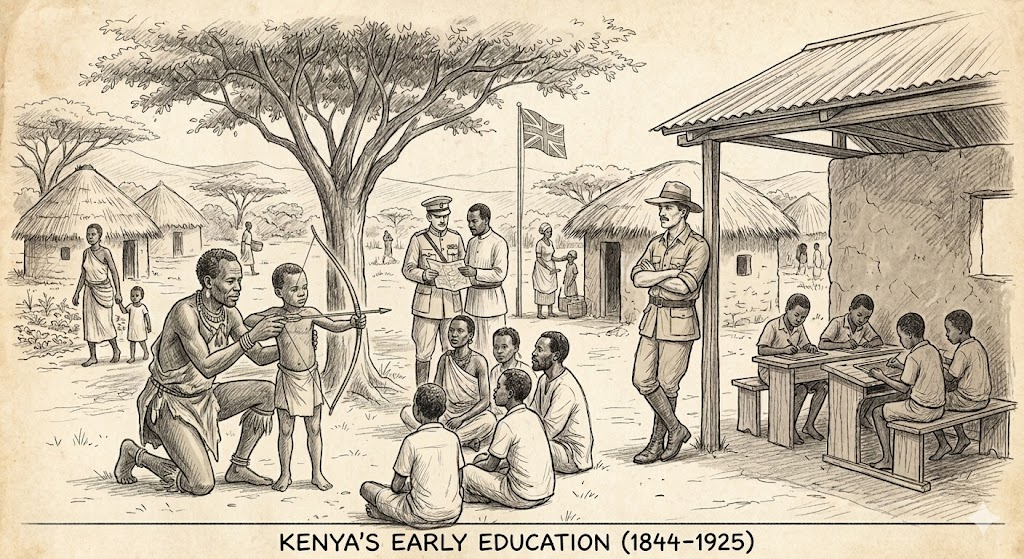
This article traces the early battle for the African mind, from the first mission station at Rabai in 1844 to the establishment of a government-controlled education system in the mid-1920s. It draws extensively on contemporary scholarship to illuminate the forces that shaped this struggle.¹
Missionary Dawn (1844–1895)
1.1. Rabai and the First School
The story of Western education in Kenya begins not in Nairobi or Mombasa, but fifteen miles inland from the coast, at a place called Rabai. Here, in 1846, Dr. Ludwig Krapf and the Rev. John Rebmann of the Church Missionary Society (CMS) established a mission station.² As scholar George E. Urch notes, it was at Rabai that East Africa’s first mission school was started by Krapf, who “realized that his converts must be taught to read the Bible.”³
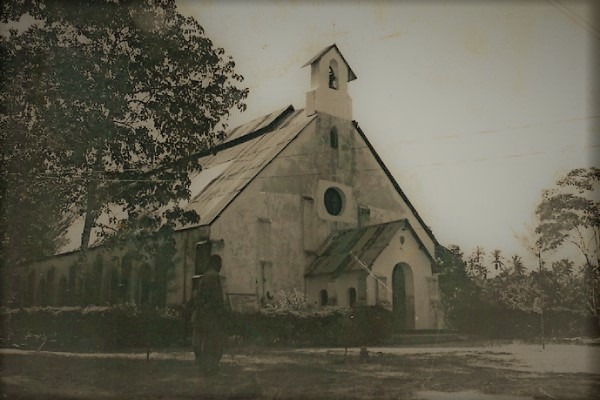
Krapf’s goal was simple: teach Africans to read so they could study the scriptures. The first students were freed slaves and local Mijikenda children. They learned the alphabet, basic arithmetic, and Christian doctrine—all in the hope that they would become evangelists to their own people.
For decades, missionary activity remained the sole source of Western education. The Holy Ghost Fathers established schools at Zanzibar, Bagamoyo, and later at Bura in the Taita Hills. The Church of Scotland Mission opened at Kikuyu in 1891, followed by the African Inland Mission at Nyangori in 1895 and the Methodists in Meru in 1901.⁴
1.2. Resistance from Tribal Elders
From the very outset, British attempts to introduce schools aroused opposition. As Urch documents, “The tribal elders permitted the early missionaries to live among them, to preach on Sunday, and to practice medicine, but they did not want their youth indoctrinated in schools.”⁵ They preferred to retain their own established educational structure—one designed to perpetuate African life as it was.
This indigenous education, as Kilemi Mwiria explains, existed long before colonial rule. It served two main goals: “First, indigenous education promoted the morals and practices that shaped the daily lives of specific ethnic groups. Second, this education aimed to transmit indigenous knowledge concerning humans and their relationship with the surrounding biophysical environment from one generation to the next.”⁶
The missionaries, however, viewed this system as heathen and sought to replace it. The stage was set for a fundamental clash of worldviews.
Railway, Settlers, and the Demand for Labour (1895–1911)
2.1. The Berlin Treaty and the Protectorate
The construction of the Uganda Railway (1896–1901) changed everything. As explored in The Rails That Built a Colony, this infrastructure project opened the interior to European settlement.
The Berlin Treaty of 1885 had already provided missionaries with “both freedom to operate and some degree of protection.”⁷ The Imperial British East Africa Company, which followed, actively encouraged mission work. In 1888, the company called on the Church Missionary Society “to establish a chain of missions corresponding to the locations of the company’s stations on a route into the interior.”⁸ The company looked to the missionaries not only to Christianize the natives but also “to assist the company in developing communication and agricultural centers.”⁹
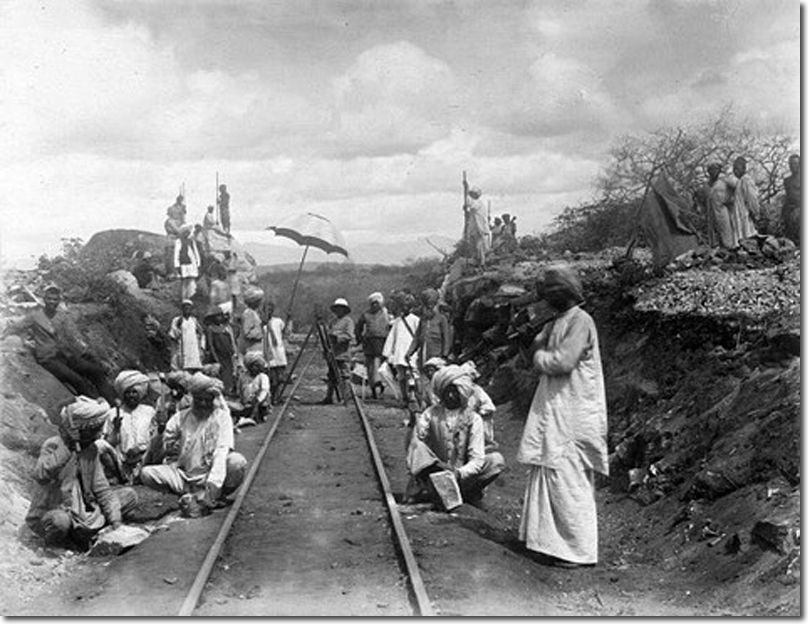
When the East African Protectorate was declared in 1895, the British government soon committed to a policy of white settlement. By 1903, this policy was firmly in place, and the government controlled all land disposal.¹⁰
2.2. Missionary Expansion and African Response
As settlers arrived, the prestige and power of Europeans grew. Africans, Urch observes, “were drawn toward Christianity in their desire to learn more about the white man’s world, for his traditional way of life offered few solutions to the problems created by the new socio-economic system.”¹¹ Mission schools entered a period of vast expansion. In 1903, only four Protestant missions worked near Nairobi; a few years later, they had “opened a network of branches up-country.”¹²
The missionaries’ objective remained primarily religious: to expose Africans to a “superior” culture and instruct them in the Word of God. The curriculum was dominated by reading and writing. As Urch notes, “A relatively high degree of literacy was necessary so that the Scripture could be understood and disseminated to others.”¹³
The African, who soon learned to equate Christianity with educational opportunity, readily responded. The ability to read and write became the key to obtaining better-paid positions on European farms.
2.3. Sir Charles Eliot and the Economic Argument
While missionaries focused on souls, colonial administrators and settlers focused on economics. Sir Charles Eliot, H.M. Commissioner for the East African Protectorate in 1904, expressed the prevailing view bluntly:
“It facilitates a better and more civilized life if natives can engage in some form of trade or occupation which causes them more or less to break with their old associations and come under Christian supervision. From this point of view I think it is a great mistake to isolate natives and place them in reserves for such isolation inevitably confirms them in their old bad customs and cuts them off from contact with superior races which might improve them.”¹⁴
Education, in this view, was not about salvation but about transformation—breaking tribal solidarity and forcing the African into a money economy.
Government Intervenes – The Fraser Report of 1909
Divergent goals between government and missions soon created conflict. Colonial officials realized they needed an overarching policy to move African education in a desired direction.
In 1909, Professor J. Nelson Fraser, Principal of the Training College at Bombay University, was invited to be protectorate adviser on African education. His report, released in October 1909, was a watershed moment.
As Urch explains, Fraser had been directed “not to reinforce plans for the literary education of the African.”¹⁵ Instead, he developed a scheme for industrial training. He proposed that the government assume control of the entire educational program, appoint a director of education, and stress “the natural adaptability of the African to industrial training.”¹⁶
Fraser’s reasoning was clear: the problem lay in inducing the native to participate in industrial education. The African preferred his accustomed life and “would not change further than force compelled.” Fraser considered it “the white man’s obligation to urge the native into industrial education; not only because white civilization required the service of the Negro but because it would elevate the African to a better standard of living.”¹⁷
The Fraser Report made the colonial administrators aware of education’s role in building the colony. An education department was organized with Mr. J.R. Orr as director, and an advisory board was appointed.
Orr organized African education into three categories:
- General Education: Run by missions, focused on reading and writing to proselytize and train teachers.
- Industrial Education: Missions were encouraged to develop this through government grants-in-aid for carpentry, masonry, agriculture, tailoring, and medical work.
- Education of Sons of Chiefs: Designed to prepare young men for administrative roles.¹⁸
Education Commission of 1919 and the Rise of Control
By 1918, it was clear to the government that missions were continuing to use education “as a tool for expanding religious activities and enlarging their own sphere of influence.”¹⁹ The government’s first attempt at a comprehensive education policy was proving inadequate.
An Education Commission was appointed, and its 1919 report addressed the core conflicts. The commission examined the literary versus technical education problem, recommending that “literary education, together with hand and eye training, be given to pupils up to eleven years of age, after which a transfer to schools providing technical or teacher training would be made.”²⁰
Crucially, the commission recommended that funds be allocated to missionary schools “on the basis of an over-all plan for African education.”²¹ This was the path to government control through the power of the purse.
The official policy was spelled out in a 1922 directive, which contained “plans for the development of African education largely through the missionary society’s ‘assisted schools’.”²² These schools were required to be open for inspection, keep detailed lesson logs, and follow a government-approved curriculum. However, as a concession to the missions, “no inspector was permitted to inquire into religious instruction or to examine any student for religious knowledge.”²³
This directive moved African education “away from its formative stage toward a well-defined program, involving the financial resources of the colony.”²⁴
Phelps-Stokes Commissions and the “Adapted Education” Philosophy
The early 1920s brought new influences from outside the colony. The League of Nations and the “trustee” concept created a feeling that colonial governments had greater responsibility toward their subjects. In 1923, a British Colonial Office white paper declared “the interests of the African native in Kenya to be ‘paramount’.”²⁵
5.1. The American Influence
Help arrived from an unexpected source—the United States. The Phelps-Stokes Fund, whose stated objectives included “educational support for the Negro, both in the United States and in Africa,” was petitioned to study education on the African continent.²⁶ Two commissions were organized, both headed by Dr. Thomas Jesse Jones, a Welsh-born American sociologist trained at Columbia University.
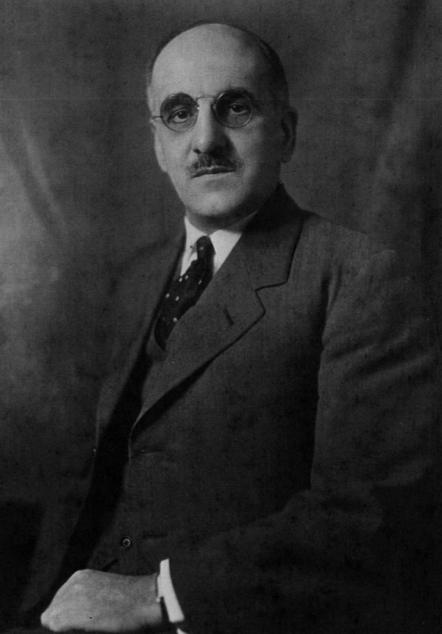
The reports they published had a far-reaching impact on educational development in British Africa. The general theme was the advocacy of African education adapted to African needs.²⁷
The East Africa commission warned against “the conceit of Western civilization in imposing a superficial imitation of European ways on others.”²⁸ It counseled both native leaders and European educators to “develop respect for whatever was good in traditional history.” The commission decried the triviality of a school curriculum that taught African youth “to sing ‘British Grenadiers’ and to revere English heroes about whom they knew nothing.”²⁹
5.2. The 1925 White Paper on Education Policy
The Phelps-Stokes findings, combined with the growing sense of imperial responsibility, led to a landmark British government white paper in 1925: “Educational Policy in British Tropical Africa.”³⁰ This memorandum laid out five guiding principles:
- The British government reserved the right to direct educational policy and supervise all institutions.
- Voluntary missionary efforts were to be welcomed and encouraged with grants-in-aid.
- Technical and vocational training should be carried out with government help.
- Education should be adapted to local conditions, conserving sound elements in local tradition while functioning as an instrument of progress.
- Religious training and moral instruction should be regarded as fundamental.³¹
5.3. Kenya’s First Education Ordinance
A direct result of the Phelps-Stokes visit and the new imperial policy was Kenya’s first Education Ordinance in 1924. As Urch explains, it “firmly placed the control of education in the hands of the government.”³²
District education committees were established in each native administrative area, composed of both Africans and Europeans, responsible for school efficiency. The Central Education Department assumed responsibility for licensing every teacher in the colony.³³
The spirit of cooperation between government and missions was formalized. By the end of 1924, the Education Department had classified 296 mission schools as government-aided, enrolling 12,986 students, and had given £14,305 for their maintenance.³⁴ This was out of an estimated 50,000 African students attending mission schools.³⁵
By 1925, with control firmly in hand, the Education Department began openly criticizing mission schools. It called for a curriculum “based as far as possible on the mentality, customs, and institutions of the African” and ordered the teaching of reading and writing in the vernacular, accompanied by hand and eye training. The primary objective was “to develop the school as a community center providing instruction and service for the surrounding community.”³⁶
The education of the African had moved from a private endeavor to a public responsibility.
Racial Ideology Behind the System
Underpinning these policy debates was a deeply held racial ideology. As Kilemi Mwiria argues, colonial Kenyan society was “organized on the basis of race, with three social groups—Africans, Asians and Europeans—forming the core of the organization. The racial ideology, which was at the same time the ruling ideology, emphasized the superiority of Europeans over the other two races with Africans being relegated to the bottom of the social ladder.”³⁷
This ideology was explicitly reflected in educational planning. The Education Department Annual Report of 1924 stressed the need to educate Europeans for leadership:
“It must never be forgotten that the European Community is a small handful in the midst of a large African population and that if Europeans would retain the leadership of Kenya, a high standard of education must be demanded.”³⁸
In contrast, African education had to be kept to a minimum. The report noted that “Illiterates with the right attitude to manual employment are preferable to products of the schools who are not readily disposed to enter manual employment… The boy who has passed through primary school… should have retained his rural attitudes.”³⁹
The unequal allocation of resources reflected this hierarchy. Mwiria provides stark figures: in 1950, Europeans, comprising 1.7% of the school population, received 33.4% of educational expenditure. Africans, over 91.7% of the school population, received only 40.9%.⁴⁰ Per pupil expenditure in 1949 was £56 for a European child, £8.3 for an Asian child, and a meagre £1 for an African child.⁴¹
The curriculum itself was designed to reinforce subordination. As Mwiria notes, “religious instruction denounced African traditions as heathen,” and lessons in geography, history, and civics “emphasized European experiences and superiority and made it appear that there was nothing worth teaching about Africa.”⁴² Oginga Odinga, the future vice president, recalled a European head teacher at Maseno using a map to show that “the red shading represented the British Empire” while dismissing African land as areas “where lazy Africans produce practically nothing.”⁴³
African Resistance and the Independent Schools Movement
Africans were not passive recipients of this system. As demand for education outstripped what missions and the state could offer, communities began to take matters into their own hands.
The Kikuyu Independent Schools Association (KISA) and the Kikuyu Karing’a Education Association (KKEA) emerged in the 1920s and 1930s, building and running their own schools. As Mwiria explains, these independent schools taught “a curriculum that combined academic subjects with Kikuyu culture and history. They rejected mission control and refused to ban practices like female circumcision, which missions condemned.”⁴⁴ By 1940, there were over 60 independent Kikuyu schools with more than 13,000 pupils.⁴⁵
The colonial government viewed these schools with suspicion, seeing them as breeding grounds for rebellion. After the declaration of the Emergency in 1952, all independent schools were closed.
Jomo Kenyatta, Kenya’s first president, had earlier articulated the deeper purpose of this movement. In 1929, he wrote to a local newspaper, urging Africans to “busy yourselves with education. But do not think the education I refer to is that which we are given a lick of. No, it is a methodical education to open out a man’s head…”⁴⁶
This movement culminated in the establishment of Githunguri Teachers’ College, the first self-help college in Kenya. Its goal, in the words of one historian, was to “provide higher education aimed at the full development of Africans, catering for their emotional desires for self-determination and cultural freedom, as well as their needs for purely intellectual development and practical skills.”⁴⁷
Conclusion: The Legacy of the Battle
By 1925, the fundamental contours of Kenyan education had been set. The government had won the battle for control. Through its grants and inspection regime, it could insist on the curriculum of its choice and the qualifications necessary for teachers. The education of the African had moved “from a private endeavor to a public responsibility.”⁴⁸
Yet the battle lines drawn in those early years—between literary and industrial education, between Western knowledge and indigenous culture, between the aspirations of Africans and the control of the state—would persist for decades. They are visible in the independent schools movement, in the struggle for access to secondary education, and in the ongoing debates about the purpose and content of Kenyan schooling today.
As Mwiria concludes, “colonial education did not, however, completely succeed in keeping the African docile, for it is mainly the educated Africans who later spearheaded the campaign for independence.”⁴⁹ The battle for the African mind was won by the Africans themselves.
Further Reading on Kenyan History
| Article | Link |
|---|---|
| A History of Land Ownership in Kenya | Read |
| The History of Coffee and Tea Farming in Kenya | Read |
| Kenya’s Colonial Administration 1920-1963 | Read |
| The Impact of Christianity on Kenyan Culture | Read |
| Mau Mau Uprising in Kenya 1952-1960 | Read |
| Jomo Kenyatta: Power, Nationhood, and the Making of Postcolonial Kenya | Read |
| The History of Nairobi | Read |
| The History of Mombasa | Read |
| The Kikuyu Independent Schools Movement | Read |
Comments Section Discussion Questions
- Do you think the missionaries’ goals were genuinely different from the settlers’, or were both ultimately serving the same colonial project?
- What elements of indigenous education survived the colonial period in your community? Are they still practiced today?
- Should the Kenyan curriculum today include more of the “adapted education” philosophy advocated by the Phelps-Stokes Commission, or is a Western-style education now essential for global competitiveness?
- The independent schools movement shows Africans taking education into their own hands. Are there modern parallels to this spirit of self-determination in education?
Last Updated: March 2026
References
¹ This article draws on George E. Urch, “Education and Colonialism in Kenya,” History of Education Quarterly 11, no. 3 (1971): 249-264; Kilemi Mwiria, “Education for subordination: African education in colonial Kenya,” History of Education 20, no. 3 (1991): 261-273; and Beth Blue Swadener with Margaret Kabiru and Anne Njenga, Does the Village Still Raise the Child? A Collaborative Study of Changing Childrearing and Early Education in Kenya (Albany: State University of New York Press, 2000).
² Urch, “Education and Colonialism in Kenya,” 250, note 1.
³ Urch, 250, note 1.
⁴ Urch, 250.
⁵ Urch, 251.
⁶ Mwiria, “Education for subordination,” 261; see also Swadener, Kabiru, and Njenga, Does the Village Still Raise the Child?, 17-18, on indigenous education’s role in transmitting knowledge, skills, and values.
⁷ Urch, 250.
⁸ Urch, 250, citing Slater W. Price, My Third Campaign in East Africa (London: William Hunt and Co., 1891), 3.
⁹ Urch, 250.
¹⁰ Urch, 251, citing George Bennett, Kenya, A Political History (London: Oxford University Press, 1963), 9.
¹¹ Urch, 251.
¹² Urch, 251, citing M.G. Capon, Toward Unity in Kenya (Nairobi: Christian Council of Kenya, 1962), 5.
¹³ Urch, 252.
¹⁴ Urch, 252-253, citing Sir Charles Eliot, The East African Protectorate (London: Edward Arnold, 1905), 241-242.
¹⁵ Urch, 253, citing East African Protectorate, Education Report, 1909 (Nairobi: Government Printer, 1909), 32.
¹⁶ Urch, 253.
¹⁷ Urch, 253.
¹⁸ Urch, 254.
¹⁹ Urch, 255.
²⁰ Urch, 256, citing East African Protectorate, Report of the Education Commission of the East African Protectorate (Nairobi: Swift Press, 1919), 9.
²¹ Urch, 256.
²² Urch, 256-257, citing Kenya Colony and Protectorate, Departmental Instructions Concerning Native Education in Assisted Schools (Nairobi: Government Printer, 1922).
²³ Urch, 257.
²⁴ Urch, 257.
²⁵ Urch, 257, citing Great Britain, Colonial Office, Indians in Kenya, Cmd. 1922 (London: H.M.S.O., 1923), 10.
²⁶ Urch, 258.
²⁷ Urch, 258, citing Thomas Jesse Jones, Education in Africa (New York: Phelps-Stokes Fund, 1922), xix.
²⁸ Urch, 258-259, citing Thomas Jesse Jones, Education in East Africa (New York: Phelps-Stokes Fund, 1925), 18.
²⁹ Urch, 259.
³⁰ Urch, 259, citing Great Britain, Colonial Office, Advisory Committee on Native Education in the British Tropical African Dependencies, Educational Policy in British Tropical Africa, Cmd. 2347 (London: H.M.S.O., 1925).
³¹ Urch, 259.
³² Urch, 260.
³³ Urch, 260, citing Kenya Colony and Protectorate, Education Ordinance, No. 17 (Nairobi: Government Printer, 1924).
³⁴ Urch, 261, citing East African Standard, *The East African Red Book, 1925-26* (Nairobi: East African Standard, 1925), 230-231.
³⁵ Urch, 261.
³⁶ Urch, 261, citing Kenya Colony and Protectorate, Education Department, Annual Report, 1925 (Nairobi: East African Standard, 1925), 13.
³⁷ Mwiria, “Education for subordination,” 262.
³⁸ Mwiria, 262, quoting Education Department Annual Report, 1924.
³⁹ Mwiria, 262.
⁴⁰ Mwiria, 263.
⁴¹ Mwiria, 263.
⁴² Mwiria, 270-271.
⁴³ Mwiria, 270, quoting Oginga Odinga.
⁴⁴ Mwiria, 272.
⁴⁵ Mwiria, 272.
⁴⁶ Mwiria, 273, quoting Mwigiuthania, 1929.
⁴⁷ Mwiria, 273, quoting Anderson.
⁴⁸ Urch, 261.
⁴⁹ Mwiria, 270.