
On 1 August 1982, junior officers of the Kenya Air Force seized the Voice of Kenya radio station and announced the end of the Moi government. For a few electric hours, the country’s fate hung in the balance. Forty years on, we revisit the causes, the chaos, and the long shadow it cast.
Before the sun rose over Nairobi on 1 August 1982, the Kenya Air Force had already seized the Voice of Kenya radio station, the Central Bank, Wilson Airport, and Embakasi International Airport. Reggae music drifted over the national airwaves between urgent broadcasts calling for the release of political detainees and an end to the corruption of the Moi regime. A short-lived revolutionary council — the “People’s Redemption Council” — had declared the end of one-party rule. For a few hours, an entire country held its breath.
The coup attempt failed. By midday, the General Service Unit (GSU) and Army loyalists had begun pushing back. By nightfall, President Daniel arap Moi was firmly — if shakily — back in control. Yet what unfolded on that single day, and in the weeks and years that followed, revealed the deep fault lines running beneath the surface of Kenya’s post-independence order: between ethnic communities, between economic classes, between a repressive state and a population losing patience with it.
This article examines the structural causes of the uprising, the events of that morning, the flawed civilian-control strategies that made the military vulnerable, and the long political shadow the coup cast — all the way to Kenya’s return to multiparty democracy in 1992. For context on how similar urban tensions manifested in the years that followed, see the aftermath section.
1. A Republic Under Strain
To understand the coup attempt, one must first understand what Kenya had become in the years leading up to it. The country that gained independence in 1963 had begun with genuine constitutional promise — a multiparty state with rights guaranteeing freedom of speech, movement, and assembly. But those promises were progressively dismantled. By the time Jomo Kenyatta died in 1978, thirteen constitutional amendments had concentrated power almost entirely in the executive presidency, stifling competitive elections and shrinking democratic space. This trajectory set the stage for the repression that would animate the coup — as explored further in the architecture section below.
When Daniel arap Moi stepped into the presidency, he brought with him the philosophy of Nyayo — “footsteps” in Kiswahili — signaling his intention to follow in Kenyatta’s path. And follow he did, though with a harder hand. Through the late 1970s and into the early 1980s, Moi tightened his grip systematically: freedom of the press was curtailed, opposition figures were detained without trial, and in May 1982, Kenya was formally declared a de jure one-party state. Those who called for political pluralism — men like Oginga Odinga and George Anyona — found themselves under arrest or house confinement.
The economic picture was equally grim. The collapse of the coffee boom, chronic foreign exchange shortages, and the punishing conditionalities of World Bank Structural Adjustment Programmes (SAPs) had combined to squeeze urban Kenyans from every direction. Graduate unemployment soared — the University of Nairobi alone had increased its annual graduates by nearly 40 percent between 1974 and 1980, yet the formal economy offered almost nothing for them. Many simply walked the streets. Slums spread, petty crime hardened into armed robbery, and the police — underpaid and politically weaponised — became more an instrument of repression than of public safety. These economic pressures fed directly into the urban unrest that continued well beyond 1982 — see The Aftermath.
In Central Province, squatters moved onto private estates amid bitter land conflicts. In western Kenya, perceived regional inequalities had long been expressed as ethnic tension — the sense that the Kikuyu-dominated government of Kenyatta, and then the Kalenjin-aligned government of Moi, had left communities behind. University campuses had become hotbeds of radical nationalism, socialist critique, and anti-government theatre. By the summer of 1982, ordinary Nairobians were openly discussing the possibility of a coup.
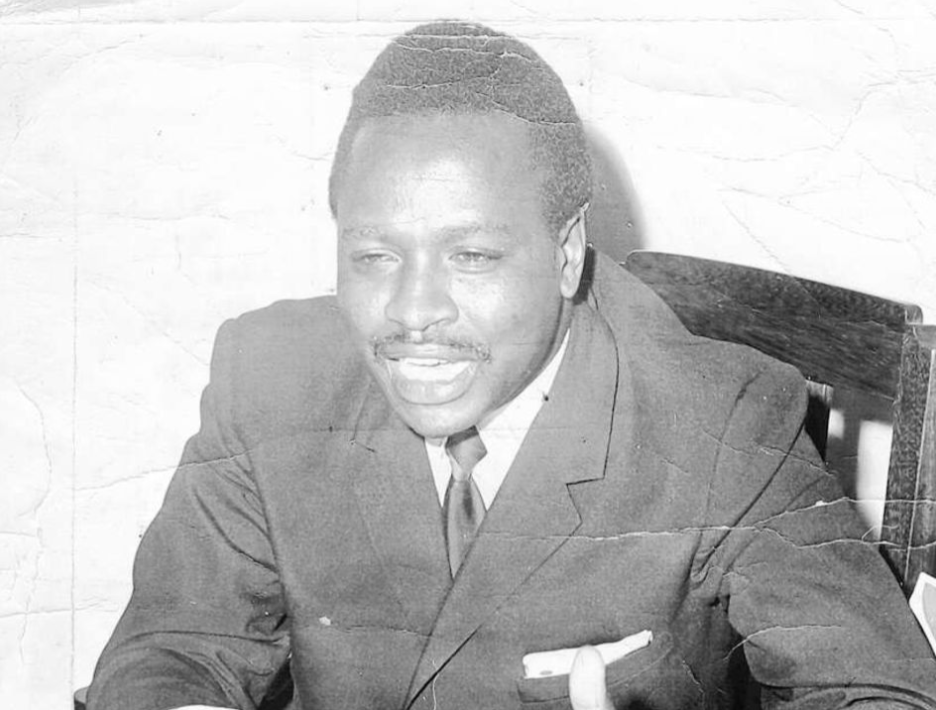
| “A small but powerful group of greedy, self-seeking elite in the form of politicians, civil servants and businessmen has steadily but surely monopolised the fruits of independence to the exclusion of the majority of the people.”— J.M. Kariuki, quoted in Ochieng’ (1995), shortly before his assassination |
2. The Men Behind the Revolt
The coup was led not by senior officers plotting in panelled offices, but by young, educated non-commissioned officers of the Kenya Air Force — men aged between twenty-five and thirty-five, many of whom had technical college or university educations. This set them apart sharply from the Army rank and file, recruited largely from rural villages. It also gave the airmen a distinctly more politicised worldview. Their profile connects directly to the structural tensions described above: a generation educated for advancement but shut out of it.
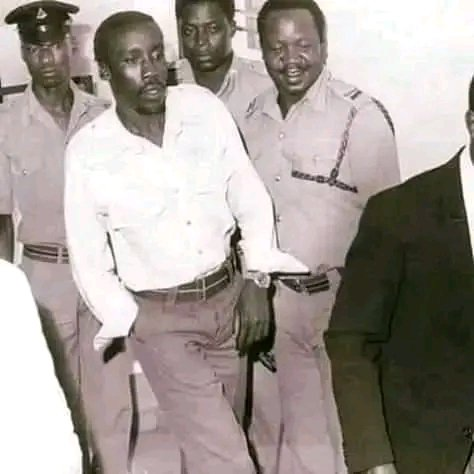
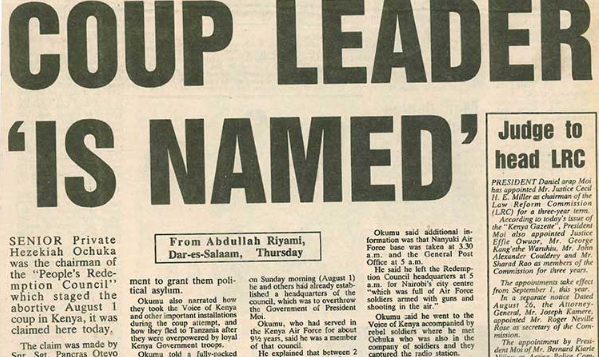
At the courts martial that followed, the grievances cited by coup leaders painted a recognisable picture: low salaries, inadequate housing, and the neglect of ordinary servicemen by an officer class more concerned with political patronage than military welfare. But the rebels also spoke of the detentions, the one-party state, and the suffocating political climate. Hezekiah Ochuka, the Senior Private who became the public face of the People’s Redemption Council, embodied this generation — technically trained, politically aware, and furious at a system that rewarded loyalty over merit. He was later executed alongside eleven others — see The Aftermath.
Most of the coup’s leadership were Luo — a fact that some commentators used to dismiss the whole affair as mere ethnic politics. This misses the deeper picture. The revolt drew support from far beyond any single ethnicity. Thousands of the urban poor poured onto the streets that morning, cheering the rebel broadcasts — people from every community in Nairobi, venting fury accumulated over years of being squeezed, ignored, and repressed. The ethnic dimension was real, but it was a vessel for class grievances that ran much deeper — grievances rooted in the very civilian control strategies that Kenyatta and Moi had pursued.
KEY FACTS AT A GLANCE
| August 1, 1982 — Key Facts | |
| Date | 1 August 1982, approx. 2:00 a.m. |
| Led by | Kenya Air Force NCOs, predominantly Luo and Kikuyu officers |
| Council | “People’s Redemption Council” |
| Seized | Voice of Kenya, Central Bank, Wilson & Embakasi airports |
| Crushed by | GSU and Army loyalists by afternoon |
| Casualties | Official: 129. Estimated: 1,500–2,000 |
| Executed | 12 coup leaders sentenced to death |
| Aftermath | KAF disbanded and reconstituted; Moi consolidated power |
3. August 1st: Hour by Hour
The coup attempt unfolded with brutal speed in its opening hours, then descended into chaos. The timeline below traces events from the first shots to the fall of the rebel council. For context on why the counter-attack was delayed, see Unanswered Questions.
~2:00 a.m. KAF units mutiny simultaneously at Nanyuki, Embakasi, and Eastleigh air bases. The coup begins.
~5:00 a.m. Rebels seize Voice of Kenya radio station, Central Bank of Kenya, and both Nairobi airports. Reggae music plays between broadcasts calling for an end to one-party rule and the release of political detainees.
Early morning University of Nairobi students are woken and called to join. Student leaders broadcast support for the “August 1st Revolution.” A bus of medical students drives into the city centre shouting support for the rebels.
Morning The “revolution” becomes chaotic. Crowds emerge from Mathare Valley and other shanty towns to loot shops, particularly Asian-owned premises. Some rebels fire on looters; others join in.
~9:30 a.m. Counter-attack on Voice of Kenya begins, led by General Mohammed, a Somali loyalist — not by the Nairobi GSU commander, whose unexplained seven-hour delay became one of the coup’s lasting mysteries.
Afternoon GSU and Army loyalists crush the rebellion. All occupants of the VOK radio station are killed in the counter-attack. Moi remains in power.
Days following Fighting continues around Nanyuki and the city outskirts. Mortuaries fill beyond capacity. The true death toll — estimated at 1,500–2,000 — is suppressed. The official figure stands at 129.
4. The Architecture of Failure: Civilian Control and Its Contradictions
Why was the Kenyan military susceptible to a coup attempt at all? The answer lies in the very strategies that successive presidents had employed to prevent one. Both Kenyatta and Moi had pursued coup-prevention through three interlocking methods: buying the loyalty of senior military officers with material rewards and illicit business opportunities; manipulating the ethnic composition of the armed forces to ensure the president’s community controlled key positions; and maintaining a powerful paramilitary counterweight — the General Service Unit (GSU) — that could neutralise any mutinous army. These three strategies are examined in detail by political scientist Boubacar N’Diaye in his landmark study (see Sources).
Kenyatta had “Kikuyuised” the GSU with remarkable speed after independence, purging Luo officers and installing Kikuyu loyalists until, by 1967, the unit was almost exclusively under Kikuyu command. When Moi came to power in 1978, he began reversing this — gradually “Kalenjinising” the military’s upper ranks, forcing out officers from other communities under the guise of age-limit rules. By the mid-1990s, observers were describing the Kenyan army as “Kalenjin at the bottom, Kalenjin at the middle, and Kalenjin at the top.”
The perverse consequence was that these strategies had made the military anything but professional. When promotion and reward were distributed along ethnic and political lines rather than merit, the core ethos of a fighting force — objectivity, loyalty to institution over person — had been systematically hollowed out. The 1982 coup, led overwhelmingly by Luo and Kikuyu junior officers who had watched Kalenjin rivals elevated over them, was in many ways the direct product of this system eating itself. This dynamic connects directly to the men who led the revolt and their documented grievances.
| “The 1982 coup attempt vividly illustrated the weak foundations on which Kenya’s civilian control strategies were built. Its fate hinged on the army’s desires.”— Adapted from Frazer (1994), cited in N’Diaye, Armed Forces & Society (2002) |
5. Unanswered Questions: The Delay and the Shadow of Njonjo
The coup was crushed, but not without leaving behind a trail of troubling anomalies. The mutiny began at approximately 2:00 a.m. The counter-attack did not begin until around 9:30 a.m. — a delay of more than seven hours. Why did the Nairobi commander of the GSU not order an immediate response? Why was the counter-attack eventually led not by that commander, but by General Mohammed, a Somali loyalist operating outside the normal chain of command? The hour-by-hour timeline makes this delay all the more striking.
Further muddying the waters was the curious figure of Lieutenant Leslie Mwambura, whose role suggests that elements within Military Intelligence — itself part of the sphere of influence of the powerful Charles Njonjo — may have been fully aware of the conspiracy in advance. Mwambura had informed his superiors of the planned coup as early as July 31st. They showed no interest. On the morning of the coup he took an active leading role in the mutiny — ordering Luo airmen to arm themselves, arranging transport, directing the loading of F-5 jets with bombs — yet was never prosecuted. The soldiers who followed his orders were executed.
Njonjo himself, the formidable Minister for Constitutional Affairs and architect of the one-party state legislation, had long harboured ambitions to replace Moi. A subsequent judicial inquiry revealed that he had attempted to buy the loyalty of 125 Members of Parliament and had assembled a shadow cabinet. Whether he actively encouraged the coup to create a pretext for seizing power in the ensuing chaos remains one of the unresolved mysteries of Kenyan political history. His eventual downfall in 1984 — itself a product of Moi’s consolidation — is addressed in the aftermath section.
6. The Aftermath: Repression, Reckoning, and a Changed Kenya
The official response was swift and comprehensive in its brutality. Moi disbanded the entire Kenya Air Force and reconstituted it under a loyalist. Twelve coup leaders were sentenced to death and executed. Over 800 were prosecuted for mutiny. The mortuaries at Kenyatta National Hospital and the City Mortuary filled beyond capacity — bodies remained on Nairobi’s streets for days. The government’s official death toll of 129 was, by most accounts, a gross underestimate of a true figure that many witnesses placed between fifteen hundred and two thousand.
The sweep that followed ensnared some of Kenya’s most outspoken voices. Nakuru North MP Koigi wa Wamwere — already detained once by Kenyatta — was arrested again on August 6th, along with University of Nairobi law lecturer Willy Mutunga. Their detention orders, published in the Kenya Gazette, exemplified how the coup’s aftermath served as cover for eliminating dissent that had nothing to do with the mutiny itself. The underlying repression the coup exposed had been building since the consolidation of one-party rule.
Charles Njonjo, whose network had been so deeply implicated in the ambiguities surrounding the coup (see Unanswered Questions), was eventually brought down through a judicial inquiry in 1984 — a piece of house-cleaning that served Moi’s consolidation of power as much as any pursuit of justice.
Yet the coup attempt left marks that could not be erased by force alone. Urban violence in the years that followed — the Muoroto evictions of 1990, the Robert Ouko assassination protests, the Saba Saba riots of July 1990 — can all be read as continuing expressions of the same rage that exploded on 1 August 1982. Each time, the state responded with force. Each time, the underlying grievances described in the opening section remained.
It was not until December 1991, under sustained internal and international pressure, that Moi finally conceded political pluralism, repealing the one-party state legislation. The first multiparty elections since independence were held in 1992. By then, nearly a decade had passed since the morning when reggae music played on the Voice of Kenya and a young sergeant named Ochuka had briefly held the microphone of history.
7. What 1982 Tells Us
The coup attempt of 1 August 1982 was not a bolt from the blue. It was the culmination of two decades of post-independence authoritarianism, ethnic manipulation of the military (see Architecture of Failure), economic exclusion of the urban poor (see A Republic Under Strain), and the systematic criminalisation of political dissent. That it failed owed less to the strength of Moi’s governance than to the disorganisation of the rebels, the belated and deeply suspicious intervention of loyalist forces (see Unanswered Questions), and a degree of luck.
Its failure did not restore confidence in the system. It deepened the fractures within Kenya’s civil-military relations, confirmed the ruling party’s willingness to kill its own citizens to stay in power, and delayed by nearly a decade the political opening that many Kenyans had already concluded was unavoidable. The students gunned down at the radio station, the thousands who died in the streets whose deaths were never officially acknowledged, the coup leaders hanged — they are part of a history Kenya is still, in many ways, working through.
What the Pambana of August 1 ultimately demonstrated was not the fragility of Kenya’s coup-plotters, but the fragility of a political order built on patronage, ethnic manipulation, and fear rather than genuine legitimacy. That lesson — that repression can survive a crisis without resolving it — remains as relevant today as it was at dawn on that August morning in 1982.
SOURCES & FURTHER READING
Currie, Kate and Larry Ray. “The Pambana of August 1 — Kenya’s Abortive Coup.” The Political Quarterly, Vol. 57, No. 1 (1986), pp. 47–59.
N’Diaye, Boubacar. “How Not to Institutionalize Civilian Control: Kenya’s Coup Prevention Strategies, 1964–1997.” Armed Forces & Society, Vol. 28, No. 4 (Summer 2002), pp. 619–640.
Murunga, Godwin Rapando. “Urban Violence in Kenya’s Transition to Pluralist Politics, 1982–1992.” Africa Development, Vol. XXIV, Nos. 1 & 2 (1999), pp. 165–198.
Ochieng’, W.R. “Structural and Political Changes.” In Ogot B.A. and Ochieng’ W.R. (eds.), Decolonization and Independence in Kenya, 1940–1993. Nairobi: East African Educational Publishers, 1995.
Read more Kenyan history at kenyanhistory.com
See More Images of the 1982 Coup?