
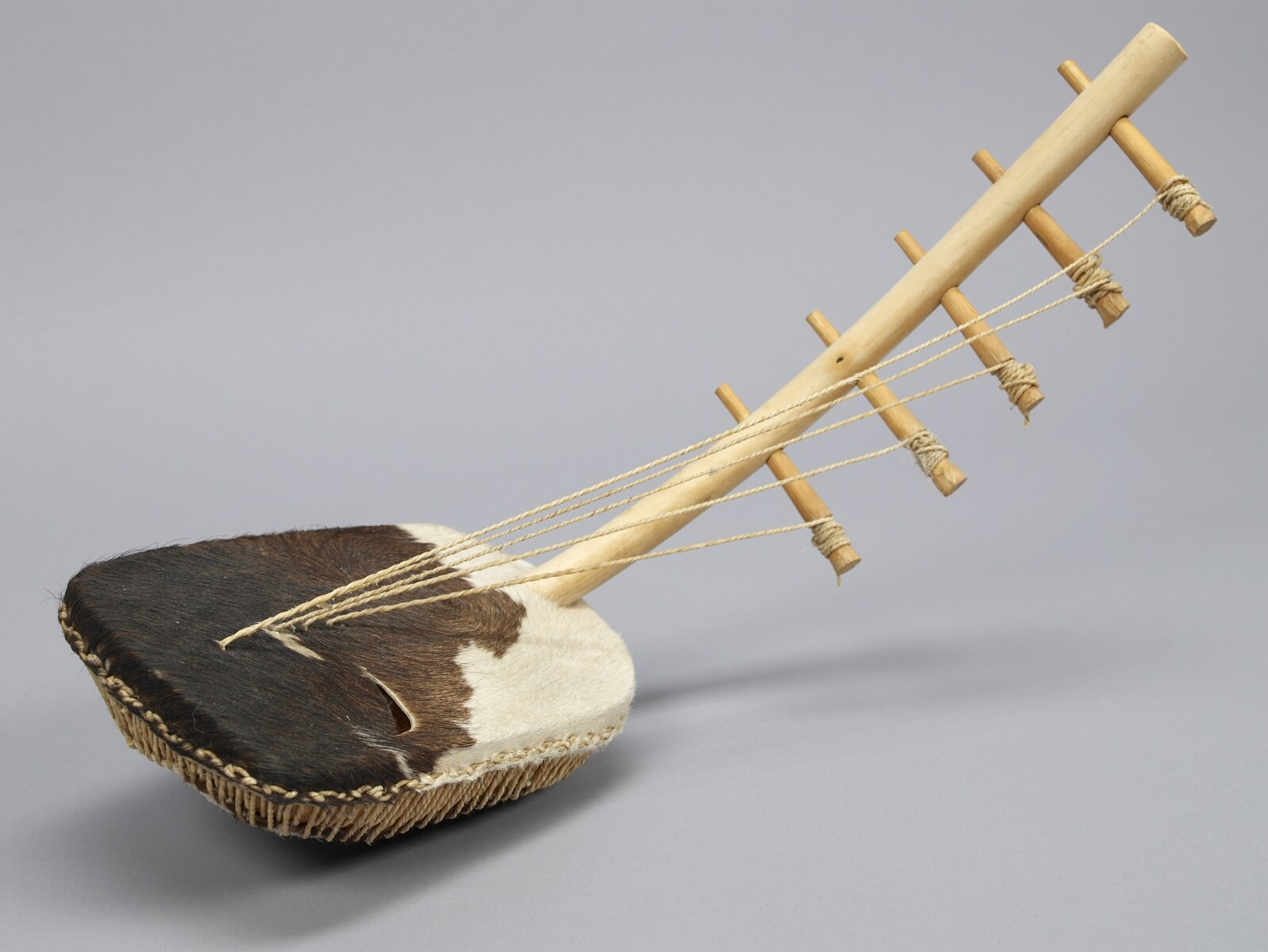
Along the shores of Lake Victoria in western Kenya, in the low-lying plains and hillsides of Busia County, there is a community of Plains Nilotes who have been growing cotton, sorghum, and finger millet for generations. They call themselves the Iteso — the people of Teso — and they are related, distantly but linguistically, to the Maasai, the Turkana, and the Karimojong of Uganda. Among all the things that mark the Iteso as a distinct community, one stands out in Kenyan music: their instrument.
The adeudeu is an arched harp — technically classified by musicologists as a chordophone, specifically a bow harp — and it is the principal musical instrument of the Iteso people. It produces a warm, resonant, low-register sound that carries well across the open landscapes of Busia. It accompanies songs, drives dances, marks ceremonies, and — in its evolved modern form — has been expanded into a full ensemble capable of playing the roles of bass, rhythm, and lead in a contemporary band. It is one of the most interesting instruments in Kenya, and one of the least known outside western Kenya.
What Is the Adeudeu? Classification and Character
The adeudeu belongs to the family of arched harps — instruments in which the strings are attached to a curved neck that arcs away from a resonating body. Unlike a flat-frame harp (like the orchestral harp), an arched harp has a bow-shaped neck rather than a rigid triangular frame, giving it a distinctive curved silhouette. Arched harps are among the oldest string instrument designs in human history, with examples known from ancient Egypt and Mesopotamia; their presence across sub-Saharan Africa represents an independent tradition of instrument design that evolved from the same basic acoustic insight: a curved stick under tension, with strings attached, produces pitched sound.
In Kenya’s broader musical landscape, the adeudeu sits alongside other notable string instruments: the litungu lyre of the Luhya and Kuria, the obokano lyre of the Kisii, and the orutu fiddle of the Luo. Each is the signature instrument of its community. The adeudeu is the Iteso’s.
The Parts of the Adeudeu
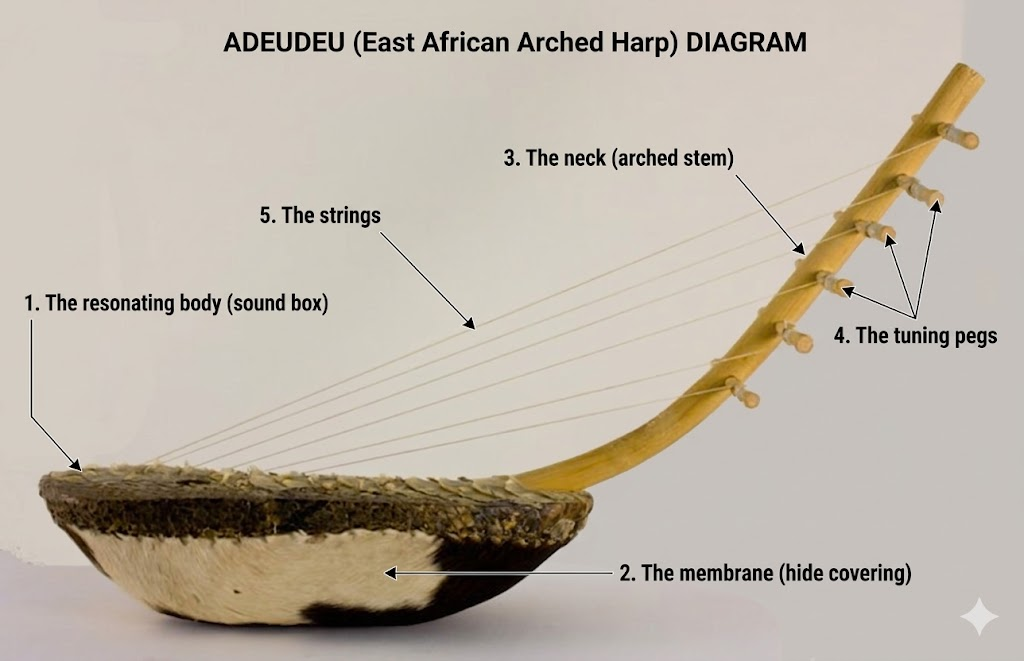
Understanding the adeudeu’s construction is essential for understanding both how it sounds and what makes each instrument slightly different from the next. Here are its main parts:
1. The resonating body (sound box)
The adeudeu’s base is an oblong wooden bowl — hollowed out from a single piece of wood, roughly the shape of a elongated dish. This is the instrument’s sound box, and its size determines the instrument’s overall pitch register: a larger body produces a lower, fuller sound, while a smaller body produces a higher, brighter tone. The traditional bowl is carved from local hardwood.
2. The membrane (hide covering)
The open face of the wooden bowl is covered with animal hide — typically goat or cattle skin, dried and stretched tightly over the bowl and secured at the edges. This membrane is the instrument’s primary resonating surface: when the strings vibrate, the membrane amplifies the sound and gives the adeudeu its characteristic warm, slightly muffled quality. At the centre of the membrane there is a sound hole — a circular opening that allows sound to escape from inside the bowl, enhancing acoustic projection.
3. The neck (arched stem)
Emerging from within the membrane and extending outward and upward in a curve is the neck — a sturdy wooden stem that gives the instrument its characteristic arched shape. The neck is anchored through the membrane into the wooden bowl, and its curve is what distinguishes the adeudeu from flat-framed instruments. The neck’s angle and length determine the string tension and therefore the tuning range of the instrument.
4. The tuning pegs
Tuning pegs are fixed along the neck at approximately 5-centimetre intervals. Each peg anchors one string and can be rotated to increase or decrease string tension, raising or lowering the pitch. Traditional pegs were carved from hardwood; modern instruments sometimes use metal hardware. The number of pegs equals the number of strings.
5. The strings
The traditional adeudeu has five strings, running from the tuning pegs on the neck down to the membrane at the base of the body. Traditionally these strings were made from twisted plant fibre or animal sinew; contemporary instruments typically use nylon or metal wire. Each string produces a different pitch depending on its length, tension, and thickness — the combined five strings cover a range sufficient to play both melody and accompaniment within a single instrument.
In modern ensembles the string count has increased: contemporary adeudeu variants have six, seven, eight, or nine strings, expanding the instrument’s harmonic range. The larger bass adeudeu, which can have six strings and a body large enough to seat two players, is strung to cover the low register of a bass guitar.
How the Adeudeu Is Played
In traditional performance, the adeudeu is played by one or two musicians simultaneously. The primary player holds the instrument against the body and plucks the strings with the fingers of one hand, producing the melodic and harmonic content. A second player, sitting behind the first, may strike the membrane or the body of the instrument with a padded hammer — a cloth-wrapped mallet that provides rhythmic percussion while the melody player focuses on the strings. This dual-player technique is distinctive to the adeudeu and produces a layered sound that one player alone cannot achieve.
The instrument plays in the low registers — it accompanies songs rather than carrying the melody above the voice. Singers perform over the adeudeu’s steady harmonic and rhythmic foundation, and the instrument’s warm low tones support the voice without overwhelming it. In ceremonies and gatherings, the adeudeu creates the musical ground from which dancing, singing, and communal participation emerge.
The Ensemble: From Traditional to Teso Jazz
The most significant development in adeudeu performance over the past half-century has been the creation of the multi-adeudeu ensemble — groups that use three or more instruments of different sizes to cover the full range of a modern band.
Research by Masasabi and Kususienya (2022) documents how Teso musicians in western Kenya, exposed to recorded popular music from the 1970s onward, recognised that the adeudeu’s range of sizes and tunings could be mapped onto the roles within a modern band. A small, high-pitched adeudeu with five strings takes the solo/lead role. A medium-sized instrument takes the rhythm role. A large, low-pitched instrument with six strings — played by two musicians — takes the bass role. Together, the three produce a sound that is simultaneously recognisably traditional and capable of playing contemporary popular music.
The South Teso Jazz group, based in Obekai village of Busia County, is among the best-known practitioners of this ensemble approach. They combine adeudeus of three sizes with a home-constructed drum set made from tin cans of different sizes (the akicheketini), a metal ring, and gourd shakers (edongotanditwol). The result is a full-band sound rooted entirely in materials and traditions from western Kenya, capable of performing both ceremonial music and contemporary compositions.
The Iteso Lukelegaka Lukasonya group, founded in 1940 and originally created to welcome people to a chief’s baraza, represents the more traditional end of the spectrum — elder musicians performing in the ceremonial contexts for which the adeudeu was originally designed. The coexistence of these two approaches within the same community reflects a broader truth about Kenyan traditional music: it is not a museum exhibit but a living practice that adapts without abandoning its foundations.
The Iteso of Kenya: Who Made This Instrument
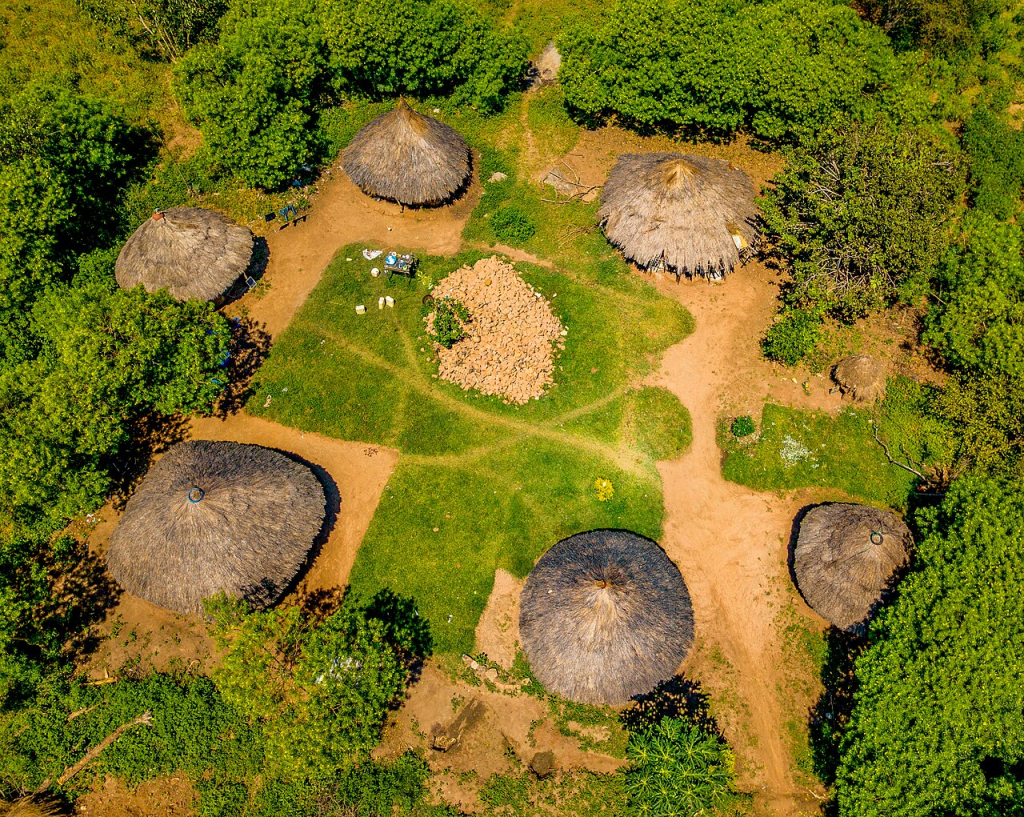
The adeudeu belongs to the Iteso — also written as Ateso or Teso — a Plains Nilotic people who number roughly 670,000 in Kenya, concentrated in Busia County in western Kenya south of Mount Elgon. They are closely related linguistically to the Turkana, the Karimojong of Uganda, and — more distantly — the Maasai and Samburu. The Iteso are unusual among the Plains Nilotic groups of East Africa in that they are farmers rather than herders: unlike the Maasai, Turkana, and Karimojong, who remained predominantly pastoral, the Iteso transitioned to agriculture over several centuries of contact with Bantu farming communities, and are today among the most productive farmers in the Kenya-Uganda border region.
Their territory was split by the colonial boundary of 1902, when part of eastern Uganda was transferred to the East Africa Protectorate (later Kenya). This division separated the Kenyan Iteso from their Ugandan counterparts — a separation that persists today, with approximately 2.3 million Iteso in Uganda and 670,000 in Kenya, sharing a language and culture across an international border that the colonial administration drew without their consent.
The adeudeu is shared across both sides of this border, present in Uganda as well as Kenya, and is classified in the Hornbostel-Sachs system of instrument classification under the same category as the harps of ancient Egypt — not because of any historical connection, but because the acoustic logic of an arched neck over a resonating body produces similar solutions independently across cultures separated by thousands of years and thousands of kilometres.
The Adeudeu in Kenyan Music Education
The adeudeu appears in Kenya’s secondary school music curriculum as one of the traditional instruments students are expected to know — which explains the pattern of GSC search queries arriving at this page. Students preparing for the Kenya Certificate of Secondary Education (KCSE) music examinations need to know the instrument’s classification, its parts, how it is played, and the community it belongs to. This article is designed to answer those questions directly.
Summary for revision:
- Classification: Chordophone — specifically an arched harp (bow harp)
- Community: Iteso (Teso) people of Busia County, western Kenya
- Traditional strings: Five (modern variants have more)
- Main parts: Wooden sound box, hide membrane with sound hole, curved neck, tuning pegs, strings
- Playing method: Strings plucked by the primary player; membrane struck by a second player with a padded hammer
- Register: Low — accompanies vocals, does not carry melody above the voice
- Modern development: Three-instrument ensemble (bass, rhythm, solo) modelled on the roles of a contemporary band
- Related instruments: Litungu (Luhya/Kuria), obokano (Kisii), orutu (Luo)
Further Reading on This Site
- Kenya Instruments — an overview of traditional musical instruments across Kenya’s communities
- A Historical Overview of Kenya’s Music — the broader story of Kenyan musical traditions
- The Turkana People of Kenya — the linguistically related Nilotic community to the northeast
- The Bantu of Kavirondo — the western Kenya communities among whom the Iteso live
- The Abagusii (Kisii) People — makers of the obokano, a related instrument
- The Tribes of Kenya — Kenya’s 44 officially recognised communities