
Key Milestones at a Glance
| Era | Key Developments | Dominant Owners |
|---|---|---|
| 1895–1920 | Missionary and settler newspapers established; press serves European community | Missionaries, Colonial settlers |
| 1920–1952 | African-run newspapers emerge; vernacular press flourishes as nationalist tool | African political associations, Asian entrepreneurs |
| 1952–1963 | Mau Mau Emergency; near-total suppression of African press | Colonial state (control), Asian/European capital |
| 1963–1992 | Independence; foreign-owned press dominates; state controls electronic media | Lonrho (UK), Aga Khan (Switzerland/Paris), Kenyan government |
| 1992–2010 | Liberalisation; media proliferation; constitutional reform | Mixed: corporate, political, community |
| 2010–Present | Digital revolution; social media; new challenges | Tech platforms, diversified media houses |
Introduction: The Power to Print
The history of media in Kenya is not merely a chronicle of technological progress—of hand-operated presses giving way to high-speed rotaries, of crackling radio signals yielding to streaming video. It is, more fundamentally, a history of power: who has possessed the power to print, to broadcast, and to shape public consciousness; who has been silenced; and how the struggle for the right to speak has mirrored the larger struggle for the nation itself.
As Dr. Polycarp J. Omolo Ochilo observes, the modern media in Africa “were a creation of European missionaries, immigrants and the colonial administrations as the chief actors.”¹ They were used primarily “as a device to maintain the status quo”—to legitimise colonial rule and to serve the informational needs of the European community.²
But from the very beginning, the media was also a site of resistance. As soon as Africans acquired the means to print, they used it to articulate demands for freedom, justice, and equality. The story of Kenya’s media is therefore the story of a double movement: the constant assertion of control by those in power, and the persistent struggle by the powerless to find a voice.
This article traces that story from the first missionary pamphlets of the 1890s to the digital newsrooms of today, examining how political conditions, economic forces, and technological change have shaped—and been shaped by—the men and women who have sought to inform, educate, and mobilise the Kenyan public.
Part One: The Colonial Dawn – The Press as Settler Instrument (1895–1920)
1.1. The First Newspapers
The printing press arrived in Kenya with the European missionaries and settlers who established themselves along the coast in the late nineteenth century. As Elizabeth Okeniyi documents in her masterful study of foreign influence on Kenyan newspapers, the first publication of note was the Taveta Chronicle, launched by the Church Missionary Society in 1895.³
This was followed in 1899 by the Leader of the British East Africa Company and the Uganda Mail, both published in Mombasa.⁴ These early newspapers were not intended for African readers. They targeted two specific audiences: the white elites living in Kenya and England, and the small but significant community of South Asian ancestry who had been brought to the region to build the Uganda Railway.⁵
As Dr. Geoffrey Korir and Dr. Justin Nabushawa note, these publications served three primary functions:
- Maintaining the status quo by legitimising the rights of the colonial masters to rule Kenya.
- Providing news and information from England, which remained “home” for most settlers.
- Creating a platform for social communication among Europeans scattered across the colony.⁶
1.2. The First Asian-Owned Press

The completion of the Uganda Railway in 1901 opened the interior to large-scale European settlement and brought a wave of Indian traders and labourers. Among them was A.M. Jeevanjee, a successful contractor who had made his fortune supplying the railway.
In 1902, Jeevanjee launched the African Standard in Mombasa—the first newspaper in Kenya owned by a person of colour. He brought W.H. Tiller from England to run the paper, which was later incorporated with the Mombasa Times and Uganda Argus.⁷ The paper was eventually purchased by Mayer and Anderson, and in 1910, when the colonial government moved its headquarters from Mombasa to Nairobi, the African Standard followed. It was soon renamed the East African Standard, a title it would carry for decades.⁸
As Okeniyi explains, the Asian press of this era had a delicate position: “Their main reason was to use the media to legitimize their second place to the whites in Kenya.”⁹ They could not afford to antagonise the European rulers on whom their presence depended.
3.3. The Legal Framework of Control
From the beginning, the colonial state established legal mechanisms to control what could be printed. The Book and Newspaper Ordinance of 1906 required all newspaper owners to register annually, providing the title, the names and addresses of owners, and average circulation figures.¹⁰
More significantly, the ordinance required all publishers and printers to post a bond of £500 against libel or seditious activity—a sum far beyond the reach of most Africans.¹¹ This effectively limited newspaper ownership to the wealthy, and ensured that the press remained in European or, occasionally, Asian hands.
The Penal Code provided additional tools for control, defining seditious material as anything that would “promote feelings of ill-will and hostility between different classes of the population of the colony.”¹² These provisions would later be used to devastating effect against the African press.
For deeper context: The legal framework of colonial control over the press paralleled the structures of land alienation and political exclusion explored in A History of Land Ownership in Kenya and Kenya’s Colonial Administration 1920-1963.
Part Two: The Rise of the African Press – Nationalism and the Vernacular Newspapers (1920–1952)
2.1. The First African Voices
The 1920s marked a turning point. A small but growing number of Africans had acquired Western education through mission schools, and they began to articulate grievances against colonial rule. As Korir and Nabushawa observe, these “African nationalists” saw the establishment of their own media as the first step toward independence.¹³
The most famous of these early publications was Muigwithania (“The Reconciler”), launched in 1928 by the Kikuyu Central Association. Its editor was a young man who would later become Kenya’s first president: Jomo Kenyatta.¹⁴
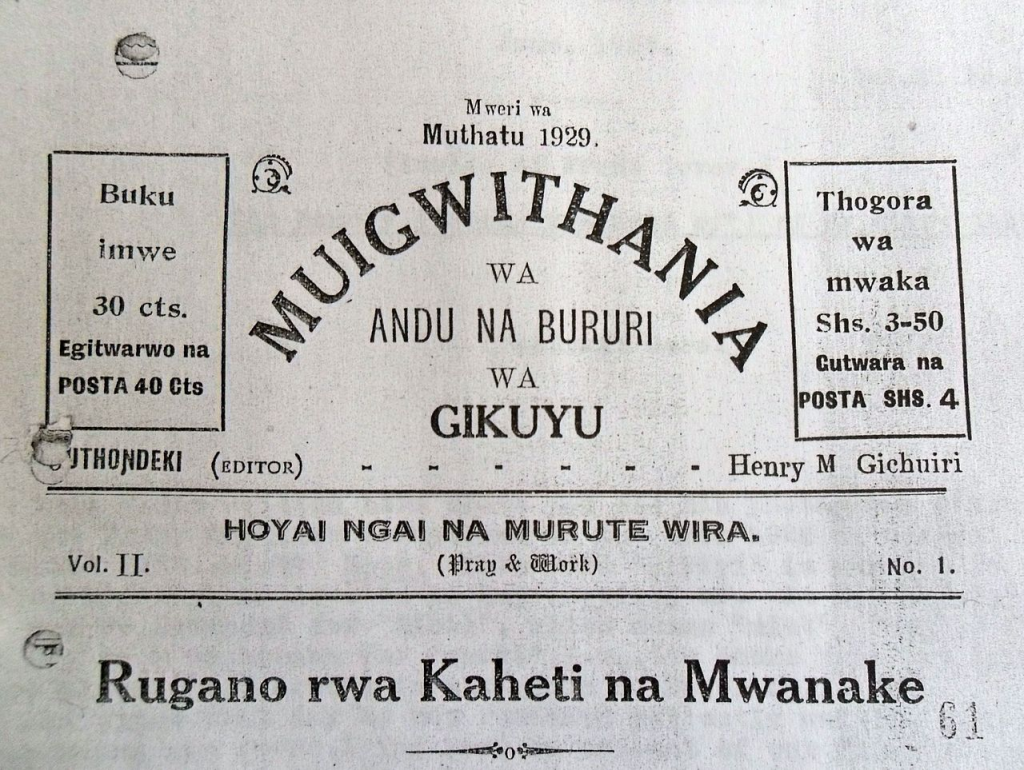
As Okeniyi notes, Muigwithania was a monthly with mixed content—advice, proverbs, and news items. It aimed “to promote African self-awareness” and to articulate the grievances of the Kikuyu people.¹⁵ It was published until the outbreak of World War II.
Other vernacular newspapers followed. Tangazo appeared in 1921. A Luo-language magazine emerged in 1937. Sauti ya Mwafrika (“The Voice of the African”) was launched in 1945.¹⁶ It has been estimated that at least fifty vernacular newspapers existed before independence, serving communities across the country.¹⁷

2.2. The Asian Connection
These African publications often depended on Asian support. Asian entrepreneurs provided printing facilities, and in some cases, Asian-owned newspapers directly supported the African cause.
The more radical Asian publications—such as the Colonial Times, the Daily Chronicle, and the Tribune—openly sympathised with African nationalism.¹⁸ As Okeniyi explains, this sympathy arose naturally: “the struggle for independence in India had been fought against the same enemy.”¹⁹
The Colonial Times was particularly outspoken. Its editor, G.L. Vidyardhi, was sentenced to four months at hard labour for comparing colonial conditions in Kenya to those in Nazi concentration camps.²⁰ The Chronicle was suppressed entirely, and its editor, Pio Gama Pinto, was detained alongside African political prisoners during the Mau Mau Emergency.²¹
2.3. The Settler Press Responds
As the African press grew, the settler press became increasingly hostile. The East African Standard consistently voiced settler demands and, in its treatment of Africans, was described as “smug to the point of arrogance.”²²
More extreme publications like the Kenya Comment displayed open bigotry. In 1958, when an African clergyman declared the inevitability of independence, the paper accused him of “bent on pushing a cause which will end us up in the arms of Russia.”²³
The Leader, commenting on Harry Thuku’s early protests in 1921, dismissed African political aspirations with characteristic condescension:
“Perhaps there is no need to take the native association too seriously; for after all the native tribesmen have not yet arrived at the plane of education and higher thought properly to understand the science of political economy.”²⁴
2.4. The Government’s Response
The colonial government viewed the growing African press with alarm. A meeting of Provincial Commissioners expressed the official view:
“As regards freedom of the press, liberty was being mistaken for license… The effect of an unbridled press amongst uneducated and politically immature Africans was infinitely more serious than that which could be achieved by inflammatory articles in newspapers in England.”²⁵
In 1940, the government launched its own African newspaper, Baraza, to counter nationalist influence. Published by the East African Standard Company on behalf of the government, Baraza was designed to convince Africans to support the Allied war effort.²⁶ It consistently printed the government view, opposing trade unions and nationalist leaders even when they clearly represented African interests.²⁷
Part Three: The Emergency – Silence and Suppression (1952–1963)
3.1. The Mau Mau Crackdown
The declaration of a state of emergency in October 1952 marked the beginning of the darkest period in Kenya’s media history. The colonial government invoked the Temporary Provisions Ordinance, giving the Registrar of Printing Presses power to cancel newspaper licences at will.²⁸
The result was devastating. Nearly all African newspapers were suspended, regardless of their political stance. Past issues were banned, and possession of banned newspapers became a criminal offence. One man, Nganga Kamau, received a six-year prison sentence simply for possessing a banned vernacular newspaper.²⁹
As Korir and Nabushawa note, “the colonial government is understood to have banned all the African publications and further introduced new legislation to strictly control the sector.”³⁰
3.2. The Kenya Vernacular Press Company
To fill the void, the government established the Kenya Vernacular Press Company, intended to publish pro-government newspapers at the district level. White editors were hired to “encourage Africans to express their views,” but in practice, they censored anything unfavourable to the government.³¹
The project was abandoned in 1957, when the worst of the emergency had passed. But its failure underscored a fundamental truth: a press imposed by the state could never command the trust or loyalty of African readers.
3.3. The Nation Group Arrives
In 1959, as the emergency situation cooled, a new player entered the Kenyan media landscape. The Aga Khan, spiritual leader of the Ismaili Muslim community, established East African Newspapers Limited—better known as the Nation Group.³²
The Nation Group launched four publications:

- Daily Nation (English daily)
- Sunday Nation (English weekly)
- Taifa Kenya (Swahili weekly)
- Taifa Leo (Swahili daily)³³
The Nation newspapers were different from anything Kenya had seen. They were attractively designed tabloids with many photographs, contrasting sharply with the grey broadsheet of the Standard. More importantly, they adopted a sympathetic attitude toward the African nationalist cause.³⁴
As Okeniyi observes, the Nation Group’s success was due in part to its modern production methods—”the most modern in Africa” at the time—and its commitment to covering all racial communities fairly.³⁵ Taifa Leo, in particular, captured the African vernacular market with a level of sophistication never before seen.
Part Four: Independence and the Foreign-Owned Press (1963–1992)
4.1. The Post-Independence Landscape
When Kenya achieved independence in December 1963, the press landscape bore little resemblance to the nationalist dream. The African vernacular press had been destroyed during the emergency. No Africans had the capital to compete with established foreign publications. And a new foreign-owned group—the Nation—had already captured the African reading public.³⁶
As Okeniyi puts it, “the independent African government entered the shoes of the colonial rulers.”³⁷ The new government faced a dilemma: if it did not nationalise the foreign-owned newspapers, Kenya would face continued foreign domination of its press. But if it did nationalise them, it would contradict its commitment to a free enterprise economy and risk international condemnation.
4.2. The Two Giants: Standard and Nation
The post-independence press was dominated by two major groups.
The Standard Group, owned by the London-based multinational Lonrho, published the East African Standard (English daily), Baraza (Swahili weekly), and a popular Friday edition. The Standard had historically supported settler interests, but after independence it adopted a policy of “responsible support for the government,” regularly running government press releases.³⁸
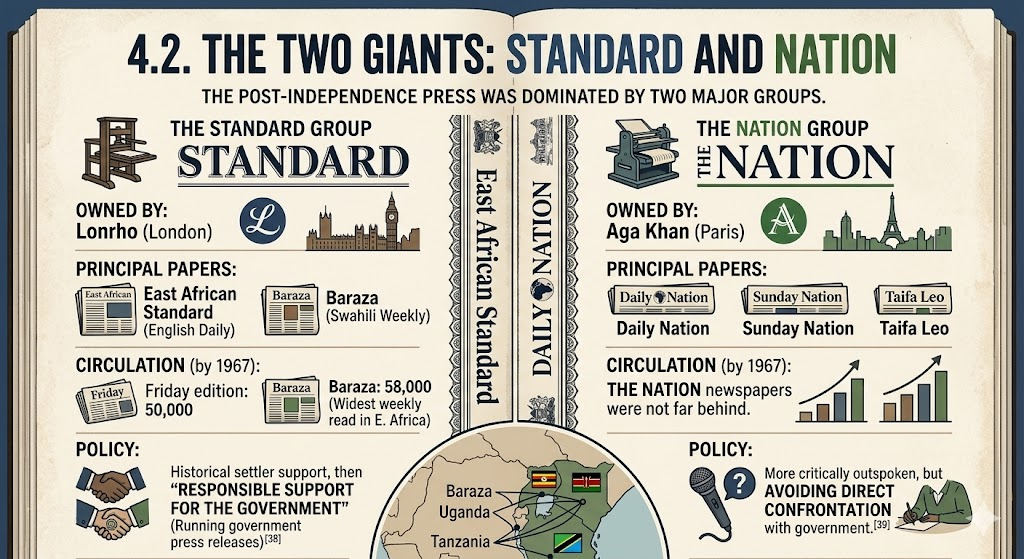
The Nation Group, owned by the Aga Khan and based in Paris, published the Daily Nation, Sunday Nation, and Taifa Leo. The Nation was more critically outspoken than the Standard, but it was careful to avoid direct confrontation with the government.³⁹
By 1967, the Standard‘s Friday edition had a circulation of 50,000—the highest of any Kenyan newspaper. Baraza was the most widely read weekly in East Africa, with 58,000 readers across Kenya, Uganda, and Tanzania.⁴⁰ The Nation newspapers were not far behind.
4.3. The Government’s Media Apparatus
While allowing foreign-owned newspapers to continue, the government built its own media infrastructure. The Ministry of Information and Broadcasting was divided into two departments:
- The Voice of Kenya (later KBC), controlling radio and television.
- The Information Department, including the government press services and the new Kenya News Agency (KNA) .⁴¹
The KNA was established with communist assistance—Czech journalist Zdenek Kubes served as its first editorial advisor, and Russia provided teleprinters and technical support.⁴² The agency became the sole national news distributor, controlling both domestic and foreign news flow. Newspapers depended on KNA for much of their content, giving the government significant indirect influence.
4.4. The First Indigenous Voice: Hilary Ng’weno
It was not until 1970 that Kenya saw its first significant African-owned publication. Hilary Ng’weno, a former editor at the Nation Group, launched the Weekly Review, a news magazine that some considered “quite the best news magazine produced anywhere in Black Africa.”⁴³
In 1977, Ng’weno followed with the Nairobi Times, a Sunday broadsheet modelled on London’s Sunday Times. At its launch, the Minister for Information and Broadcasting declared:
“With the establishment of the weekly I earnestly hope that Kenyans in particular can at least look forward to a press that portrays their national aspirations in their proper perspectives.”⁴⁴
Yet even these publications depended on the government’s goodwill. Their capital base was weak, their circulation limited largely to urban areas, and their survival required careful navigation of political sensitivities.
4.5. The Limits of Press Freedom
The Kenyan constitution guaranteed “freedom of expression,” but as Ochilo notes, “it does not guarantee freedom of the press. The law merely guarantees freedom of speech to all persons.”⁴⁵ This distinction was crucial: the media enjoyed no constitutional protection beyond that of ordinary citizens.
As the late G.K. Rukwaro observed, “this freedom can be derogated on so many grounds that at the end of the day one is left in doubt as to what freedom one has.”⁴⁶
The government exercised control through multiple mechanisms:
- Informal pressure: Editors would receive telephone calls from government officials indicating displeasure with particular stories.⁴⁷
- Legal threats: The penal code’s provisions on sedition and criminal libel were frequently invoked.
- Direct action: In 1989, the government banned several critical publications, including Beyond magazine, the Financial Review, Development Agenda, and the Nairobi Law Monthly. Between 1988 and 1990, some 20 publications were banned.⁴⁸
- Ownership: Politicians loyal to the ruling party were encouraged to own media outlets, ensuring supportive coverage. The Kenya Times, launched in 1983, served as the official KANU party newspaper.⁴⁹
4.6. The Conflict Over Foreign Ownership
Foreign ownership of Kenya’s major dailies remained a source of tension throughout this period. In November 1976, at a UNESCO seminar on African news media, the Permanent Secretary in the Ministry of Information declared that no newspaper in Kenya “can claim to have Kenya’s interest at heart” because editorials were not written in the country “or in Africa for that matter.”⁵⁰
He voiced the suspicions of many Kenyans: “We should all wonder as to why I would want to start a newspaper in London, Paris or Moscow, unless I had some interests other than informing the people.”⁵¹
Yet African journalists themselves were divided. Hilary Ng’weno argued that foreign ownership was not necessarily the same thing as foreign control. George Githii, who served as editor-in-chief of the Nation Group, initially claimed complete editorial freedom—until he resigned in April 1977, citing “interference from Paris” as the chief reason.⁵²

Githii’s resignation letter stated:
“You will recollect that I maintained, as a matter of principle, that the encroachment by the chief shareholder upon sacred editorial space in order to express sectional and communal interests amounts to direct interference with editorial integrity and press freedom.”⁵³
After his resignation, Githii told the Weekly Review that press freedom did not only involve government pressure: “owners can be just as bad.”⁵⁴
4.7. The Standard and the Succession Debate
The limits of press freedom were starkly illustrated during the “Change the Constitution” movement of 1976. As President Kenyatta aged, a faction within the ruling elite sought to remove the constitutional provision that would automatically make Vice President Daniel arap Moi the successor.
The Standard, whose local chairman Udi Gechaga supported the movement, became its mouthpiece. In October 1976, the paper’s London correspondent filed a story stating that “London is watching with approval” the movement—implying that the Lonrho-backed faction had international support.⁵⁵
The Nation, under George Githii, opposed the movement. A fierce newspaper war ensued, with each side accusing the other of undermining the constitution. Attorney General Charles Njonjo eventually issued a statement warning that anyone “imagining the death or deposition of the president” could face the death sentence. The Standard dismissed this as “The Big Bluff.”⁵⁶
When Kenyatta finally intervened to quash the movement, the Standard abruptly changed course, praising Njonjo and publishing a series of biographical sketches to prove its loyalty to the new President Moi.⁵⁷
The episode revealed how easily foreign-owned newspapers could be drawn into domestic political battles—and how quickly they would abandon their positions when power shifted.
Part Five: The Liberalisation Era – Multi-Party Politics and Media Expansion (1992–2010)
5.1. The Repeal of Section 2A
In December 1991, under intense domestic and international pressure, President Moi repealed Section 2A of the constitution, ending Kenya’s status as a de jure one-party state. The return to multi-party politics had profound implications for the media.
As Korir and Nabushawa note, the realisation of multi-party democracy “signaled a new dawn for the country’s media sector.”⁵⁸ The most significant change was the liberalisation of media policies, which led to an explosion of new media outlets.
5.2. The FM Radio Revolution
The airwaves were liberalised in the 1990s, leading to a dramatic proliferation of Frequency Modulated (FM) radio stations. For the first time, Kenyans could tune in to stations broadcasting in their mother tongues, addressing local issues, and playing local music.
Community-based media also emerged. As Korir and Nabushawa document, a few dedicated individuals participated in drafting legislation for community media, organised training workshops, and produced educational resources.⁵⁹ By the early 2000s, community radio stations were operating across the country, giving voice to previously marginalised communities.
5.3. The Print Media Expands
The print media also expanded. New newspapers appeared, including The Star, which would eventually become the third major daily. The Nation and Standard groups faced competition from smaller publications, though their dominance remained unchallenged.
The Kenya Times, owned by the ruling party, continued publication but lost influence as KANU’s political power waned after the 2002 election.
5.4. Constitutional Reform and Media Freedom
The struggle for a new constitution, culminating in the 2010 Constitution of Kenya, was a defining moment for media freedom. Civil society organisations, media professionals, and human rights activists campaigned for explicit protections for press freedom.
The result was Article 34 of the new constitution, which for the first time provided constitutional guarantees for media freedom:
Article 34: Freedom of the Media
- Freedom and independence of electronic, print and all other types of media is guaranteed…
- The State shall not—
(a) exercise control over or interfere with any person engaged in broadcasting, the production or circulation of any publication or the dissemination of information by any medium; or
(b) penalise any person for any opinion or view or the content of any broadcast, publication or dissemination.
The constitution also established the Kenya Film and Classification Board and the Communications Authority of Kenya as independent regulators, replacing the more politically controlled bodies of the past.
Part Six: The Digital Age – New Media, New Challenges (2010–Present)
6.1. The Digital Revolution
The 2010s brought the digital revolution to Kenya’s media landscape. Smartphone penetration increased dramatically, and mobile internet became widely accessible. Social media platforms—Facebook, Twitter, WhatsApp, and later TikTok—emerged as major sources of news and information.
Traditional media outlets adapted, launching websites, mobile apps, and social media channels. The Daily Nation and Standard now reach millions of readers online, far exceeding their print circulations.
6.2. New Players, New Voices
Digital technology lowered barriers to entry, enabling new players to enter the media space. Online news sites like Tuko.co.ke, Kenyans.co.ke, and Citizen Digital attract large audiences. Bloggers, YouTubers, and podcasters have created alternative spaces for commentary and analysis.
The 2010s also saw the emergence of fact-checking organisations like Africa Check and PesaCheck, responding to the proliferation of misinformation online.
6.3. Old Challenges in New Forms
Yet many of the old challenges have persisted in new forms.
Political pressure remains a reality. Journalists who report critically on the government face harassment, intimidation, and sometimes violence. The 2019 murder of investigative journalist John Kituyi remains unsolved.
Economic pressures have intensified. Traditional media business models have been disrupted by digital platforms, leading to job losses and reduced investment in journalism. The dominance of foreign-owned platforms like Google and Facebook in the advertising market has made it difficult for local media to sustain themselves.
Disinformation has emerged as a major challenge. False information spreads rapidly on social media, often with serious consequences. During election periods, coordinated disinformation campaigns have sought to manipulate public opinion and incite ethnic tensions.
6.4. The Ongoing Struggle for Press Freedom
Despite constitutional protections, press freedom in Kenya remains contested. The Media Council of Kenya and other professional bodies work to defend journalists’ rights and promote ethical standards. But as Ochilo argues, “the media in Kenya must continue to impress on the government that in a democratic society the government is a trustee of the collective will of the people.”⁶⁰
The struggle is not only against government pressure but also against commercial pressures and the interests of media owners. As Githii recognised decades ago, “owners can be just as bad” as governments when it comes to interfering with editorial independence.⁶¹
Part Seven: Reflections – The Media and National Development
7.1. The Role of Media in Development
Throughout this history, the media has played a crucial role in Kenya’s development. As Ochilo notes, the media has been instrumental in promoting better health for children, sound environmental policies, and public participation in governance.⁶²
UNICEF’s campaigns for Oral Rehydration Therapy (ORT) and the Expanded Programme on Immunisation (EPI) were extensively promoted by Kenyan media, contributing to significant reductions in infant mortality.⁶³ Environmental issues have gained prominence through sustained media coverage.
7.2. The Watchdog Function
The media’s watchdog function—exposing bureaucratic incompetence, corruption, abuse of power, and human rights violations—remains essential to democratic governance. As the late Prof. Paul Ansah argued, “the mass media constitute the institutional framework for exercising a regular scrutiny on the activities of the government to see how performance matches promise.”⁶⁴
This function has been performed, intermittently and at considerable risk, by Kenyan journalists throughout the post-independence period. The exposure of the Anglo-Leasing scandal, the Goldenberg scandal, and numerous other corruption cases would not have been possible without persistent investigative journalism.
7.3. The Unfinished Business
Yet the fundamental problems identified by scholars decades ago remain unresolved.
As Okeniyi concluded in 1981, “All indications are that the press in Kenya will continue under foreign domination and foreign influence.”⁶⁵ Today, the Nation Media Group is listed on the Nairobi Stock Exchange and has significant local ownership, but the Aga Khan remains the majority shareholder. The Standard Group is publicly traded but retains strong international connections.
The economic challenges Okeniyi identified persist: “Advertising does not generate enough revenue to provide more than minimum pay and in cases where these revenues are high, they are mostly helpful to the foreign investors who dominate the advertising business.”⁶⁶
And the political challenges Ochilo outlined continue to constrain press freedom: excessive political interference, legal constraints, and the absence of explicit constitutional protections (now addressed, but still contested in practice).⁶⁷
Conclusion: The Voice of the People
The history of Kenya’s media is a history of struggle—a struggle for the right to speak, to publish, and to be heard. It is a story of colonial suppression and nationalist resistance, of foreign ownership and indigenous aspiration, of state control and constitutional liberation.
From the first missionary pamphlets of the 1890s to the digital newsrooms of today, the media has been both a mirror reflecting Kenyan society and a force shaping it. It has been used to maintain power and to challenge it, to divide communities and to unite them, to obscure the truth and to reveal it.
As Kenya looks to the future, the questions that have animated its media history remain urgent. Who owns the means of communication? Who controls what can be said? Whose voices are heard, and whose are silenced?
The answers to these questions will determine not only the future of Kenya’s media but the future of its democracy. For in the end, a free press is not a luxury—it is the foundation on which accountable government, informed citizenship, and genuine development must be built.
The struggle continues.
Discussion Questions
- How did the colonial government’s legal framework for press control shape the development of Kenyan journalism?
- What role did Asian-owned newspapers play in the nationalist movement?
- Has foreign ownership of major newspapers hindered or helped press freedom in Kenya?
- How has digital technology changed the media landscape, and what new challenges has it created?
- Does Kenya’s media today fulfil the “watchdog function” effectively? Why or why not?
- What more needs to be done to ensure genuine press freedom in Kenya?
References
¹ Polycarp J. Omolo Ochilo, “Press Freedom and the Role of the Media in Kenya,” 1.
² Ochilo, 1.
³ Elizabeth Wako Okeniyi, “A Study of Foreign Influence on Newspapers in Kenya from 1900 to 1980” (MA thesis, North Texas State University, 1981), 3.
⁴ Geoffrey Korir and Justin Nabushawa, “An Overview of Kenya’s Media Historical Developments: A Legacy of Persistent Threats and Impediments,” The International Journal of Humanities & Social Studies 9, no. 2 (2021): 109.
⁵ Korir and Nabushawa, 109.
⁶ Korir and Nabushawa, 109-110.
⁷ Okeniyi, 3.
⁸ Okeniyi, 3.
⁹ Okeniyi, 5.
¹⁰ F.D. Corfield, Historical Survey of the Origins and Growth of Mau Mau (London: Colonial Office, 1960), 193.
¹¹ Norman N. Miller, “Kenya: Nationalism and the Press 1951-1961” (MA thesis, Indiana University, 1962), 8.
¹² Corfield, 194.
¹³ Korir and Nabushawa, 110.
¹⁴ Okeniyi, 4.
¹⁵ Okeniyi, 4.
¹⁶ Korir and Nabushawa, 110.
¹⁷ Okeniyi, 4.
¹⁸ William A. Hachten, Muffled Drums: The News Media in Africa (Ames: Iowa State University Press, 1971), 201.
¹⁹ Okeniyi, 8.
²⁰ Makhan Singh, History of Kenya’s Trade Union Movement to 1952 (Nairobi: East African Publishing House, 1969), 132.
²¹ Frank Barton, The Press of Africa (New York: Africana Publishing Company, 1979), 73.
²² Rosalynde Ainslie, The Press in Africa: Communications Past and Present (New York: Walker and Company, 1967), 100.
²³ Barton, 73.
²⁴ Quoted in Ainslie, 101.
²⁵ Corfield, 191.
²⁶ Miller, 10.
²⁷ Singh, 292.
²⁸ Corfield, 193.
²⁹ Miller, 27.
³⁰ Korir and Nabushawa, 110.
³¹ Miller, 30.
³² Hachten, 203.
³³ Hachten, 203.
³⁴ Barton, 76.
³⁵ Ainslie, 105.
³⁶ Okeniyi, 9-10.
³⁷ Okeniyi, 5.
³⁸ Hachten, 210-211.
³⁹ Hachten, 212.
⁴⁰ Hachten, 210.
⁴¹ Hachten, 206.
⁴² Joseph Healey, “Mass Media Growth in Kenya” (MA thesis, University of Missouri, 1968), 50.
⁴³ Barton, 95.
⁴⁴ Nairobi Times, October 30, 1977, 1.
⁴⁵ Ochilo, 8.
⁴⁶ Ochilo, 8.
⁴⁷ Hachten, 218.
⁴⁸ Korir and Nabushawa, 111.
⁴⁹ Korir and Nabushawa, 111.
⁵⁰ Weekly Review, November 8, 1976, 3.
⁵¹ Weekly Review, November 8, 1976, 4.
⁵² Weekly Review, May 9, 1977, 3-8.
⁵³ Weekly Review, May 9, 1977, 7.
⁵⁴ Weekly Review, May 9, 1977, 4.
⁵⁵ Joseph Karimi and Philip Ochieng, The Kenyatta Succession (Nairobi: Transafrica Book Distributors, 1980), 39.
⁵⁶ Karimi and Ochieng, 47.
⁵⁷ Karimi and Ochieng, 50.
⁵⁸ Korir and Nabushawa, 112.
⁵⁹ Korir and Nabushawa, 112.
⁶⁰ Ochilo, 11.
⁶¹ Weekly Review, May 9, 1977, 4.
⁶² Ochilo, 6.
⁶³ Ochilo, 6-7.
⁶⁴ Paul Ansah, quoted in Ochilo, 8.
⁶⁵ Okeniyi, 48.
⁶⁶ Okeniyi, 49.
⁶⁷ Ochilo, 8-9.