
Revenue, race, and the great tax paradox — how African hut taxes bankrolled European settler privilege from the 1940s to independence.
By the KenyanHistory.com
Between the 1940s and independence in 1963, Kenya’s colonial government collected millions of pounds in revenue each year. The popular narrative credited European settlers — with their sprawling coffee estates and sisal plantations — as the engine of the colonial economy. The numbers told a very different story.
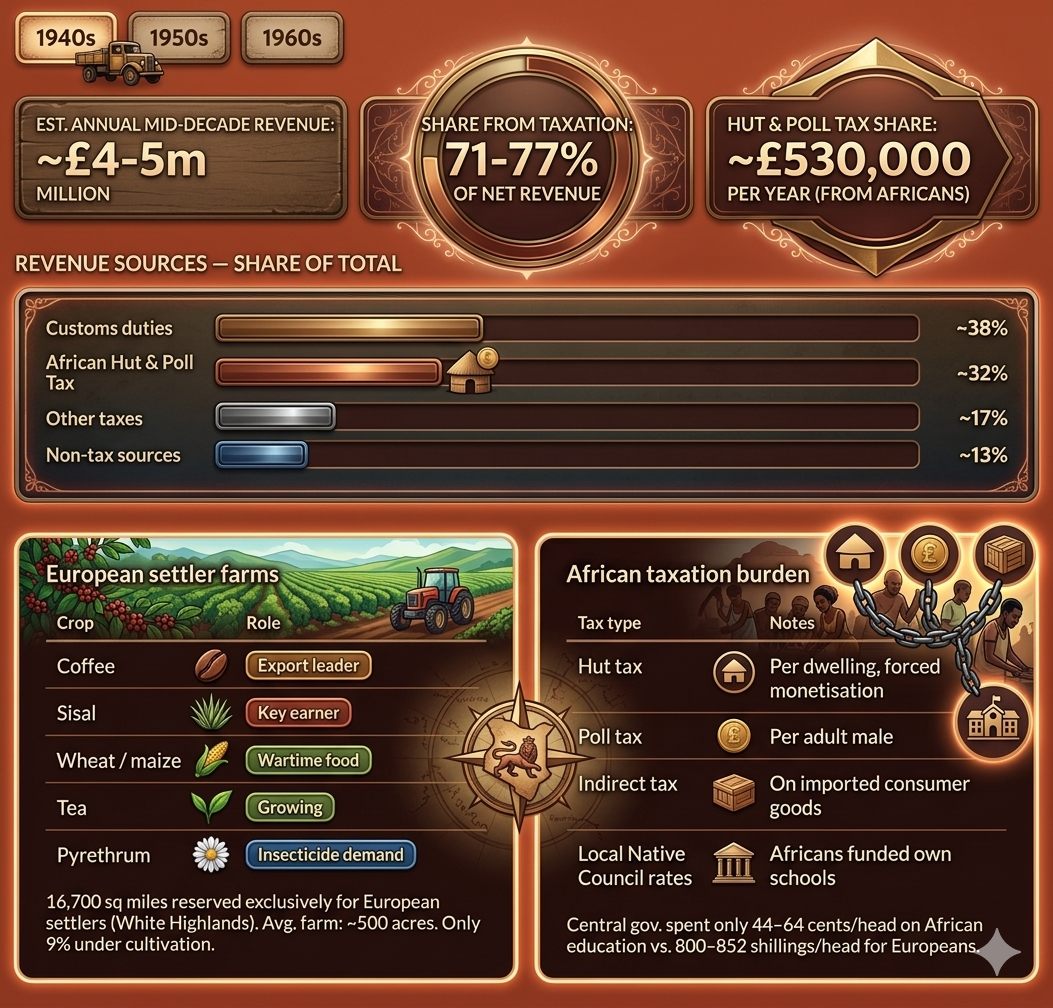
In the decades leading up to independence, the two dominant pillars of Kenya’s government revenue were Customs Import Duties and the African Hut and Poll Tax. Together, they accounted for well over 70 per cent of all tax collected. The people least served by colonial governance were, in effect, its primary financiers.
This is not a marginal historical footnote. It is the central economic contradiction of British Kenya — and understanding it is essential to understanding why Mau Mau happened, why the reserves were overcrowded and eroded, and why Africanisation at independence proved so difficult and costly.
71–77%
of net revenue came from taxation (1925–1936 baseline that carried into the 1940s)
>70%
of that tax revenue from just two sources: customs duties and African Hut & Poll Tax
97%
of European District Council revenue came from Government grants in 1945 — not from settler taxes
The Hut Tax: A Mechanism of Control, Not Just Revenue
The Hut Tax was introduced in the earliest years of British rule, but its logic persisted and deepened right through the 1940s. On its face it was a revenue measure — a levy on each dwelling occupied by an African family. In practice, it was an economic weapon with a single purpose: to force African men into wage labour on European-owned farms and estates.
As historian Bethwell Ogot makes plain in Zamani: A Survey of East African History, the mechanism was blunt and deliberate. A Masters and Servants Ordinance of 1906, explicitly modelled on South African Transvaal law, stipulated that any labourer who broke his contract would be imprisoned. “Through taxation,” Ogot writes, “the ‘native’ was to be forced to work.” The Poll Tax — levied on top of the Hut Tax per adult male — tightened the vice further.
“Through taxation the ‘native’ was to be forced to work. This was the beginning of ordinances for contract labour.”Bethwell A. Ogot, Zamani: A Survey of East African History (1974)
Robert Maxon’s East Africa: An Introductory History confirms that settlers openly demanded tax increases on Africans precisely because they understood what it would do: push men off their own land and onto settler estates. “The settlers called on the government to raise taxes demanded from Africans in order to force them to work,” Maxon writes, “and in fact a Poll Tax was levied in addition to a Hut Tax.”
The arithmetic of this coercion ran through every decade. In the 1940s, Hut and Poll Tax receipts ran at roughly £530,000 per year — a substantial share of total government revenue, year after year, paid exclusively by Africans.
The 1940s: War, Conscription, and Settler Gains
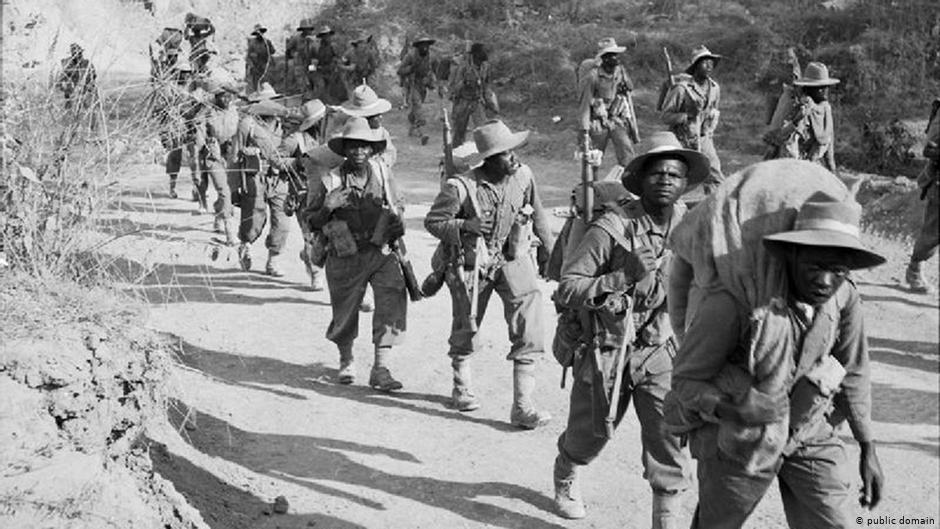
The Second World War accelerated every existing inequality in Kenya’s colonial economy. With the threat of Italian invasion from Somaliland, African political organisations were banned outright. The Kikuyu Central Association, the North Kavirondo Central Association, and several others were proscribed and their leaders detained at Kapenguria.
Meanwhile, the settlers moved with speed. Their influence on the Executive Council expanded. Most consequentially, forced labour for Africans was formally introduced on European farms. By March 1943, some 16,000 conscripted Africans were in employment — roughly three-quarters of them on private undertakings including coffee and tea plantations. These were declared “essential undertakings” under wartime regulations. The minimum wage for this conscripted workforce was set at 8 to 10 shillings per month — barely enough to cover a household’s tax liability.
Revenue sources vs. spending beneficiaries — 1940s Kenya
| Revenue stream | Who paid | Who benefited |
|---|---|---|
| Customs import duties | All consumers, disproportionately African by volume | Mainly European infrastructure and services |
| African Hut & Poll Tax | Exclusively Africans | Largely non-African services, per Lord Moyne inquiry (1932) |
| European District Council revenue | 97% from central govt. grants (1945) | European settled areas |
| Local Native Council rates | African communities funded 2/3 themselves | African reserves — schools, basic infrastructure |
| Export duties (coffee, sisal) | Settler agriculture (indirectly) | General government budget |
At the end of the war, Governor Sir Philip Mitchell introduced a system of portfolios for settler members of the Executive Council. The first two portfolios handed to European settlers were Agriculture and Local Government — the portfolios that affected African lives most directly. The pattern was consistent: African taxes, African labour, European governance.
European Farms: The Myth of the Economic Backbone
The settlers had long argued that European agriculture was the economic backbone of the Colony — that without their farms Kenya would produce nothing of export value. This claim was directly contradicted by the evidence Ogot marshals. In 1934, Uganda’s exports totalled £3.5 million, the overwhelming majority coming from African smallholder agriculture — mainly cotton. Kenya’s exports that same year amounted to less than £2 million, with barely £300,000 attributable to African production.
“Would it not have paid Kenya from a purely business point of view to concentrate on stimulating African production for export?” Ogot asks pointedly. The question answers itself — but the answer was politically inconvenient for the settler community.
European settler farms — what they received
- Land Bank loans at low interest rates
- Direct government grants for capital equipment
- Government-funded agricultural research
- Maize and wheat subsidies
- Government marketing schemes and transport
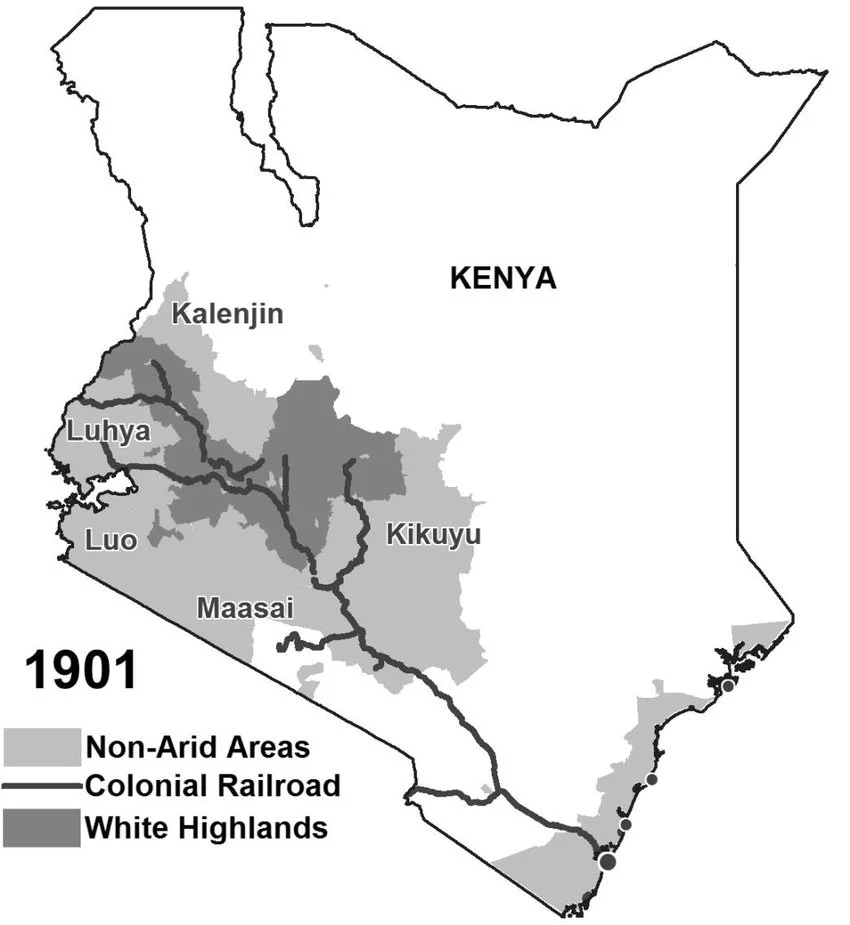
- 16,700 sq miles exclusively reserved (White Highlands)
- Forced/conscripted labour during wartime
African producers — what they received
- No Land Bank access — excluded by design
- No capital grants for farming equipment
- Coffee growing banned in early decades
- Overcrowded reserves — Kiambu at 400/sq mile by 1919
- 44–64 cents/head spent on African education from central funds (vs. 800–852 shillings for Europeans)
- Compelled to subsistence by policy — “fastened to the straightjacket of subsistence production”
- Taxed to fund the system that excluded them
Maxon’s account makes the structural logic plain: the decision to develop Kenya through European settlement — rather than through African peasant production as in Uganda — was not economically inevitable. It was a political choice. And it was a choice underwritten, from the beginning, by taxes levied on the people the settlers sought to exclude.
The 1950s: Boom, Deficit, and Mau Mau
The 1950s brought commodity price booms and a rapid rise in export earnings. Coffee was the headline story: export revenues rose from £3.47 million in 1950 to £6.91 million by 1955, nearly doubling in five years. Sisal and tea also expanded. The government budget grew substantially.
But Kenya ran a persistent trade deficit throughout the decade. Imports consistently outpaced exports — £42.3 million in imports against £24.1 million in exports in 1951 — financed by capital inflows from overseas and the growing role of Nairobi as East Africa’s commercial hub. Manufacturing expanded rapidly and would account for over 20 per cent of national income by 1960.
Kenya’s export trajectory — long-run (£ millions)
| Year | Exports | Imports | Key export drivers |
|---|---|---|---|
| 1911 | £0.3m | £1.1m | Early settler crops, African maize |
| 1931 | £2.3m | £3.0m | Coffee, sisal, maize; hut tax dominant revenue |
| 1951 | £24.1m | £42.3m | Coffee, sisal — price boom begins |
| 1961 | £35.3m | £62.5m | Coffee ~30%, sisal ~12%, tea ~10% |
Behind the export figures, the living conditions of African workers deteriorated. The cost of living rose 40 per cent between 1949 and January 1952; minimum wages rose from 7 shillings 62 cents per week in 1949 to 14 shillings 13 cents in 1952 — a rise that never kept pace with inflation. Agricultural workers on European farms — roughly 40 per cent of all African workers — earned an average of 4 shillings 24 cents per week, plus rations of maize flour.
The 1952 Mau Mau uprising was not, as colonial propaganda insisted, a retreat into atavistic tribalism. It was the culmination of five decades of systematic dispossession: land taken, taxes extracted, labour coerced, and wages held deliberately below subsistence. Governor Mitchell’s assertion as late as 1950 that educated Africans had “the sort of education that our children have by the time they are twelve years of age” captures the contempt that made non-violent redress impossible.
The 1960s: Transition and the Weight of History
As independence approached, the colonial economy began a belated process of transformation. The Million Acre Scheme — a government-funded programme to purchase European farms in the White Highlands and settle African families on them — got underway from 1961. African smallholders were finally permitted to grow coffee commercially. The hut and poll taxes were abolished at independence.
But the structural legacy was not so easily dismantled. Half a century of deliberate suppression of African commercial agriculture had left smallholder production impoverished. The civil service, built to administer a racially segregated state, was large, sophisticated, and almost entirely European — Africanisation was urgent but difficult precisely because the colonial system had been so comprehensively exclusive.
The Decade in Numbers
1960
Manufacturing exceeds 20% of national income. Nairobi is now East Africa’s industrial and commercial centre — generating invisible exports that help finance the persistent trade deficit.
1961
Million Acre Scheme begins. Government buys out European farms and resettles African families. Several million acres of former European farms transfer to African ownership over the following years.
1963
Independence on 12 December. Hut and Poll Tax abolished. Kenya inherits a diversified but deeply unequal economy — more sophisticated than Uganda’s, but with African incomes consistently lower and commercial agriculture still in the early stages of Africanisation.
Ogot’s conclusion is measured but precise: “In Kenya, African incomes were lower but the economy was more diversified. Africanisation of commercial agriculture and the civil service had at last begun, but the former was impoverished by a half century of neglect, and recruitment to the latter was difficult and costly because of its size and sophistication.”
The Paradox, Restated
The colonial economy of Kenya was not built by European settlers, despite everything the mythology of the White Highlands implied. It was built on African land, by African labour, funded in substantial part by African taxes — and then administered overwhelmingly for African exclusion. The customs duties that made up the largest single revenue stream were ultimately paid by consumers; the more those consumers were drawn into the cash economy (itself driven by the need to pay hut taxes), the more revenue flowed to a government that spent it disproportionately on European infrastructure and services.
Lord Moyne’s exhaustive 1932 examination put it plainly: “In the development of the undivided or colonial services in Kenya the prevailing bias has been towards the convenience of a civilisation in which the native so far shares little of direct advantages.”
That civilisation did not pay for itself. Kenya did.
Primary Sources
- Ogot, Bethwell A. (ed.). Zamani: A Survey of East African History. East African Publishing House / Longman, 1974. Chapters on Kenya under British rule and Economic & Social Developments before Independence.
- Maxon, Robert M. East Africa: An Introductory History. West Virginia University Press, 1994. Chapters on the Establishment of European Rule and the Colonial Economy.
- Kenya Colony. Annual Reports of the Native Affairs Department, various years 1925–1952.
- Report of Lord Moyne’s financial inquiry into Kenya, 1932 (cited in Ogot).
- East African Royal Commission 1953–1955 Report, Cmd. 9475, London, 1955.