
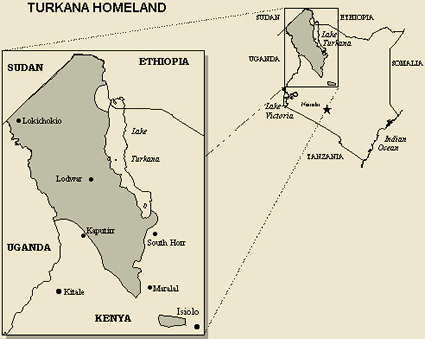
In the far northwest of Kenya, where the land drops away from the highlands into a vast semi-arid basin and the air shimmers with heat for most of the year, there is a lake that should not exist. Lake Turkana — 290 kilometres long, sitting in the middle of one of the driest landscapes on the continent — is the world’s largest permanent desert lake and one of the most scientifically significant bodies of water on earth. Its shores hold fossils that rewrite human prehistory. Its basin has yielded stone tools 3.4 million years old. And walking across its western shores today, tending their cattle and camels on the same volcanic plains where the earliest ancestors of all modern humans once walked, are the Turkana.
The Turkana are Kenya’s third largest Nilotic people and among the most distinctive communities in East Africa — semi-nomadic pastoralists who have inhabited one of the continent’s harshest environments for over three centuries, building a culture of extraordinary resilience, artistry, and martial confidence. They are largely invisible in standard Kenyan history, which tends to focus on the communities of the central and western highlands. But the Turkana are not a peripheral people. They are custodians of the oldest human story on earth, survivors of a colonial administration that never fully subdued them, and today at the centre of one of Kenya’s most complex political and economic transformations — sitting, as it turns out, on billions of barrels of oil.
The Cradle Before the People: Lake Turkana’s Deep Past
Before the Turkana arrived, and long before any human community in any modern sense existed, the basin that bears their name was already one of the most important locations in the story of human evolution. The exposed sedimentary beds around Lake Turkana — laid down over millions of years of volcanic activity and lake level fluctuation — have preserved fossils and stone tools at a density and completeness found almost nowhere else on earth.
The most celebrated of these discoveries is the Turkana Boy, formally designated KNM-WT 15000 — a nearly complete skeleton of a juvenile male Homo erectus found in 1984 on the bank of the dry Nariokotome riverbed on Lake Turkana’s western shore. The discovery was made by Kenyan fossil hunter Kamoya Kimeu, working with a team led by palaeontologist Richard Leakey, when Kimeu noticed a fragment of ancient skull in the pebbled ground. What subsequent excavations revealed over several seasons was the most complete early human skeleton ever found: a boy who died approximately 1.5 million years ago, his frame fully bipedal, his body proportions strikingly close to those of modern humans, his brain roughly two-thirds the size of ours.
Turkana Boy transformed palaeontology. He provided evidence — direct, physical, unambiguous — that Homo erectus was fully upright, fully adapted to open savanna environments, and far more morphologically modern than previous reconstructions had suggested. He demonstrated that the key physiological changes leading toward Homo sapiens had occurred far earlier than previously thought. Every person alive today is descended from ancestors who lived in landscapes like the one that preserved him.
But Turkana Boy is only the most famous of the basin’s discoveries. Koobi Fora on the eastern shore of Lake Turkana has been described as the richest and most varied site for early hominin remains in the world, yielding fossils of multiple Homo species spanning over two million years. In 2012, researchers from the Turkana Basin Institute discovered stone tools at Lomekwi 3 dated to 3.4 million years ago — the oldest stone tools ever found, predating the previously accepted earliest tools by 700,000 years, and suggesting that tool-making behaviour began earlier in human evolution than anyone had imagined. The entire Turkana Basin, in other words, is an open book of human origins — and the Turkana people are its living inhabitants.
The early pastoralists who first settled around Lake Turkana’s shores arrived approximately 5,000 years ago, as the lake was shrinking from its high-water mark at the end of the African Humid Period. Archaeological evidence — pottery, livestock bones, burial sites — shows a transition from fishing and foraging economies to herding over this period. The distinctive pillar burial sites found around the lake, including the extraordinary site at Lothagam North, suggest a complex, socially organised community capable of large-scale commemorative construction. These were not the ancestors of the modern Turkana, but they were the first of many peoples to make this demanding landscape home.
Origins: From the Karamojong Cluster
The Turkana themselves are a much more recent arrival in the basin. Their oral traditions, supported by linguistic analysis and comparative ethnography, trace their origins to the Karamojong cluster of peoples in what is now northeastern Uganda — a group that includes the Karimojong, the Jie, the Dodos, and several other closely related communities who share language, culture, and remembered history.
The founding narrative is characteristically direct. Turkana oral tradition records that the ancestors of the Turkana were originally part of the Jie people near the Tarach River headwaters in Uganda. Around the early 18th century, a group set off following a stray bull that had wandered eastward into unknown country. The search party — the story goes — found the bull in a land of good grazing, and decided to stay. Those who followed became the Turkana; those who remained became the Jie. The story is almost certainly a compressed version of a more complex and gradual migration, but it preserves something true: the Turkana separated from their linguistic relatives in Uganda and moved east into the basin that now carries their name.
The migration was not a single movement but a sustained expansion over several generations. By the early 19th century, Turkana cattle camps were pushing southward and eastward from the Tarach headwaters, following seasonal grazing and water sources. As they moved, they encountered and displaced or absorbed other communities — Cushitic-speaking groups, earlier Nilotic settlers, fishing peoples along the lake shore. By roughly 1850, the Turkana occupied most of the territory they inhabit today, stretching from the Ethiopian and South Sudanese borders in the north to the Pokot and Samburu boundaries in the south, and from Uganda in the west to the shores of Lake Turkana in the east.
What enabled this rapid expansion was not simply numbers or military capability, though both were significant. It was also ecological adaptability. The Turkana developed a herding system capable of sustaining large animal populations in extremely arid conditions — managing cattle, camels, goats, sheep, and donkeys as a diversified portfolio, moving herds between different ecological zones according to season and rainfall. Where single-species herders collapsed in drought, the Turkana’s diversified system provided resilience. The camel, in particular — better adapted to extreme aridity than cattle — gave the Turkana access to pasture that other communities could not use.
Society: Cattle, Age-Sets, and the Emuron
Turkana society is organised around cattle, but cattle are not merely an economic resource. They are the medium through which relationships are formed, obligations discharged, status demonstrated, and spiritual life maintained. A Turkana man names his cattle individually, sings to them, and can identify each animal in a herd of hundreds by its distinctive marks and temperament. The care of cattle is not a job. It is a vocation that defines what it means to be a full member of the community.
The basic social unit is the family, grouped into clans — ateker — that trace patrilineal descent and provide the framework for marriage, inheritance, and collective obligation. Cattle give clan brands; marriage requires cattle as bride price; friendships are sealed with the exchange of animals. The network of obligations created by these exchanges knits the community together across the vast distances that nomadic pastoralism requires.
The age-set system
Turkana men belong to one of two alternating age sets, called Ngimor (Stones) and Ngirisai (Leopards). A man belongs to the set opposite his father — if the father is a Stone, the son is a Leopard, and his son will be a Stone again. The sets alternate through the generations, creating a social structure that cross-cuts clan boundaries and provides a basis for collective action across the community. In the past, warriors of the same age-set fought together, ate together at feasts, and wore distinctive ornaments marking their group. The system is less rigid than the Maasai age-set structure but serves a similar purpose: creating solidarity, regulating competition, and providing an organisational framework for defence and raiding.
The Emuron: diviner and healer
Spiritual authority among the Turkana rests with the emuron (plural: ngimurok) — diviners who mediate between the living community and the spirit world, advise on matters of war and migration, interpret dreams and omens, and heal the sick. The emuron is not a political leader in a formal sense, but their influence is pervasive: no major decision about movement, raiding, or negotiation was undertaken without consulting them. As the existing article on Turkana resistance to colonial rule on this site documents, the authority of the emuron was central to how the Turkana organised their response to British encroachment — and one of the first things the colonial administration tried to undermine.
The Turkana relationship between the sacred and the social is seamless in a way that outsiders consistently misunderstand. There is no separation between religion and daily life — every significant act, from building a house to going to war to giving birth, has a spiritual dimension and a ritual marking. The ngimurok are not priests standing apart from ordinary life; they are specialists within it, their power derived from demonstrated ability to communicate with the ancestral and spirit world on the community’s behalf.
Material Culture: Craftsmanship in the Desert
Turkana material culture is remarkable both for its beauty and for its practicality in an extreme environment. Living without permanent structures, carrying everything they own across hundreds of kilometres of semi-arid terrain, the Turkana have developed material traditions that are simultaneously functional and aesthetically sophisticated.
Turkana women are among East Africa’s finest basket weavers, producing tightly coiled vessels that can hold water, grain, and milk — essential storage in a landscape where containers must be lightweight, durable, and multipurpose. The baskets are made from doum palm fibre, dyed in geometric patterns, and represent a technical tradition passed from mother to daughter across generations. They are now recognised internationally as significant African art objects and are sold in craft markets across Kenya.
Houses — awi — are built over a wooden framework of domed saplings, thatched with doum palm fronds, hides, or skins, large enough to hold a family, and designed to be assembled and disassembled in hours. During the wet season they are covered with cattle dung for insulation. Animals are kept in a brushwood enclosure attached to the house. The entire household unit can be packed onto donkeys and moved within a day.
Men carry a distinctive low stool — the ekicholong — which serves simultaneously as a seat, a headrest (protecting ceremonial head decorations from being damaged on the ground), and a tool. They also carry wrist knives of steel and goat hide and, traditionally, spears and throwing sticks carved from the wood of the edome tree, used for hunting birds and small animals. The stool, the knife, the spear — each is both tool and identity marker, telling a detailed story to anyone who knows how to read it about the owner’s age, status, and clan.
Turkana ornamentation is elaborate and gender-specific. Women wear multiple strands of beaded necklaces, coiled aluminium armbands, and elaborate lip and ear piercings. Men wear ostrich feather headdresses for ceremonial occasions, their hair styled and decorated with clay and animal fat. The adornment is not vanity — it is a visual language communicating social status, life stage, and group identity to every Turkana who encounters you.
The First European: Count Teleki, 1888
The first European to enter Turkana territory was the Austro-Hungarian explorer Count Samuel Teleki von Szek, whose expedition reached the lake in June 1888. Teleki named it Lake Rudolf, after Crown Prince Rudolf of Austria — a name that survived until Kenya’s independence, when it was renamed Lake Turkana after its people. Teleki’s account of his journey describes a confident, well-armed population that regarded his expedition with curiosity rather than fear, and that was perfectly capable of overwhelming him if it chose to.
The British came later and found the same thing: a people who inhabited territory so remote and so inhospitable that it had never been worth conquering, and who had no interest in being administered. The story of Turkana resistance to colonial rule is told in detail in the existing article on this site. The key fact is that effective British control of Turkana territory was not achieved until 1926, thirty years after the declaration of the East Africa Protectorate, and even then it was thin. The final military pacification — the Labur Patrol of 1918, involving over 5,000 troops — caused enormous casualties but did not end Turkana autonomy. The Northern Frontier District, which included Turkana territory, was administered as a closed zone throughout the colonial period — restricted from movement by other Kenyans, left largely to its own devices, and described in colonial reports as “the wildest and most worthless district in Kenya.”
That description — wildest and most worthless — is worth pausing over. The British called the Turkana Basin worthless because they could not farm it and could not easily tax it. What they did not know was that beneath its parched surface lay something that would eventually make it one of the most contested pieces of ground in East Africa.
Post-Independence: Marginalisation and Underdevelopment
Kenya’s independence in 1963 changed the political map but did little to change the material reality of Turkana County. The Northern Frontier District had been deliberately excluded from the development investment that the colonial government directed toward the agricultural zones of the highlands and coast. Independence transferred sovereignty without transferring resources, and the new Kenyan government — faced with immediate development needs across a vast country — prioritised the more densely populated and economically productive regions.
Turkana County remained what it had been under colonialism: remote, underfunded, dependent on humanitarian aid during the periodic droughts that struck the region, and largely invisible in national political calculations. Pastoralist communities across northern Kenya were systematically disadvantaged by development models built around sedentary agriculture — land titling schemes, educational infrastructure, agricultural extension services — that had little relevance to mobile herding economies.
Cattle raiding, always a feature of Turkana life, became significantly more dangerous in the post-independence period as firearms — AK-47s replacing spears — entered the region through the porous borders with Uganda, South Sudan, and Ethiopia. The raids that had previously been fought with casualties measured in single figures became military engagements with high death tolls, destabilising entire communities and forcing government security responses that rarely distinguished between raider and victim.
The Turkana remained, as they had always been, at the edge of the Kenyan state’s attention — present in census figures, absent from budget allocations, and fiercely resistant to being governed in ways that made no sense for their economy and ecology.
Oil, Water, and the New Scramble
In 2012, the Irish oil company Tullow Oil confirmed commercial oil deposits in the Lokichar Basin in southern Turkana County — the first significant oil discovery in Kenya’s history. Subsequent exploration confirmed reserves estimated at over 750 million barrels. For a country that had been importing all its petroleum at significant cost, the discovery was transformative. For Turkana County, it was the beginning of a new and complicated chapter.
The questions raised by Turkana’s oil wealth are not simple. Who benefits? The county government, under Kenya’s devolution framework, is entitled to a share of revenue — but the amounts, the timelines, and the distribution mechanisms have been subjects of sustained dispute between the county, the national government, and the oil companies. Local communities near the Lokichar exploration sites demanded employment, contracts, and infrastructure investment. When those demands were not met, roadblocks and demonstrations disrupted operations. The pattern was familiar from oil regions across Africa: extraction that created wealth at the national level while leaving local communities as observers of a transformation they could not control.
Simultaneously, geological surveys revealed something potentially even more significant: a vast underground aquifer beneath Turkana County, holding an estimated 250 billion cubic metres of fresh water — one of the largest groundwater reserves ever discovered in Africa. In a county where communities walk for hours to find water for their herds, and where drought periodically kills both livestock and people, the discovery prompted immediate questions about how the water could be used, who would control it, and whether large-scale irrigation agriculture could transform the economy of what had always been considered irredeemably pastoral land.
The Turkana Basin Institute, founded by Richard Leakey in 2005, continues to drive palaeontological and archaeological research in the region. New fossil discoveries are announced regularly — including, in recent years, a 3.6-million-year-old partial skeleton potentially belonging to Australopithecus anamensis, and further Lomekwi stone tools pushing back the record of human technological behaviour. The basin that the British called worthless is now understood to be one of the most scientifically valuable landscapes on earth.
The Turkana Today
The 2019 census counted 1,016,174 Turkana in Kenya — just over 2% of the national population — making them the third largest Nilotic ethnic group after the Luo and the Kalenjin. They remain concentrated in Turkana County, the largest county in Kenya by area, covering roughly 77,000 square kilometres of semi-arid terrain. Lodwar is the county capital; Kakuma hosts one of the world’s largest refugee camps, housing over 200,000 people from South Sudan, Somalia, Ethiopia, and the Democratic Republic of Congo.
Traditional pastoralism remains the foundation of Turkana life, though climate change is making it increasingly precarious. The droughts that historically struck every decade now strike more frequently and with greater severity, reducing the grazing capacity of the land and forcing communities to rely on food aid during crises. The 2022 drought — described by aid organisations as the worst in forty years — caused severe livestock losses across northern Kenya and left hundreds of thousands of Turkana in acute food insecurity.
And yet the Turkana persist, as they always have, with a combination of ecological knowledge, social solidarity, and adaptive ingenuity that no development programme has fully understood or replicated. The emuron still read the signs of rain and season. The basket weavers still work the doum palm fibre into vessels of extraordinary precision. The herders still sing to their cattle by name. The annual Turkana Festival at Loiyangalani still draws communities from across the north to celebrate a culture that has survived volcanic landscapes, colonial armies, post-independence neglect, oil companies, and forty-year droughts.
They are, in the deepest possible sense, people of deep time — inhabitants of the landscape where the human story began, custodians of a record that belongs to the whole species, and a community whose history deserves far more attention than Kenya’s standard histories have given it.
Further Reading on This Site
- Fighting for Land and Identity: Turkana Resistance to Colonial Rule — the detailed history of how the Turkana confronted British colonial administration
- The Northern Frontier District — the colonial administrative framework that kept Turkana isolated
- The First Peoples of the North: Kenya’s Cushitic Inheritance — the Cushitic communities who neighbour the Turkana to the south and east
- Rendille: Camel Nomads of Northern Kenya — a closely related pastoral community of the same region
- The El Molo: The Forgotten People of Lake Turkana — the tiny fishing community on Lake Turkana’s eastern shore
- Colonialism in Kenya: Origins, Impact, and Resistance — the wider context of British colonial expansion into which Turkana resistance fits
- The Tribes of Kenya — overview of all 44 officially recognised Kenyan ethnic communities
