
Kenya’s 2007/08 Post-Election Violence
In the days between Christmas 2007 and the end of February 2008, Kenya burned. Streets that had been busy with holiday shoppers became battlegrounds. Neighbourhoods where Kikuyu, Luo, Kalenjin and Luhya families had lived side by side for decades turned into killing grounds defined by ethnicity. Churches became refuges — and then targets. More than 1,300 Kenyans died. Over 300,000 were driven from their homes. A country that had long styled itself as East Africa’s anchor of stability stared into an abyss it had been approaching for decades.
The violence of 2007 and 2008 did not come from nowhere. It was the culmination of nearly half a century of ethnic politics, land grievances, manipulated elections, state patronage and an inequality that independence had promised to end but never did. To understand what happened in those terrible weeks, you have to go back much further — to Kenyatta, to Moi, to the colonial carve-up of land that seeded resentments still raw in 2007.
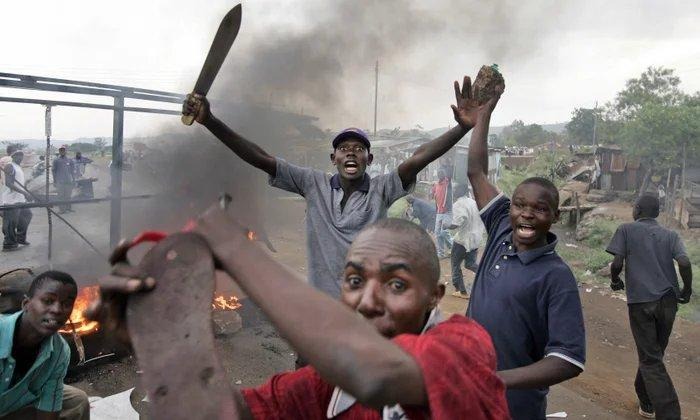
Armed rioters on the streets of Nairobi in January 2008. The violence erupted within hours of the disputed election result announcement. Photo: Reuters
— — —
The Election of 27 December 2007
The presidential election pitted incumbent Mwai Kibaki, leading the Party of National Unity (PNU), against opposition leader Raila Odinga of the Orange Democratic Movement (ODM). The two men had once been allies. In 2002, they had stood together under the National Rainbow Coalition (NARC) and ended Daniel arap Moi’s 24 years in power in one of Kenya’s most celebrated democratic moments. By 2005, the alliance had collapsed. Kibaki had, in the view of his former partners, broken a Memorandum of Understanding that promised Odinga a powerful prime ministerial role. That betrayal poisoned the well for everything that followed.
Odinga had built a broad coalition for 2007 — drawing from his own Luo base, Kalenjin communities in the Rift Valley, the Luhya of Western Kenya, and young, poor Kenyans in Nairobi’s vast informal settlements. His campaign was explicitly populist: land justice, poverty reduction, redistribution. Kibaki’s PNU stressed economic growth. You can read more about Odinga’s career in our profile of Raila Odinga and about Kibaki in our comprehensive profile of Mwai Kibaki.
Voting day on 27 December was, by most accounts, relatively orderly. But as results began arriving at the Electoral Commission of Kenya (ECK), something went wrong — or was made to go wrong. The ODM held a strong lead in parliamentary seats. Early presidential tallies showed Odinga ahead. Then, in the final hours of counting, the numbers shifted dramatically. On 30 December, ECK chairman Samuel Kivuitu announced Kibaki’s victory by a margin of 231,728 votes — just 2.3 percentage points. Kibaki was sworn in within hours, in a hasty ceremony that independent observers, the ODM and much of the international community found deeply suspicious.
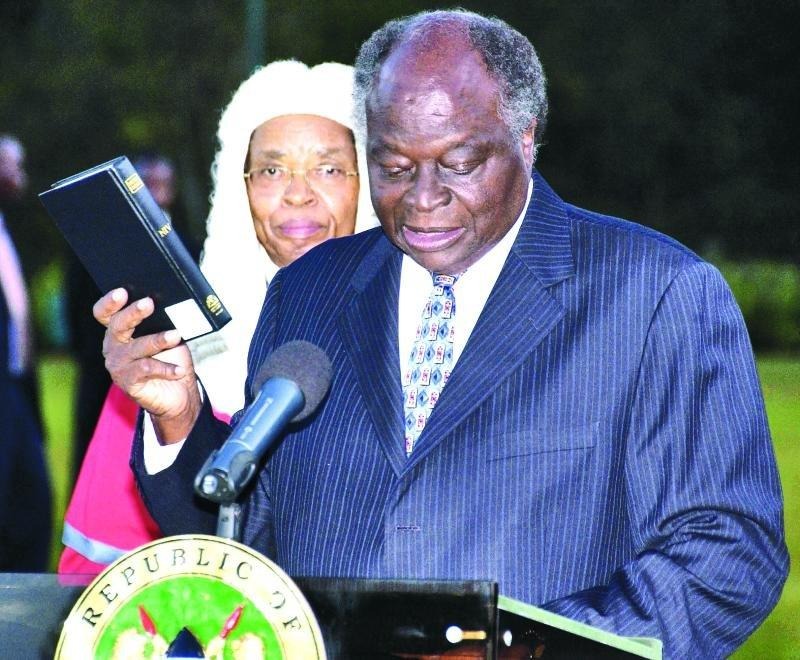
President Mwai Kibaki takes the oath of office on the evening of 30 December 2007, within hours of the ECK announcing his victory. The hasty swearing-in inflamed an already tense situation.
Odinga immediately alleged fraud. The ECK chairman himself later admitted he did not know whether the results he had announced were accurate. The violence that followed was not simply spontaneous rage — it was the detonation of accumulated grievances, lit by what many Kenyans experienced as a stolen election.
— — —
The Violence: What Happened and Where
The worst violence concentrated in four areas: Nairobi’s informal settlements, particularly Kibera and Mathare; the Rift Valley, especially around Eldoret and Nakuru; Kisumu and the wider Nyanza region; and parts of the Coast. The pattern was not random.
In Nairobi’s slums, where poverty was densest and the sense of exclusion deepest, ODM supporters attacked PNU supporters perceived as having “stolen” the election. The violence quickly acquired an ethnic character, with Kikuyu targeted in ODM strongholds and Luo and Luhya targets in PNU areas. Police responded with lethal force, killing dozens of protestors in the first days.
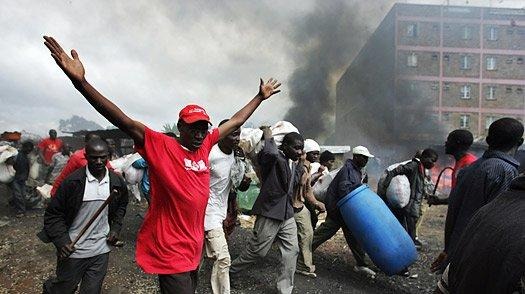
Chaos on the streets of Nairobi’s Mathare slum in January 2008. Kibera and Mathare were among the hardest-hit areas in the capital during the first wave of violence.
In the Rift Valley, the violence was more organised and more lethal. Kalenjin communities attacked Kikuyu settlers — communities that had moved into the Rift Valley through politically motivated resettlement schemes going back to the Kenyatta era. The most horrifying single incident occurred on 1 January 2008 at the Assemblies of God church in Kiambaa, near Eldoret, where a crowd locked approximately 35 people — mostly women and children who had taken refuge there — inside and set the building on fire.
In Kisumu, protests against the election result were met with police gunfire. Dozens were killed in the first days alone. The city had a long memory of state violence — our article on the Kisumu Massacre of 1969 details how that earlier episode of state violence against Luo protesters had never been fully reckoned with.
The reprisals were equally brutal. In Nakuru and Naivasha, Kikuyu gangs — some linked to the Mungiki criminal organisation — attacked Luo and Kalenjin residents in coordinated revenge killings. By late January and February, the violence had taken on a cyclical, retaliatory logic that threatened to spiral beyond any political resolution.
“Ordinary people do not wake up one morning and suddenly decide to kill their neighbours.” — Ngugi wa Thiong’o, writing during the crisis
— — —
The Deep Roots: Ethnicity, Land and the Postcolonial State
To frame the 2007 violence purely as “tribal” — as much of the international media did — is to miss almost everything that matters about it. Ethnicity was real, and it mattered. But it was an instrument in the hands of political elites, not a primordial force operating on its own. For context on how these ethnic political dynamics developed, see our article on the history of political parties in Kenya and our piece on colonialism in Kenya.
Kenya’s ethnic politics were institutionalised from the first days of independence. Under Jomo Kenyatta (1963–1978), senior government positions were disproportionately filled by Kikuyu. By the time of Kenyatta’s death in 1978, six of the eight Provincial Commissioners were Kikuyu, and the majority of permanent secretaries and parastatal heads came from the GEMA communities. Development resources followed political patronage. Regions that produced senior officials got roads, schools and investment. Others waited. Our profile of the Kikuyu people provides more on this community’s central place in postcolonial Kenya.
Under Daniel arap Moi (1978–2002), the pattern shifted but did not end. Moi, a Kalenjin from the Rift Valley, trimmed Kikuyu influence and built his own patronage networks. When opposition pressure mounted in the early 1990s, his government oversaw — and many believe orchestrated — ethnic clashes in the Rift Valley in which Kalenjin militia attacked Kikuyu and Luo settlers. Those attacks prefigured 2007 in their geography, their method and their logic.
The land question ran through all of it. Colonial Kenya had dispossessed African communities of vast tracts of land. At independence, rather than reversing this systematically, the Kenyatta government allowed politically connected Kikuyu to purchase former settler farms — a process that Kalenjin communities in the Rift Valley experienced as a continuation of dispossession rather than its correction. By 2007, this was still an open wound. William Ruto, the Kalenjin political leader who threw his lot in with Odinga and the ODM, explicitly promised that an ODM government would address historical land injustices in the Rift Valley.
For more on the long history of land ownership disputes that underpinned this violence, see our deep-dive into the history of land ownership in Kenya and our article on Kenya’s White Highlands.
— — —
The Role of Political Elites
The violence of 2007/08 was not purely spontaneous. In the immediate aftermath of the result, genuine rage drove people into the streets. But a significant portion was organised, financed and directed by political figures on both sides.
The Waki Commission, which investigated the violence, found evidence of premeditation: lists of targets, weapons stockpiled in advance, and the coordination of groups across distances that would have been impossible without planning and resources. Leaders on the ODM side were accused of organising and financing Kalenjin militia attacks in the Rift Valley. On the PNU side, leaders were accused of coordinating with the Mungiki criminal gang to carry out retaliatory attacks on Luo and Kalenjin communities in Nakuru and Naivasha.
This is not a comfortable truth for either political camp, and it has never been fully addressed in Kenyan public life. The ICC process, which brought charges against Uhuru Kenyatta and William Ruto among others, ultimately collapsed — partly due to witness interference and partly due to political pressure from the Kenyan government. No senior figure has ever been convicted for their role in the violence.
The cartoonists who documented the crisis understood this dynamic instinctively. Political cartoons from the period depicted Kibaki and Odinga fighting over a steering wheel while the country burned around them — the two men who should have led consumed by a contest for power that was costing their people their lives. Our multiparty democracy article charts how the conditions for this political failure developed over the preceding decade.
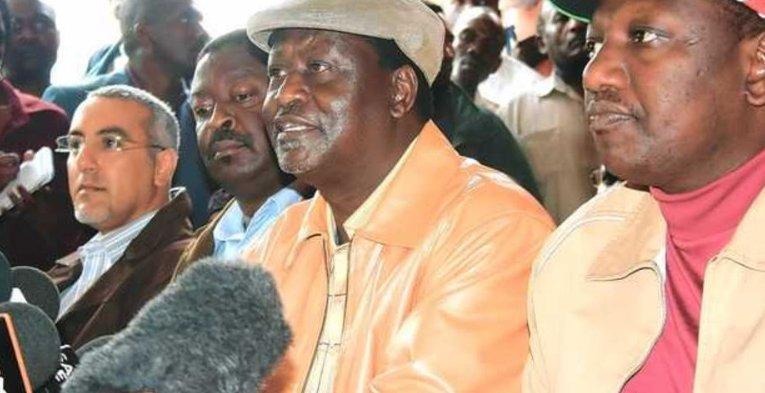
Raila Odinga addresses reporters during the post-election crisis. Odinga alleged fraud immediately after Kibaki’s swearing-in and refused to recognise the result.
— — —
The Media: Kenyan and International
The media’s role in the crisis was complex and contested. Kenya’s Independent Review Commission found that elements of the media had inflamed rather than reported the violence, particularly local-language radio stations that broadcast inflammatory content in the earliest days. The Nation Media Group’s own managing editor later admitted that “tribal emotions came into our journalism.”
Kenyan print journalists who covered the crisis carried it with them for years. Many described witnessing extreme violence, receiving death threats, or being forced to flee. These experiences shaped how journalists covered the next election in 2013: researchers found the memory of 2007 became “the ghost in the room,” creating a “culture of restraint” that led some journalists to sanitise inflammatory statements and downplay genuine problems with the electoral process.
International media coverage, particularly in Britain, received serious academic criticism. Studies found a consistent tendency to explain the violence through a “tribal” lens — emphasising ethnic identity as a self-evident cause while ignoring the political, economic and historical context. The Daily Telegraph used the word “tribe” or its derivatives more than 145 times across 107 articles. As BBC correspondent Fergal Keane put it at the time: “Kibera is dirt poor — there the poor are being set at each other’s throats. This drives the rage… it certainly isn’t a simple issue of tribalism.”
— — —
Kofi Annan and the National Accord
The crisis was resolved — partially, imperfectly — through mediation led by former UN Secretary-General Kofi Annan, heading the African Union’s Panel of Eminent African Personalities. Annan arrived in Nairobi in late January 2008, when the death toll was still rising and the country appeared to be on the edge of full civil war.
On 28 February 2008, the National Accord and Reconciliation Act was signed. Kibaki would remain President. Odinga would become Prime Minister in a newly created post. Cabinet positions would be shared between the two parties. The agreement ended the killing. It did not resolve the underlying causes.
The National Accord included four agenda items: the immediate cessation of violence; a humanitarian response to displaced persons; a power-sharing government; and — crucially — a set of long-term reforms addressing constitutional change, land reform, poverty, inequality and historical injustices. Agenda Four was the most important and the least implemented.
A new constitution was enacted in 2010, introducing devolution, stronger institutions and a revised electoral framework. Our article on majimbo and Kenya’s lost federalism provides background on the long debate over how power should be distributed in the country — a debate the 2010 constitution sought, finally, to settle.
— — —
Aftermath and Unfinished Business
When Kenyans went to the polls again in March 2013, they did so under a new constitution and with new institutions, but with many of the same fault lines intact. The election was won by Uhuru Kenyatta — under indictment by the International Criminal Court for crimes against humanity allegedly committed during the 2007/08 violence. His running mate was William Ruto, who faced similar charges. They won. The ICC cases against both men subsequently collapsed.
The 2013 election passed without major violence. The 2017 election was more turbulent, with a Supreme Court annulment of the presidential result — a first in African history — followed by a disputed re-run that Odinga boycotted. Violence occurred but on a smaller scale than 2007/08.
What did not happen, in the years following the crisis, was a sustained national reckoning with what had occurred. The Truth, Justice and Reconciliation Commission (TJRC), established in 2008, produced a report in 2013 that documented historical injustices going back to colonialism. Its recommendations were largely ignored. Victims of the 2007/08 violence — the bereaved, the displaced, those who were raped or maimed — have received little in the way of justice or compensation.
The 300,000 people who fled their homes represent perhaps the most visceral evidence of this incompleteness. Many who were driven from farms in the Rift Valley never returned. Their land was occupied by others. The ethnic geography of Kenya shifted measurably as a result of the violence, with communities becoming more spatially segregated than they had been before.
— — —
Why It Matters
The 2007/08 post-election violence is not ancient history. It is living memory for millions of Kenyans, and its effects — on land, on communities, on politics, on the way journalists do their work — remain visible today.
It demonstrated with terrible clarity what ethnic politics, manipulated elections and impunity can produce. It showed that poverty and inequality create the conditions in which political elites can ignite violence among communities that would otherwise live peaceably. It revealed that the media — both domestic and international — can fail the public in a crisis, either by inflaming tensions or by flattening complex political struggles into simple ethnic caricature.
It also showed that Kenya can step back from the abyss. The mediation of 2008, the constitutional reforms of 2010, the peaceful conduct of the 2013 election — these are achievements. They are fragile achievements, built on foundations that include unaddressed land grievances, a culture of elite impunity and poverty that remains among the deepest in the region.
What Kenya has not yet managed is to look fully at what happened and why: to hold accountable those who organised the killing, to compensate those who suffered it, and to build the economic and institutional foundations that would make such a catastrophe genuinely less likely rather than merely less imminent.
The fire of 2007 and 2008 was extinguished. The fuel that fed it is still there.
— — —
Related Articles on Kenyan History
→ Mwai Kibaki: A Comprehensive Profile
→ Raila Odinga: Political Life and Legacy
→ Daniel arap Moi: Kenya President Biography
→ The Kisumu Massacre of 1969: Independence Betrayed
→ The Birth and Evolution of Kenya’s Multiparty Democracy
→ A History of Land Ownership in Kenya
→ Kenya’s White Highlands: Land, Race and the Economics of Exclusion
→ The History of Political Parties in Kenya
→ Majimbo Dreams: Kenya’s Lost Federalism
→ Jomo Kenyatta: Power, Nationhood and the Making of Postcolonial Kenya
— — —
Sources
This article draws on: Opondo P.A., “Ethnic Politics and Post-Election Violence of 2007/8 in Kenya,” African Journal of History and Culture (2014); Weighton & McCurdy, “The Ghost in the News Room,” Journal of Eastern African Studies (2017); Keith Somerville, “British Media Coverage of the Post-Election Violence in Kenya, 2007–08,” Journal of Eastern African Studies (2009); Nyongesa Ben Wekesa, “Cartoons Can Talk? Visual Analysis of Cartoons on the 2007/2008 Post-Election Violence in Kenya,” Discourse & Communication (2012); Kimani Njogu (ed.), Healing the Wound: Personal Narratives about the 2007 Post-Election Violence in Kenya; and the reports of the Waki Commission and the Independent Review Commission (Kriegler Commission).
