

There are few foods as modest and yet as quietly heroic as kunde. It does not boast like maize or demand attention like coffee. But it thrives where almost nothing else will. In Kenya’s most unforgiving landscapes — where rains fail, soils are thin, and the sun writes cracks in the earth — kunde lives. It doesn’t just survive. It holds entire communities together.
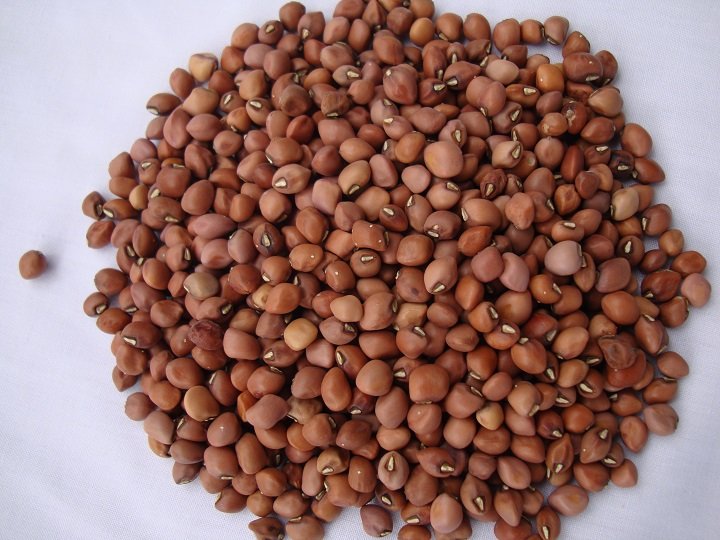
Vigna unguiculata, known more widely as the cowpea, is one of Africa’s oldest and most adaptable legumes. It tolerates drought, matures quickly, and gives everything: edible leaves, nutrient-rich seeds, and leftover vines that double as fodder. It even heals the land it grows in. As a nitrogen fixer, kunde literally breathes life back into depleted soils, making it a companion crop that improves conditions for everything planted alongside it or after it.
In Kenya it answers to many names: kunde in Kikuyu, likhuvi in Luhya, alot-bo in Luo, nthooko in Kamba, and egesare in Kisii. The fact that nearly every major Kenyan community has its own word for this plant is itself a clue to how long and how deeply it has been part of life here. This is not a crop that arrived with colonialism. It was already old when the first European botanist tried to classify it.
So what does this humble bean have to do with the history of East Africa?
Everything.
A Seed, Charred and Ancient
In July 2024, archaeologists published what may be the most significant update in East African agricultural history in decades. Deep in the Chelelemuk Hills of western Kenya, at a site known as Kakapel Rockshelter, researchers uncovered the earliest direct evidence of domesticated plant farming in equatorial East Africa. Their paper, published in the Proceedings of the Royal Society B (Goldstein et al., 2024), details the recovery of a single charred cowpea seed — burned but intact — buried in a hearth used approximately 2,300 years ago.
That seed — more than any document, oral history, or linguistic reconstruction — confirms that farming had reached the interior Lake Victoria Basin long before colonial timelines suggest. It places kunde at the foundation of western Kenya’s agricultural history — not as a recent introduction but as an ancient inheritance.
Kunde had arrived.
West African Origins, East African Transformations
Cowpea is thought to have originated in West Africa, domesticated by communities who understood its value generations before the invention of writing. From there it moved slowly eastward — across rivers, forests, and savannas — until it found new soil in what is now western Kenya. It also moved north to Egypt by 2500 BC, east to India by 1500 BC, and — carried by European slavers — to the Americas from the 16th century onward, where it became a foundational crop in Southern US cooking, the Caribbean, and Brazil.
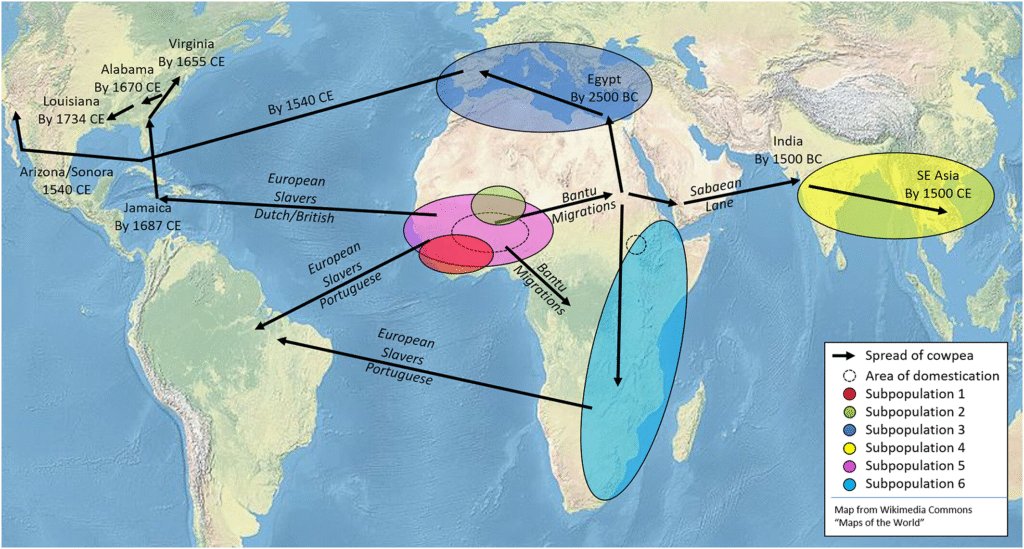
At Kakapel, the seed was found alongside Urewe ceramics — the distinctive pottery typically associated with the early Bantu expansion into East Africa. These weren’t just potters. They were migrants, carrying with them language, technology, iron smelting, and food. Kunde was part of that package — a crop that moved with people because it was useful precisely where people needed to go: dry places, marginal soils, landscapes that did not forgive poor planning.
But the seed didn’t spark an agricultural revolution overnight. Early farmers at Kakapel still relied heavily on wild foods. The local foragers — likely Kansyore fishers who had inhabited the lake basin for millennia — didn’t vanish when the farmers arrived. They adapted. Kunde was an addition to an existing food system, not a replacement. Which makes its story even more compelling: it is a crop that has always coexisted, always supplemented, always filled the gaps that other foods left.
One Plant, Many Faces
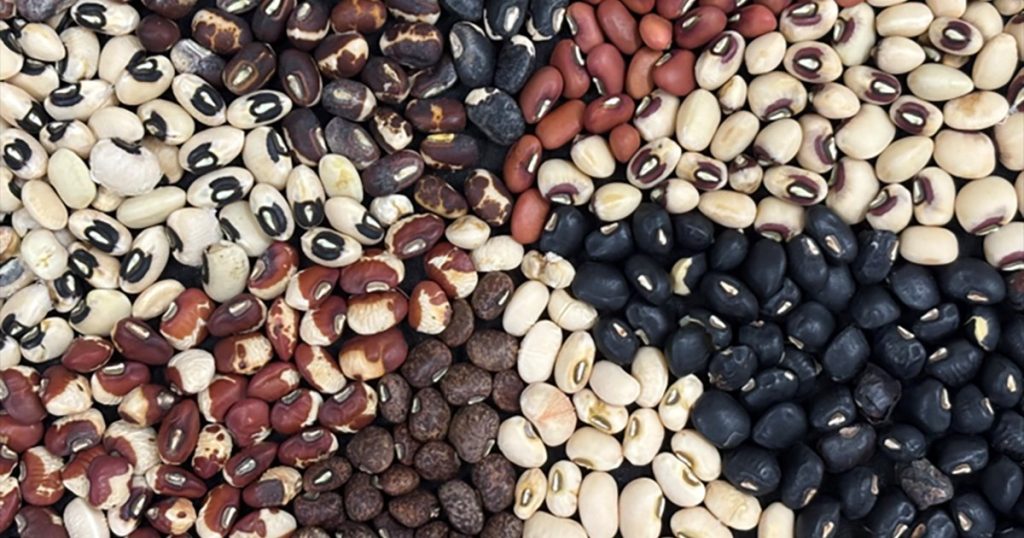
One of the least appreciated facts about kunde is the range it encompasses. The cowpea is not a single uniform crop. Thousands of years of farmer selection across West, East, and Central Africa have produced a plant of extraordinary genetic diversity — from the cream-and-black black-eyed pea familiar in American Southern cooking, to the deep reddish-brown seeds most common in Kenyan markets, to near-black and mottled varieties found in specific highland communities. Some varieties are grown primarily for their seeds. Others are cultivated mainly for their leaves. Some mature in as little as 60 days; others take three months but yield more reliably in marginal conditions.
This diversity is not an accident. It is the accumulated agricultural intelligence of generations of farmers — particularly women farmers — who selected, saved, and shared seeds according to criteria that formal plant science is only now beginning to appreciate: drought tolerance, leaf-to-seed ratio, cooking time, and flavour. The woman in a Kitui market selling three different types of kunde from three different baskets is the custodian of knowledge that no laboratory has fully replicated.
Kenya’s Most Underappreciated Crop
In counties like Kitui and Makueni — the semi-arid heart of Ukambani — kunde is not a supplementary crop. It is the crop. In years when the rains fail and maize yields almost nothing, kunde’s deep root system and short growing cycle mean it can still produce a harvest. It is planted in the margins of maize fields, along field boundaries, and in the poorest corners of the shamba where nothing else is expected to grow.
In western Kenya — in Kakamega, Vihiga, and Migori — kunde leaves are a staple green vegetable eaten several times a week. The Luhya cook likhuvi with groundnuts in a preparation that is both nutritionally complete and deeply rooted in the community’s culinary memory. In Luo households around Lake Victoria, alot-bo is often the first green of the growing season, appearing before other crops have established themselves.
And yet, despite its ecological and nutritional importance, kunde rarely features in agricultural marketing campaigns, urban grocery chains, or government food security programmes. It is a crop of the margins — rural, subsistence-driven, overwhelmingly female-grown and female-cooked. But that is precisely why it has endured when commercially backed crops have failed. Nobody needed to tell kunde farmers what it was worth. They knew.
What Kunde Actually Contains
A single cup of cooked cowpeas contains approximately 13 grams of protein, 11 grams of dietary fibre, and meaningful quantities of iron, folate, zinc, potassium, and magnesium. Compared to maize — Kenya’s dominant calorie crop — cowpeas are substantially more nutritious per gram, with a protein content that rivals chicken on a calorie-for-calorie basis and a fibre content that supports gut health, stable blood sugar, and sustained energy in ways that maize ugali eaten alone cannot.
The leaves, when young and cooked correctly, are equally impressive — high in vitamins A and C, calcium, and iron. In communities where anaemia is a persistent nutritional challenge, particularly among women and young children, kunde greens eaten regularly represent a low-cost, locally available intervention that requires no supply chain, no refrigeration, and no foreign subsidy.
The irony that kunde is sold as a subsistence food in rural markets while imported quinoa and kale are marketed as superfoods in Nairobi’s upmarket supermarkets at ten times the price is not lost on anyone paying attention.
How Kenyans Cook Kunde
Kunde arrives on the table in two distinct forms. The leaves — picked young and tender from the vine — are cooked as a green vegetable, similar to spinach or sukuma wiki. The seeds (dried beans) are cooked slowly into a thick, protein-rich stew. Both are kunde. Both have fed this land for over two thousand years.
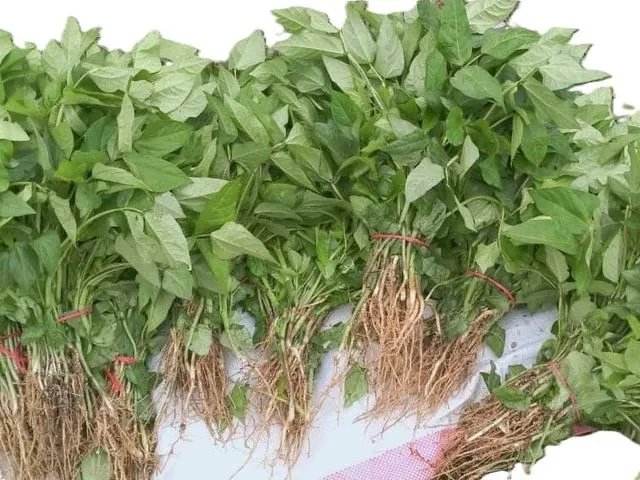
Kunde leaves — the vegetable
The leaves require one step that separates a good pot from a bitter, chewy one: softening. Traditionally, cooks used a pinch of magadi — natural soda ash harvested from the Rift Valley’s soda lakes — to break down the tough fibres quickly and preserve the leaves’ deep green colour. Today, a small pinch of bicarbonate of soda works in most kitchens.
To prepare: Strip the leaves from their stems, discarding any that are yellowed or tough. Wash thoroughly in cold water. Bring a small amount of water to the boil, add a pinch of soda ash or bicarbonate, then add the leaves and cook for five minutes until tender. Drain well. In a separate pan, heat oil over medium heat and fry a diced onion until golden, add a crushed garlic clove and a chopped tomato, and cook down until the tomato softens — about five minutes. Add the drained leaves, season with salt, and stir together over low heat for two more minutes.
In western Kenya, the Luhya finish likhuvi with a spoonful of ground groundnuts stirred through at the end — adding protein, body, and a nutty depth that transforms the dish from a side vegetable into something more substantial. Serve alongside ugali, rice, or chapati.
Kunde beans — the stew
This is the version that has crossed into global cookbooks under the name “cowpea stew.” It is simple, deeply flavoured, inexpensive, and more nutritious than it has any right to look. Pre-soaked overnight, the whole dish takes under an hour.
To prepare: Soak dried cowpeas overnight in cold water, then drain and rinse. Cover with fresh water and bring to the boil, skimming any foam, then reduce to a simmer for 35–45 minutes until just tender. While the beans cook, fry a diced onion in oil until golden, add two ripe chopped tomatoes and cook until completely soft and jammy — this is the base and it matters, so don’t rush it. Add two tablespoons of smooth peanut butter, stir in a ladle of the bean cooking water, and let the sauce come together for three minutes. Add the cooked, drained beans, season generously with salt, add a pinch of cumin and a squeeze of lemon, and simmer together for ten more minutes until the sauce thickens.
At the coast, coconut milk replaces the peanut butter entirely — kunde na nazi — producing a lighter, fragrant version that reflects centuries of Indian Ocean influence on coastal Kenyan cooking. Add a whole dried chilli and a cinnamon stick and serve over rice.
Both versions reheat better than they cook fresh. Both cost a fraction of equivalent protein from meat. Both were being made in some form long before any recipe for them was written down.
A Bean with a Memory
The story of kunde is not just botanical. It is historical. That charred seed at Kakapel carries more than calories. It holds memory — of trade and travel, of the Bantu farmers who moved it eastward, of the forager communities who incorporated it into an existing food system without abandoning what they already knew. It is a memory of a continent that farmed, traded, and fed itself long before it was surveyed, carved into colonies, and told that its food traditions were primitive.
The colonial period did not improve Kenya’s food security. It redirected agricultural land toward export crops — coffee and tea — and displaced the subsistence systems that had sustained communities through drought and disruption for centuries. Kunde survived that displacement not because anyone protected it but because it is extremely difficult to displace. It grows in the gaps. It persists in the margins. It seeds itself in the edges of fields that other crops have abandoned.
In a time when climate uncertainty is reshaping what can be grown where, the lesson from Kakapel is clear: survival lies in resilience, not uniformity. The communities that will eat well in 2050 are the ones that remember what their grandmothers grew.
Kunde remembers. It is the food of foragers, herders, and farmers. It bridges the Iron Age migration and the modern shamba. It is both ancient and urgently contemporary. It is, quite literally, the bean that made dry land livable — and it is still doing exactly that, in every county in Kenya that the rains do not reach.
Further reading
- The History and Culture of the Kamba Community — the people of Kitui and Makueni, where kunde is a lifeline crop
- The History of Coffee and Tea Farming in Kenya — the export crops that colonial agriculture prioritised over food security
- The Bantu of Kavirondo — the western Kenya communities whose ancestors brought kunde to the Lake Victoria basin
- Colonialism in Kenya: Its Origins, Impact, and Resistance — how colonial agriculture reshaped Kenya’s food systems
