
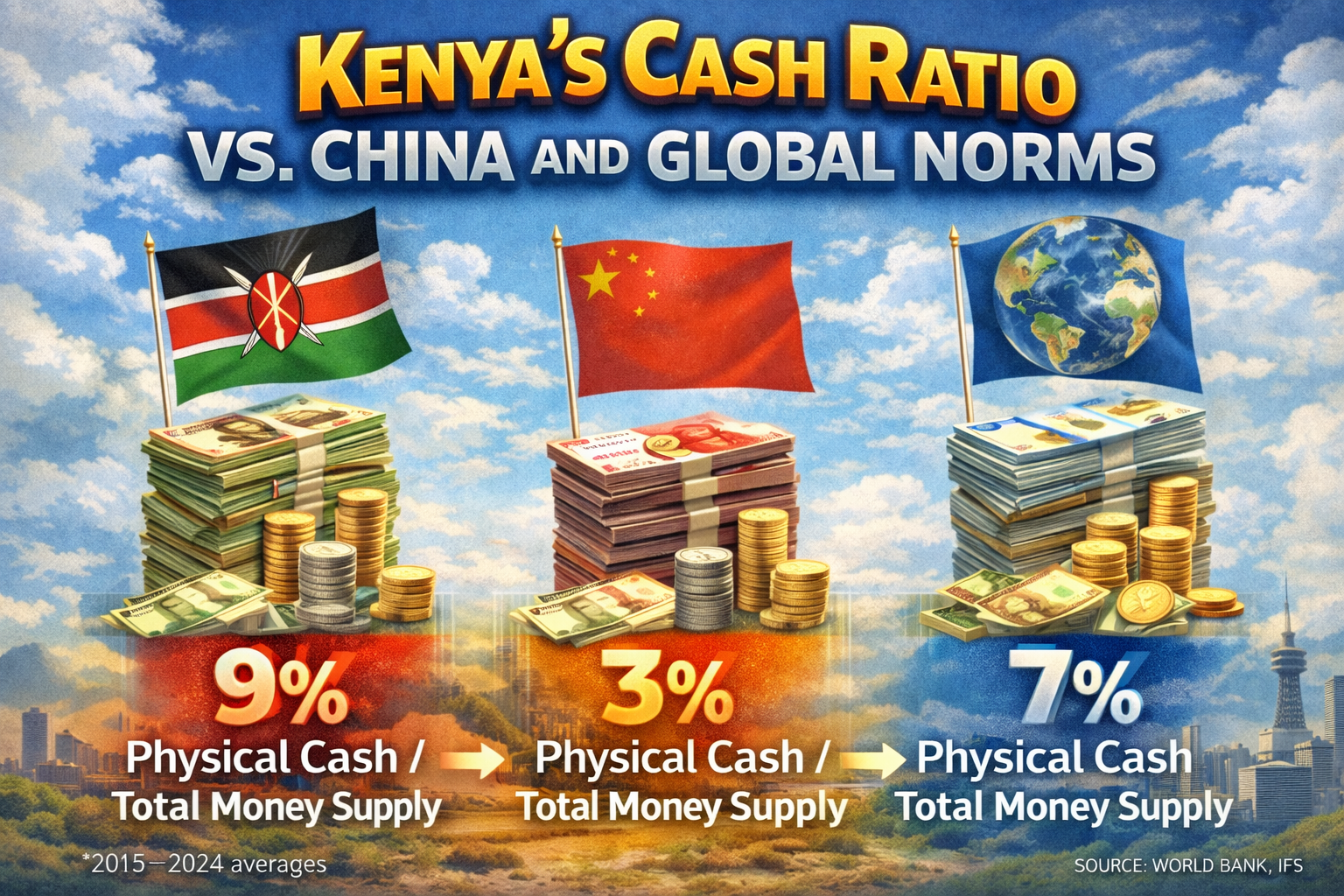
Kenya’s banking liquidity structure is notably cash-light: only about 7–10% of Kenya’s broad money supply is physical cash, with the rest being bank deposits or electronic money. This low cash ratio, achieved largely thanks to widespread mobile money (M-Pesa), is comparable to or even lower than many larger economies. For instance, in the United States roughly $2.3 trillion in currency circulates versus over $22 trillion in broad money (≈10% in cash). The Euro Area is similar (~€1.6 trillion cash vs ~€15.7 trillion M2, ≈10%). Japan’s cash share is around 9% (¥111 trillion cash vs ¥1.27 quadrillion M2). Notably, China’s economy has an even lower cash ratio than Kenya: as of 2022–2025, about ¥10.5 trillion yuan in cash circulated against a colossal ¥330 trillion in broad money – only ~3–4% of China’s money supply is physical currency. Similarly, the UK’s cash is under 3% of its money stock. In contrast, some emerging economies still rely more on cash; for example India has seen currency in public hands rise to ~14–15% of its M3 money supply in recent years. Kenya’s ~7–10% cash share, therefore, is quite low by global standards for a developing country – more in line with advanced or highly digitized economies. This suggests Kenya’s financial system has “leapfrogged” to digital liquidity, reducing reliance on notes and coins.
China’s Money Supply vs. Currency in Circulation
China’s monetary composition underscores how atypical Kenya’s case is among emerging markets. China’s total money supply (broad money M2) is enormous – about RMB¥330 trillion as of mid-2025 – while currency in circulation (M0) was only around ¥10 trillion. In percentage terms, cash makes up merely ~3% of China’s money stock. This is an exceptionally low ratio; by comparison, Kenya’s ~7–10% and India’s ~15% indicate more cash usage. China’s low cash fraction reflects the scale of deposit money and credit in its economy. Chinese banks have created trillions in deposit money via fractional-reserve banking, far outpacing the base of physical cash. The People’s Bank of China (PBoC) reports broad money (M2) to be over 30 times the amount of cash in circulation, illustrating how banking multiplies money.
Under China’s fractional reserve system, banks only hold a portion of deposits in reserve and lend out the rest, expanding the money supply. The PBoC sets a required reserve ratio (RRR) that banks must keep (historically high but recently around 7–10% on average after cuts). This means Chinese banks can lend roughly 90% of their deposit base, effectively creating new money with each loan. The result is a broad money stock far larger than the physical cash base – a common feature of modern banking, but pronounced in China due to high savings and credit growth. Indeed, after years of monetary expansion, China’s M2 has become truly colossal (over $45 trillion). The gap between M2 and M0 reflects that most money in China is bank-created deposit money. In practical terms, only a tiny fraction (a few cents on the dollar) of money circulating in China is in paper or coins; the rest exists as digital yuan balances in bank accounts.
This structure is not unique to China – advanced economies also have low cash ratios – but China stands out among big emerging economies. Its fractional-reserve banking is tightly managed by the PBoC using tools like the RRR and lending quotas, yet the sheer scale of credit means physical cash is a negligible slice of liquidity. In effect, China’s financial system operates with a vast amount of “inside money” (bank deposits) relative to “outside money” (cash issued by the central bank). Kenya is somewhat similar in that inside money (bank deposits + mobile money float) dominates, whereas many developing countries historically had higher outside-money shares.
Digital Payments and Low Cash Demand in China
A key reason China sustains such a low cash ratio is its ubiquitous digital payments infrastructure. Over the past decade, Chinese consumers and businesses rapidly adopted mobile wallets and online payment platforms. Alipay and WeChat Pay – launched in 2004 and 2013 respectively – have become near-universal payment methods, handling everything from retail purchases to peer-to-peer transfers via QR codes. By the early 2020s, cash use in China had plummeted: state media reported that by 2022 only 3.7% of the total money in circulation was in the form of cash, and this share was “continuing to fall”. In other words, over 96% of China’s money circulation by value was digital – a testament to how thoroughly electronic payments have replaced cash for transactions.
Several factors enabled this transformation in China:
- Mobile Penetration and Fintech Innovation: With high smartphone usage, even street vendors and taxis can seamlessly accept QR code payments. The two dominant apps integrated e-commerce, banking, and social features, making cashless payments extremely convenient. By 2018, an estimated 83% of all payments in China were via mobile channels, and by 2024 it became common for urban shops (even beggars) to prefer QR payments over cash.
- Trust and Network Effects: The ecosystem reached critical mass – virtually everyone has a mobile wallet, so digital payments are accepted everywhere. This drastically reduced the need to carry cash. Surveys found cash usage in only ~5% of transactions by the late 2010s, and even lower in value terms.
- Pandemic Acceleration: COVID-19 further discouraged handling cash. China, like many places, saw a surge in contactless payments during 2020–21, cementing habits of paying by phone.
- Government Policy Support: Although China’s cashless rise was led by private fintech firms, authorities ultimately supported it – with some caveats. In fact, the PBoC was sufficiently confident in low cash demand that it integrated the new digital yuan (e-CNY) pilot into currency stats. By end of 2022, about 13.6 billion e-CNY were in circulation (counted as part of M0), signaling the central bank’s push toward a state digital currency. Meanwhile, to mitigate risks, the PBoC required third-party payment platforms to hold 100% reserve backing for customer balances by 2019, effectively preventing Alipay/WeChat from creating money on their own.
The result is that China today is often cited as a leading “cashless society.” People conduct daily life with digital RMB: from buying groceries, to paying bills, to splitting restaurant tabs – all via apps. Cash demand in China remains low not because of a lack of money growth (M2 is huge), but because deposit and wallet-based money fulfill most needs. Indeed, the PBoC noted the “declining ratio of currency outside banks” as a positive development that improves monetary policy transmission (more money is within the banking system where it’s traceable and interest-bearing). Recently, China’s government even had to remind businesses not to refuse cash, for the sake of inclusivity for tourists and the elderly. But overall, digital payments have enabled China to function with remarkably little physical cash relative to its economy’s size.
Similar Liquidity Structures in Other Economies?
Is Kenya’s 7–10% cash-to-money ratio typical or unusual globally? In advanced economies, low cash ratios are common – often a single-digit percentage of money supply, as seen with China or the UK. For example, Britain’s physical cash in circulation (~£93 billion) is only ~3% of its broad money (M2 ~£3.1 trillion). The U.S. and Eurozone, while more cash-reliant than China, still hover around 8–10% as noted earlier. Japan maintains a slightly higher cash preference (~9%), partly due to cultural factors, but even there over 90% of liquidity is non-cash.
Among major Asian economies, South Korea is often cited as a cashless champion: only ~14% of payment transactions by volume involve cash, and cash is being rapidly overtaken by cards and mobile payments. Korea’s cash in circulation as a share of GDP and money supply has been falling steadily (the government even piloted “coinless society” programs). Singapore too has high digital payment usage, though a precise cash ratio is harder to find; still, physical SGD cash is only a minor portion of total liquidity in its highly banked population.
For developing countries, Kenya’s low cash ratio is less typical. Many emerging economies still have a substantial share of money in physical form due to less developed banking or digital payment infrastructure. For instance, India’s cash comprised nearly 15% of M3 in 2023–24 (a post-demonetization peak), reflecting the continued role of cash in transactions and as a store of value. Other large emerging markets (e.g. Indonesia, much of Africa) also tend to have double-digit percentages of money in cash. In that context, Kenya is an outlier – its cash ratio is unusually low for its income level. This is largely attributed to M-Pesa’s ubiquity. Since its introduction in 2007, mobile money in Kenya absorbed transactions that would have been done in cash, effectively shifting money holdings from notes under mattresses to electronic balances. Today, over 96% of Kenyan households use mobile money services, and by some estimates M-Pesa handles ~59% of Kenya’s GDP in transaction value. As people are comfortable holding funds as mobile e-money or bank deposits, the demand to hold physical cash has stagnated. Central Bank of Kenya data indeed show currency outside banks dropping relative to M3 over the past decade, indicating more of the money stock is in digital form.
In summary, Kenya’s liquidity structure – with roughly 90+% of money supply existing as bank or mobile deposits – is more akin to a developed or East Asian economy than to many peers. It’s not unprecedented globally (China and others demonstrate even lower cash reliance), but Kenya stands out among African and low-middle income countries. This near-cashless structure illustrates how technological innovation (mobile money) can rapidly change the composition of money in an economy.
Why Many Asian Governments Are Tough on Crypto
Across Asia, numerous governments (especially China, India, South Korea, Singapore) have adopted aggressive stances toward cryptocurrencies, ranging from strict regulations to outright bans. Several core concerns drive this wary approach:
- Illicit Activity, Crime and Money Laundering: Authorities fear that crypto-assets can facilitate untraceable or illegal transactions. Cryptocurrencies (especially those emphasizing anonymity) could enable money laundering, terrorism financing, drug trade payments, and other crimes outside of regulated channels. For example, China’s central bank has repeatedly flagged the risk of crypto being used for money laundering, fraud, and “underground” payments. India’s Reserve Bank likewise warns that without regulation, crypto and stablecoins can be “exploited for serious crimes, including money laundering, terrorism financing, and financing of weapons proliferation.” South Korea originally banned corporate crypto investments in 2017 “due to concerns about money laundering”, and continues to enforce strict Anti-Money Laundering (AML) measures on exchanges. Singapore’s regulator (MAS) too has emphasized that the primary risk addressed in its crypto regime is AML/CFT (countering the financing of terrorism). In short, Asian governments worry that crypto’s pseudonymous nature could create a haven for illicit flows and challenge the extensive AML controls in their formal financial systems.
- Loss of Monetary Sovereignty & Control: Another major concern is that widespread adoption of private cryptocurrencies or foreign-denominated stablecoins could undermine a country’s control over its own monetary system. China sees this as an existential threat: officials have labeled dollar-backed stablecoins and crypto as “outright political threats” to monetary sovereignty, because they enable capital to flow beyond the reach of China’s capital controls. Beijing relies on strict currency control to manage the economy and keep wealth within China; a parallel dollar stablecoin network that citizens or businesses could use freely would erode the Communist Party’s currency monopoly and ability to direct credit. This fear partly drove China’s harsh ban on crypto trading in 2017–2021 – the PBoC explicitly cited the need to “maintain the central bank’s currency issuance right” and prevent crypto from challenging the renminbi. Similarly, India’s government and RBI have expressed that private crypto could “cause erosion of monetary control” and complicate monetary policy transmission. The RBI has argued that if stablecoins pegged to dollars or other currencies became widely used, it could weaken the rupee’s role and “pose significant risks to India’s monetary sovereignty.” Even Singapore, despite its fintech-friendly image, has consistently prioritized sovereign control – MAS’s chief stated a firm “no” to cryptocurrency as money, partly because it doesn’t want unbacked private monies circulating widely. In summary, many Asian policymakers view unregulated crypto as a parallel currency that could dilute their power to manage the economy, issue legal tender, and ensure financial stability.
- Competition with National Payment Systems: Asian nations have invested heavily in modernizing their own payment ecosystems – from India’s UPI instant mobile payments, to China’s UnionPay network and e-CNY digital currency, to Kenya’s M-Pesa (in Africa, but a parallel case). Cryptocurrencies (and associated platforms) are often seen as unwelcome competitors to these official or regulated payment channels. For instance, China’s ban on crypto coincided with the rollout of its central bank digital currency (e-CNY) and tighter oversight of fintech payment giants. Allowing Bitcoin or stablecoins for domestic payments could undermine adoption of the e-CNY and weaken the grip of Alipay/WeChat (which the state can regulate), so the authorities drew a hard line. In India, the government touts the success of UPI – a free, real-time bank transfer system used by hundreds of millions – and has launched its own Digital Rupee (CBDC) pilot. Officials likely view cryptocurrencies as redundant at best, and at worst as siphoning users away from the formal, taxable digital economy. There’s also a financial inclusion narrative: India and others prefer expanding bank or mobile payment access in a controlled way rather than via volatile crypto-assets. Likewise, Kenya’s regulators, while not explicitly part of this “Asian” group, have been protective of M-Pesa’s domain – the Central Bank of Kenya warned in 2018 that cryptocurrencies like Bitcoin are not legal tender and aren’t guaranteed, implicitly favoring supervised mobile-money and banking channels. Governments fear losing users and transaction data to privately run crypto networks, especially if those networks become popular for remittances or e-commerce. In a sense, crypto is seen as a competitor to national payments infrastructure – one that operates outside government oversight and could undercut the effectiveness of domestic platforms (for example, by offering lower-cost transfers but also bypassing capital controls or Know-Your-Customer rules).
- Risk of Parallel Financial Systems: Expanding on sovereignty concerns, crypto can form a shadow financial system that authorities don’t control. Policymakers worry about the emergence of an alternate banking universe – where people park savings in crypto wallets, take loans via DeFi (decentralized finance) platforms, and trade assets on exchanges that lack the safeguards of traditional banks. This raises multiple issues:
- Financial Stability: If a large number of citizens put wealth into crypto, a crash in crypto markets could have spillover effects on the real economy. Regulators in South Korea during the 2017 ICO boom, for example, were alarmed that retail speculation in crypto was reaching fever pitch (at one point Korean exchanges drove Bitcoin prices to 20% above global rates). The government intervened with strict exchange rules and banned ICOs to prevent a potential bubble burst from hurting consumers and banks. Singapore’s MAS similarly has cautioned that crypto markets are highly risky and not suitable for retail investors, fearing that unchecked speculation could lead to losses that erode public trust in finance.
- Regulatory Arbitrage: Crypto can enable lending, payments, and even deposit-like activities without the regulatory compliance required of banks (no capital requirements, no deposit insurance, etc.). This “banking outside the banks” worries regulators. China specifically cracked down on crypto mining and exchanges in part to shut off avenues for evading its strict financial regulations (e.g. using Bitcoin to bypass bank FX controls). India’s draft bills on crypto (such as the 2019 draft ban) cited that cryptocurrencies lack an underlying asset and pose risks to financial stability and consumer protection. Even Singapore, which licenses some crypto companies, has set a “high bar” for approvals and will “generally not issue a license” if risks are too high. The common theme is ensuring crypto doesn’t grow into a parallel system outside government control and oversight.
- Tax Evasion and Capital Flight: Governments also worry that an uncontrolled crypto system enables tax evasion (since transactions can be hidden) and capital flight (moving wealth offshore in crypto form). China’s strict ban in 2021 was partly to plug capital flight channels – the ban came as authorities noticed individuals using Tether/Bitcoin to move funds abroad, undermining yuan stability. India’s RBI highlighted that crypto could be used to “bypass the current system for transferring foreign exchange in and out”, impeding controls on capital flows. For countries with capital controls or tightly managed currencies (China, India to some extent), this is a red line. South Korea, while a free capital market, still requires real-name bank accounts for crypto trading to ensure taxable, trackable flows and to prevent offshore evasion or North Korea’s illicit fund transfers via stolen crypto – a real geopolitical concern.
In summary, Asian governments’ aggressive crypto regulations come down to a simple premise: protect the state’s interests in finance. They want to stop crime and fraud, maintain monetary sovereignty, promote their own trusted digital payment systems, and avoid an uncontrolled financial realm that could destabilize the economy or weaken their authority. Whether via outright bans (China), heavy restrictions (India’s huge crypto taxes and strict KYC rules), or stringent licensing (Singapore, South Korea), the goal is to reassert oversight and control over money in an era when crypto technology is challenging the traditional levers of control.
Are Mobile Money Platforms Like M-Pesa Similar to Crypto?
Kenya’s M-Pesa and similar mobile money platforms share some surface similarities with cryptocurrencies – in that they create a form of digital, cash-like liquidity outside of traditional bank accounts. However, there are crucial differences. Let’s unpack the structure and effects of M-Pesa, and why its success raises interesting parallels (and contrasts) with crypto:
Structure of M-Pesa vs Crypto: M-Pesa is a centralized electronic money system run by a telco (Safaricom) under central bank regulation. Users convert physical cash or bank deposits into M-Pesa e-money (stored as a phone account balance) and can send that value via SMS or app to others in seconds. In essence, Safaricom issues digital tokens pegged 1:1 to Kenyan shillings – much like a stablecoin issuer would – and holds the equivalent value in trust at commercial banks as backing. Importantly, by law 100% of M-Pesa’s float is backed by secure assets (bank deposits and government securities). This makes M-Pesa’s e-money fully reserve-backed and not a new currency; it’s more analogous to a prepaid voucher or a narrow-bank deposit. Cryptocurrencies, by contrast, can be decentralized (no single entity in control, as with Bitcoin) and often are not backed by any asset (their value floats with supply and demand). Even stablecoins that are pegged to fiat (like USDC or USDT) usually operate on public blockchains and aren’t officially sanctioned legal tender.
That said, both systems allow people to hold and transfer value digitally without using a traditional bank account. With M-Pesa, a large portion of Kenyans skipped ever having a bank relationship – their mobile wallet became their de facto bank. This is somewhat analogous to how crypto proponents envision individuals holding money in digital wallets outside banks. In Kenya, someone’s M-Pesa balance is functionally “digital cash” – it can be used at merchants, sent to family, or saved on the phone, all outside the conventional banking network. The convenience and trust in M-Pesa have grown so high that many Kenyans are content to keep substantial value there rather than in paper cash or bank deposits. In effect, M-Pesa created a parallel payments ecosystem, albeit one tethered to the official currency and overseen by regulators. Crypto networks similarly create parallel ecosystems, but without the tether (for non-stablecoins) or without the same oversight.
Impact on Money Supply and Bank Reserves: One might ask – if most money is swirling around in M-Pesa rather than as cash, does this let banks “create” more money? In Kenya’s case, M-Pesa’s impact has been to reduce the demand for physical cash (M0) and increase the use of electronic “inside money”. However, because M-Pesa’s float sits in bank trust accounts, those funds are still part of the banking system’s liabilities (deposits). Essentially, M-Pesa took cash that would be outside banks and brought it into banks as float deposits, thereby increasing the share of broad money that is intermediated by banks. This could expand banks’ capacity to lend (since that money is now on deposit and can be fractionally re-lent), although in practice Safaricom’s trust accounts may be kept in very liquid form, not aggressively loaned out by banks. Even so, the money multiplier in Kenya likely rose as mobile money gained traction – the ratio of M3 to M0 increased, meaning each shilling of base money supports more overall liquidity. Banks can extend more credit when the public isn’t siphoning off as much cash. In that sense, Kenya’s near-cashless economy expanded the ability of banks to create money digitally, somewhat akin to how advanced economies operate with high deposit-to-cash ratios. Kenyan central bankers have noted that a “declining ratio of currency outside banks to M3” improves monetary policy efficiency and signals more money is in banked form.
Crypto assets, if widely adopted, could have a somewhat parallel effect of creating alternative liquidity. For example, if a significant share of the public shifted to holding stablecoins (say a USD-pegged coin) instead of local bank deposits or cash, the traditional banking system’s share of “money” would shrink. People would be transacting in a quasi-money outside domestic banks and central bank control. This is precisely what regulators fear: an extreme scenario where a “crypto parallel economy” reduces the efficacy of monetary policy and bank lending (since funds leave the bank deposit base). Interestingly, Kenya’s experience with M-Pesa foreshadowed elements of this scenario – albeit in a regulated way. M-Pesa showed that non-bank platforms can become dominant mediums of exchange and stores of value. The Kenyan central bank was comfortable with this because M-Pesa is KSh-backed and supervised, but it demonstrates how quickly people can embrace a new form of money if it’s more convenient.
Governments’ Crypto Fears Mirrored in M-Pesa? The question can be asked: Does the success of M-Pesa mirror the fears governments have around crypto? In some ways, yes. M-Pesa created a digital, quasi-“cash” circulating outside normal bank deposit accounts, which could be seen as a smaller-scale analog of what a stablecoin or cryptocurrency might do. Notably:
- Disintermediation of Banks: With so much liquidity in M-Pesa, traditional banks in Kenya had to adapt. They lost fees from payments that went through mobile money instead, and had to partner with mobile money (offering interfaces, or using M-Pesa agents for cash-in/out). Banks remained important (they hold the float and provide loans), but the customer-facing transaction layer was captured by a non-bank actor. If crypto or private e-money grew large, banks in other countries might similarly lose their direct touch with consumers (becoming back-end utilities rather than payment providers). Governments worry about this because banks are their regulated channel for influencing credit and monitoring flows. In China, for example, the rise of Alipay/WeChat prompted the PBoC to impose the reserve requirement on them to avoid banks being completely disintermediated. With crypto, disintermediation goes further – potentially no identifiable entity to regulate in the transaction chain.
- Parallel Currencies and Trust: M-Pesa’s value is firmly tied to the shilling, so it didn’t threaten currency sovereignty. But imagine if Safaricom had tried to issue its own unpegged digital token – that would look much like a cryptocurrency and surely the Kenyan regulators would not have allowed 30 million people to transact in a private pseudo-currency. In fact, a hypothetical scenario sometimes discussed: since Safaricom essentially “prints” M-Pesa credits (backed by KSh 1:1), they could alter that peg if unrestrained – e.g. define 1 M-Pesa unit to be worth 0.8 shillings and effectively create more units. Of course they cannot do this under regulation, but the thought experiment shows how a dominant private money system could theoretically expand the money supply on its own. This is exactly what governments fear with unregulated stablecoins or cryptocurrencies: that private entities could inflate a parallel money or that the public could start using a currency not controlled by the state. CFR analysts noted that if dollar stablecoins gained traction in China, they could even start displacing day-to-day yuan usage, “strengthening the dollar’s dominant position” and undermining renminbi sovereignty. That scenario is not far removed from, say, Kenyans relying on M-Pesa – except in Kenya’s case it’s still the national currency being used. It shows how governments prefer digital innovation to be in local unit and under watch (M-Pesa yes, Bitcoin no).
- Financial Integrity: M-Pesa is fully traceable by Safaricom and authorities can demand records, etc., which has helped mitigate its use in crime. Even so, there have been instances or allegations of misuse – e.g. militant groups like Al-Shabaab reportedly tried to use mobile money to move funds, prompting Kenyan banks and regulators to tighten monitoring. This highlights that any digital value transfer system can be abused. The difference is, M-Pesa’s centralized nature means suspicious transactions can be flagged and accounts frozen by order. With decentralized crypto, the worry is that bad actors can transfer funds without any central chokepoint for authorities to intervene. The success of M-Pesa (and its occasional abuse) may actually bolster regulators’ arguments that “we need strict oversight on digital payment networks” – a mindset they extend to crypto as well. In countries like India, the government promotes UPI and plans a retail CBDC, partly to provide digital convenience with traceability, thus undercuting the perceived need for private cryptocurrencies that might facilitate black-market dealings.
Global Examples and Interpretations: We can see analogous patterns elsewhere:
- In China, the rise of Alipay/WeChat Wallet – much like M-Pesa – prompted regulators to ensure those funds are ring-fenced and under PBoC purview (100% reserve at central bank). China then introduced the e-CNY to assert that the sovereign digital currency should ultimately win out. Meanwhile, China banned crypto outright, likely because it saw no benefit in a parallel system when its own digital payments were already efficient – and crypto only introduced volatility and loss of control.
- In Nigeria, a country with high crypto adoption, the government in 2021 restricted banks from serving crypto exchanges, citing similar reasons of protecting the financial system and curbing illicit flows. Nigeria simultaneously launched an eNaira (CBDC) to push a state-controlled digital alternative. This mirrors the pattern: encourage official digital money (or regulated private e-money) but suppress unregulated crypto alternatives.
- In Europe and the U.S., while not banning crypto, authorities are drawing clearer lines (e.g. stablecoin issuers must be insured institutions, crypto firms must implement KYC/AML, etc.) to integrate these new forms into the traditional oversight framework. Notably, there’s discussion of treating stablecoin issuers like narrow banks – conceptually similar to how Safaricom’s M-Pesa is effectively a narrow bank since it holds full reserves. Governments appear comfortable with digital money so long as it doesn’t become “wildcat” money. M-Pesa is an example of private-sector innovation aligned with central bank policies, whereas a cryptocurrency operating outside the system is not.
Does M-Pesa enable a “near-cashless” economy in a way that expands money creation? Yes – Kenya shows that when people switch to digital payments en masse, the economy can handle a much lower physical cash float relative to GDP or money supply. Banks don’t need to worry as much about cash withdrawals (which in fractional banking can be a limiting factor), so they can operate with lower physical liquidity buffers. In Kenya, only ~KES 280 billion (~$2.5 B) cash is outside banks, against a broad money of over KES 5 trillion – a strikingly low ratio. This means the money multiplier is high and largely constrained by regulatory decisions (reserve requirements, etc.) rather than cash demand. Crypto advocates often talk about high-velocity digital money; Kenya achieved high velocity and inclusion without crypto, via mobile money. Ironically, that success might make Kenyan regulators more cautious about crypto – they might feel, we already have a well-functioning digital currency ecosystem (M-Pesa + banks), why risk destabilizing it with an unregulated crypto system? In fact, Kenya’s central bank has warned that cryptocurrencies could be a “danger to financial stability” and lacks legal protection for users, implicitly arguing that the existing digital payment systems (which they supervise) are safer.
In conclusion, M-Pesa and crypto both represent shifts toward digital, cashless transactions, but one is tightly woven into the regulated financial fabric, while the other often stands outside it. Mobile money’s triumph in Kenya expanded the effective money supply and demonstrated many benefits of a cash-light economy – higher financial inclusion, faster payments, and economic digitization – without relinquishing control of currency or monetary policy. Governments look at crypto and see a risk that you get those same digital benefits minus the control. The Kenyan case underscores that the real issue is not digital vs physical money, but who issues and oversees the digital money. M-Pesa shows a model where private innovation and central bank oversight cooperatively increase liquidity and reduce cash needs. Crypto, in the eyes of many officials, threatens to do so in a rogue way – creating “digital cash” that is beyond the reach of central banks or commercial bank reserves. Thus, the very success of things like M-Pesa (and Alipay, etc.) in near-cashless, high-liquidity economies highlights why governments are intent on channeling digital money into forms they can regulate (mobile money, fintech, CBDCs) rather than ceding ground to decentralized cryptocurrencies. The Kenyan experience can be seen as both a proof of concept for digital finance’s promise and a cautionary tale for letting any large-scale payment system evolve without appropriate safeguards. As global finance continues to evolve, finding the balance between innovation and oversight remains the central challenge – one that Kenya navigated with M-Pesa, and which looms globally with the rise of crypto.
Sources:
- International currency and money supply statistics, showing physical cash vs M2 in major economies.
- Guardian reporting on China’s cashless transition (cash at only ~3.7% of money in circulation).
- People’s Bank of China and analysts on China’s digital payments dominance and policy responses.
- Central Bank of Kenya data on currency outside banks and broad money (indicating a declining cash/M3 ratio).
- Reserve Bank of India statements on crypto and stablecoin risks to sovereignty, crime, and capital controls.
- Council on Foreign Relations analysis of China’s crypto ban motives (capital flight, monetary monopoly).
- Caixin Global on PBoC requiring 100% reserves for mobile payment wallets.
- Harvard Business School case discussion on M-Pesa and its potential to influence money supply.
- Forbes and Africa Check on M-Pesa’s share of Kenya’s transactions and GDP.
- Comments on illicit use of M-Pesa and resulting AML responses.