
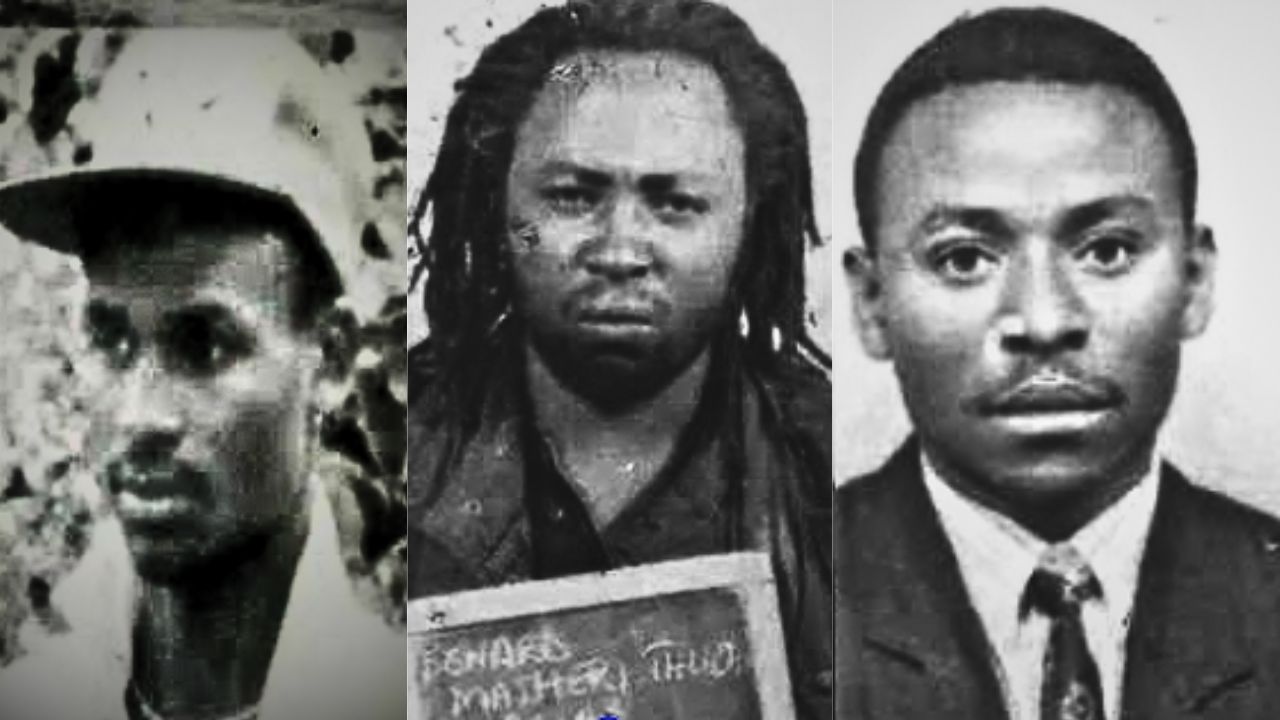
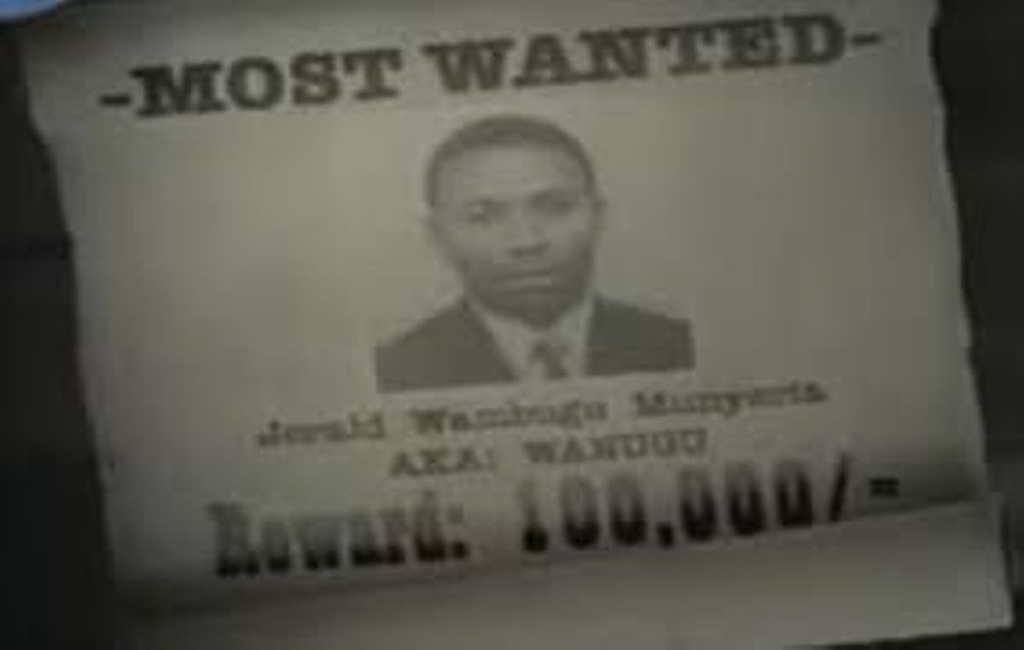
On 21 August 1995, Police Commissioner Shadrack Kiruki named three men as Kenya’s most wanted and put a price of Sh100,000 on each of their heads.
They were Anthony Ngugi Kanagi, known as Wacucu; Gerald Wambugu Munyeria, known as Wanugu; and Bernard Matheri Thuo, known as Rasta. Within two years, all three were dead, shot by police in three separate operations. None of them was ever tried in court.
Kenya still tells their story as a thriller: three bandits, one fearless detective and a long chase that ended in gunfire. The records from the time tell a darker one. The squad that hunted them became one of the most feared, and most criticised, police units in the country’s history.
[IMAGE 1 — featured] Three-face composite of Wacucu, Wanugu and Rasta, or Rasta’s booking photo.
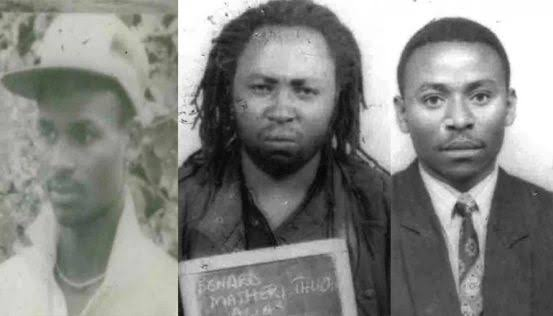
Caption: Bernard Matheri Thuo, “Rasta”, in a police booking photograph.
Alt text: A police booking photograph of a man with dreadlocks holding a name board reading Bernard Matheri Thuo.
Credit: [source]
“Nairobbery”: the city that made them
The three men belonged to a crime wave with a clear starting point. In 1992 Kenya’s economy stalled, growing by just 0.4 percent. Structural adjustment cut public-sector jobs and raised prices, and donors froze aid in late 1991.
The same year, guns flooded in. Somalia’s collapse emptied its armouries, and gun-running into Kenya peaked in 1992. Criminals were soon carrying AK-47s and Uzis against police armed with G3 rifles.
The numbers climbed with them. Police recorded more than 10,000 robberies in 1992, a figure the historian Echvin Gimode called “extremely conservative”. By 1993, the Daily Nation reported about ten cars stolen in Nairobi every day, four of them at gunpoint.
Many of the young men drawn into this world came off the matatu stages. Wacucu and Wanugu both worked as touts, drivers and mechanics before police named them as gunmen. The stages were also where police found informers, so gang and squad were recruiting from the same crowd.
By 1995, the violence had reached foreign diplomats. In November that year, armed men raided the homes of the Indian, Pakistani and Malawian High Commissioners, and a British diplomat was shot and paralysed. In February 1997, the Irish Times gave the city a nickname that stuck: “Nairobbery”.
The three men
Wacucu (Anthony Ngugi Kanagi) had been a matatu driver, a mechanic and a karate instructor at Kariokor Social Hall. He was buried at Kiranga village in Kandara, Murang’a.
Wanugu (Gerald Wambugu Munyeria) was described by the Standard as a former Nairobi mechanic and tout from Kamuyu, Nyeri. His age at death is given variously as 23, 26 and 27.
Rasta (Bernard Matheri Thuo) was from Kiria-ini in Murang’a. A primary-school dropout, he was building houses on a plot at Kaganjo when he died, aged 33. Police regarded him as the gang’s planner and its best shot.
The only crime tally from the time comes from the Weekly Review of 22 December 1995. It linked the gang to 67 murders and to injuries to 194 people, five of them police officers. Because none of the three ever stood trial, every crime attached to them is a police accusation, reported by the press.
Two killings are on firmer ground. On 13 November 1995, Colonel Geoffrey Baariu Luruti was shot twelve times outside his home in Kahawa Sukari. A fourth gang member, Timothy Irungu Ndegwa, was later convicted of the murder and sentenced to death, and the Court of Appeal upheld the sentence in 2009.
In 1996 the Daily Nation reported that Wanugu’s gang had killed Christopher Maurice, a British aid worker with Farm Africa, and a minibus driver named Mbaki Nderitu. Police believed Nderitu died because he had tipped them off about Wanugu the year before.
Alpha Romeo and Daniel Seronei
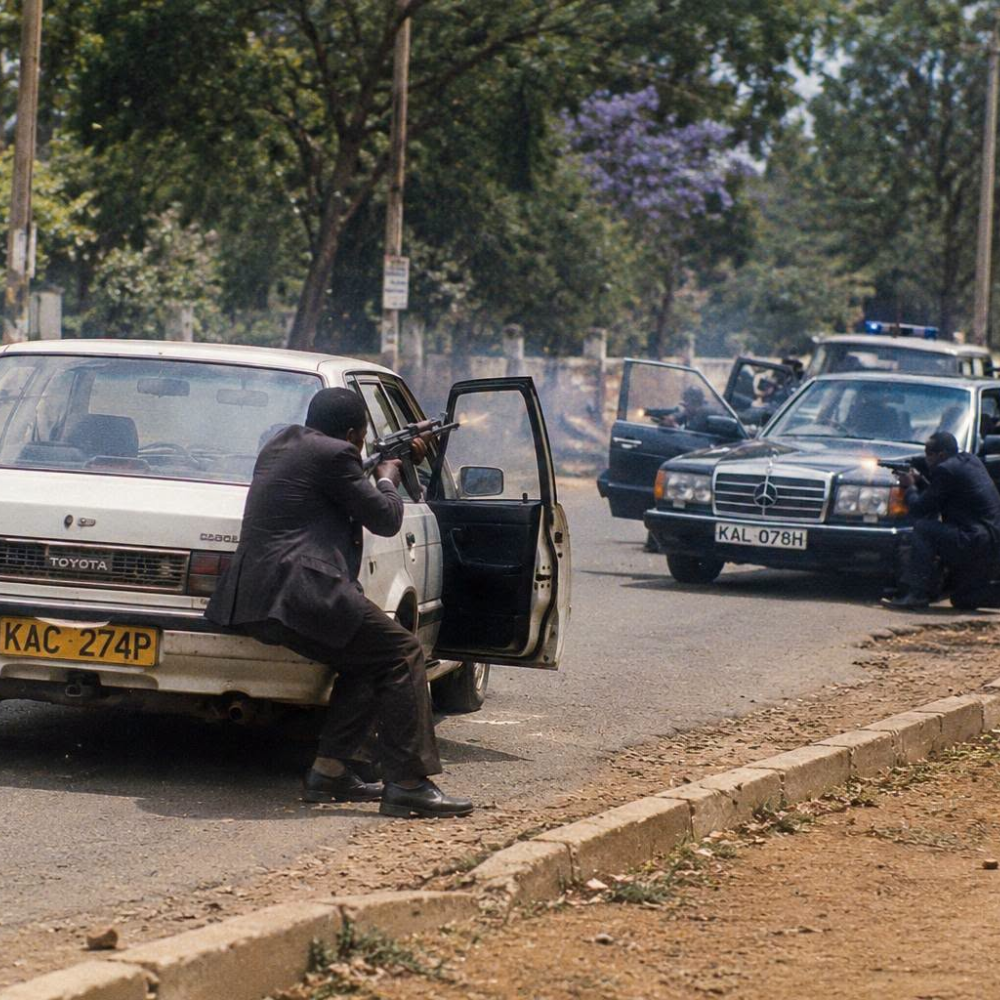
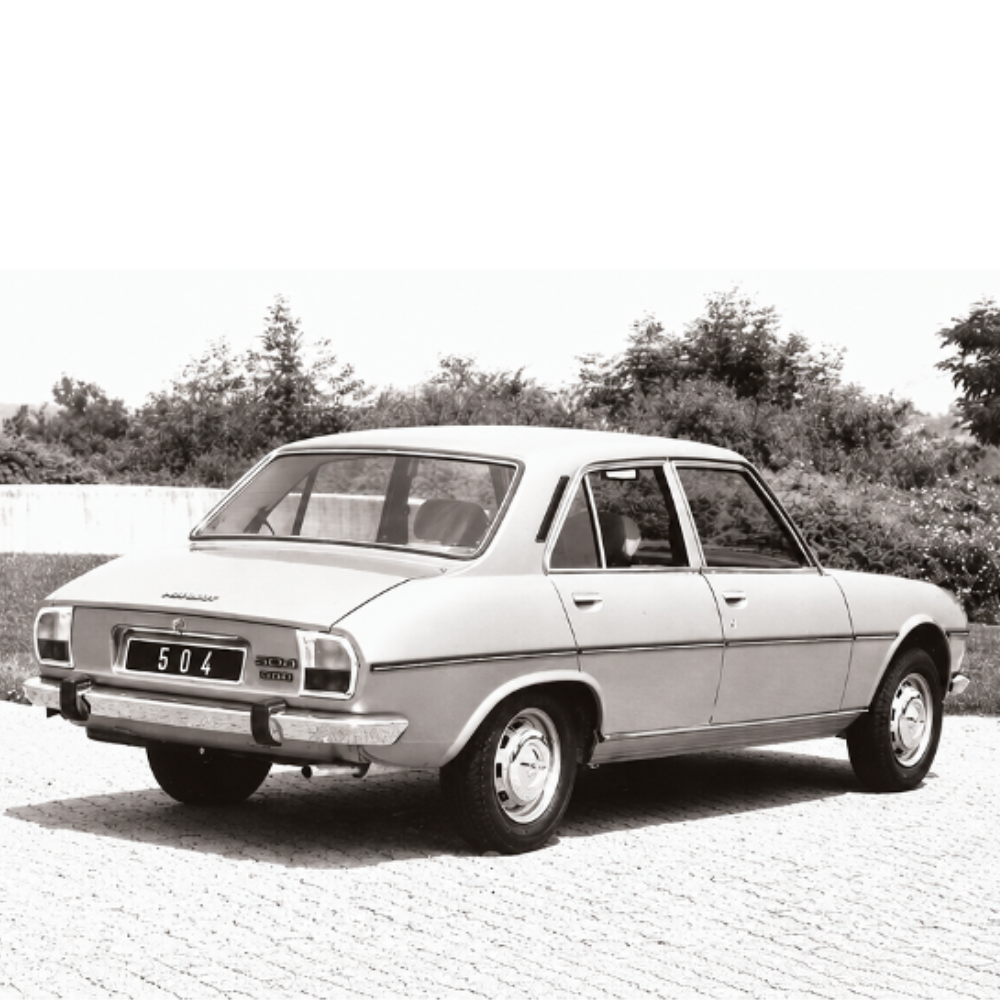
The Flying Squad was set up in the early 1990s under CID Director Noah arap Too, based at Pangani police station in Nairobi with a second base at Makuyu. Sources date its founding to 1992, 1993 or 1995. Its officers worked in plain clothes, drove grey or white Peugeot 504 station wagons and reported directly to the CID chief.
On 1 January 1996, according to the Daily Nation, a small CID team began hunting the three men full-time. It became known by its radio call-sign, Alpha Romeo.
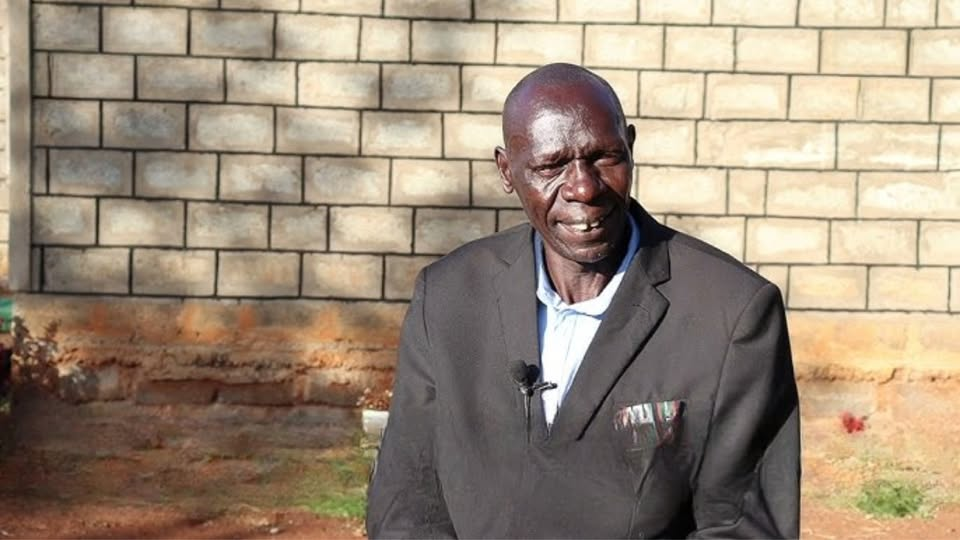
Its best-known member is Daniel Seronei. Almost everything published about him traces back to a single set of interviews he gave in 2013, to KTN’s Jaramandia la Uhalifu and to the Standard. In those interviews he describes himself as the team’s field leader, call-sign “Alpha Two”, who went beyond the rules to get results. He recruited women officers and paid matatu drivers for tips by going easy on their traffic offences.
Other accounts give a bigger role to Chief Inspector Timothy Kamunde, who died in 2002. The Standard says Kamunde himself was code-named “Alfa Romeo”. The most likely reading is that both men worked within the same Flying Squad radio network.
Three deaths in twenty months
Ongata Rongai, 4 January 1996
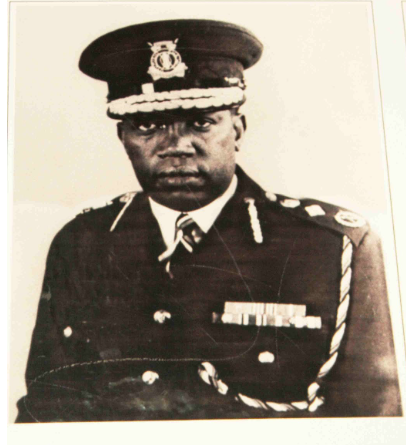
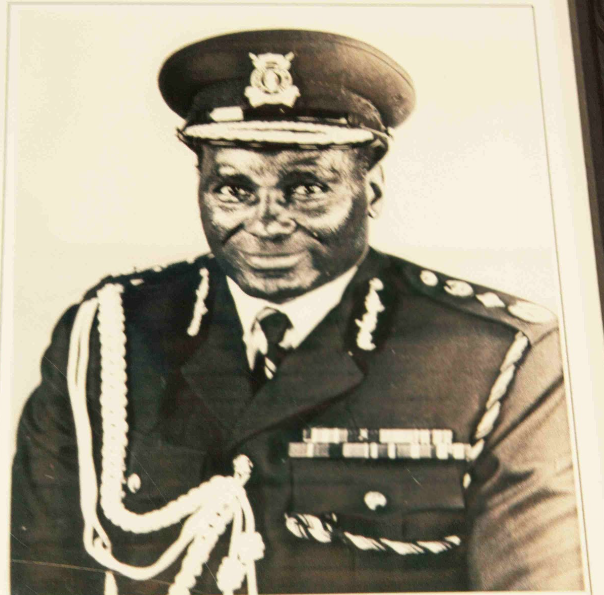
Four days after the hunt began, police intercepted Wacucu and Wanugu in a car on its way to Wanugu’s rented house in Ongata Rongai. Wacucu was shot dead. Wanugu was hit, but a bulletproof vest saved him and he escaped. A 1997 news digest names the officer who led the ambush: Duncan Wachira, then Nairobi’s provincial police chief and later Commissioner of Police.
The body raised its own questions. In 2008, Wacucu’s mother, Serah Nyokabi Kanagi, told the Standard she had identified it under police pressure. Relatives later said the man they buried was darker and taller than her son, and lacked the warts he had on his fingers. Police replied that gangsters use several names.
Kabatini, 27 June 1996
Wanugu spent six months on the run. In April he slipped a week-long police ambush in Mombasa. By May, the Daily Nation reported, he had fled into the forests of Nyandarua and Laikipia.
On 27 June 1996 he was tracked to Kabatini shopping centre near Nakuru and shot dead. A woman with him was killed too. Seronei later said he went in alone, disguised as a mechanic, and fired as Wanugu held the woman in front of him. The Standard’s account says only that a Flying Squad team acted on a tip-off.
She has never been named in the press. But an Amnesty International report from 1997 lists the death in June 1996, in Nakuru, of Jane Wanjira Mathenge. It says she was shot by a plainclothes officer immediately after he killed her cousin, a wanted criminal, outside a hotel, and that the officers involved were promoted. Every detail fits Kabatini except “cousin”. If it is the same event, the woman who died beside Wanugu has a name.
Kiria-ini, 1 September 1997
Rasta lasted fourteen more months. In Seronei’s account, an undercover officer, Amina Chute, rented rooms next to his hideouts in Umoja and Kayole. When Rasta’s contacts in the police tipped him off, his gang attacked the two officers. The Daily Nation independently confirms how he was finally found: police followed his sister as she carried tobacco to his hiding place in Murang’a.
On 1 September 1997, a large force of Flying Squad, GSU and local police surrounded his mother’s compound at Kiria-ini. Rasta opened fire and wounded a GSU officer. He was hit and died while being evacuated. Seronei says that when asked why he had not given up, Rasta replied that he could not surrender. Accounts of how long the gunfight lasted range from thirty minutes to two hours.
At home, Rasta was remembered differently. His widow, Dorcas Nyambura, told KTN years later that he was a polite man and a businessman, and some villagers called him their liberator.
The other ledger
The manhunt is the story Kenya remembers. The documents from the time record something else: police killings that rights groups counted rising year after year, and a widening gap between what the government admitted and what rights groups counted.
| Year | Killed by police: government figure | Killed by police: Kenya Human Rights Commission |
|---|---|---|
| 1996 | 74 (June 1995 to June 1996) | 88 (January to September) |
| 1997 | 94 | 123 (January to September) |
| 1998 | 69 | 164 (January to September) |
| 1999 | 63 (January to October) | 187 (January to September) |
Source: US State Department country reports on Kenya, 1996 to 1999, which quote both sets of figures. The government’s count fell every year; the KHRC’s, from only nine months of each year, rose every year.
In 1997, Amnesty International wrote that the scale of the killings meant one of two things: either the police were operating a shoot-to-kill policy approved at a senior level, which the government denied, or they were out of control. When the Commissioner of Police said action had been taken against officers who overstepped their powers, Amnesty called the statement “simply untrue”.
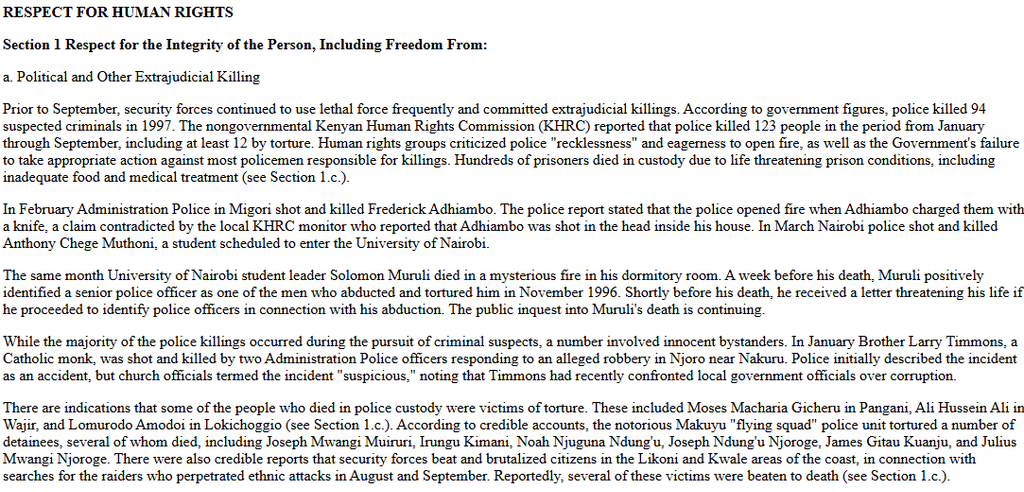
The Flying Squad’s base at Makuyu, in Murang’a, left the clearest record. In 1997 the US State Department named six men who died after torture there: Joseph Mwangi Muiruri, Irungu Kimani, Noah Njuguna Ndung’u, Joseph Ndung’u Njoroge, James Gitau Kuanju and Julius Mwangi Njoroge. In November 1997, Commissioner Wachira announced that the Makuyu unit was disbanded. By the end of the year, local MPs said, only two of its thirty officers had been moved.
The timing is striking. Rasta was killed on 1 September 1997. Ten weeks later, the same police force publicly censured the squad that had hunted him.
[IMAGE 8] Page from the US State Department’s 1997 human rights report on Kenya, the Makuyu paragraph.
Caption: The US State Department’s 1997 report on Kenya names six men who died after torture at the Makuyu Flying Squad base.
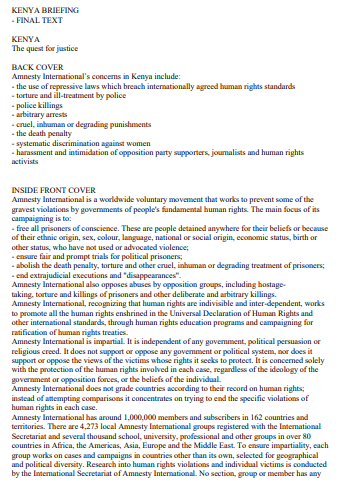
Credit: Amnesty International (cover photo: AP)
The hunter becomes the hunted
Seronei was promoted after Rasta’s death. Two years later, by his own account, his colleagues tried to kill him.
He says that on 15 December 1999, after a court appearance in a robbery case, a Flying Squad car forced his vehicle to stop in Buru Buru Phase 1, and officers he knew opened fire. He puts the number of rounds at 56. Four hit him. He says neighbours raised the alarm and stopped the officers from taking him away. Police called it a case of mistaken identity.
What followed, again in his account, was a transfer to Kakamega while he was still injured, an abduction there by armed men, and dismissal from the force in 2001 for desertion. When KTN found him in 2013 he was 49, in poor health, and still carrying a bullet in his chest that he could not afford to have removed. On camera, police spokesman Charles Owino said Seronei had done good work and called the shooting a clash between officers.
No newspaper report, inquiry or court record of the Buru Buru shooting has been found. But the wider record makes his story plausible. The US State Department recorded that a CID officer, Duncan Ndwega, was tortured by the Flying Squad in April 1999, eight months before Seronei says the squad turned on him. In November 2000, a Flying Squad officer from Pangani was sentenced to hang for robbery with violence.
The line Seronei is most often quoted as saying sums up how he sees it: when you do your work faithfully, a police officer never survives.
What the legend gets wrong
The story has been retold so often online that errors have hardened into fact. These are the most common.
| Claim you will read | What the record shows |
|---|---|
| Rasta killed AIDS researcher Job Bwayo and two American women, and was shot by about 100 officers near Athi River | Those crimes, and that raid, belong to a different man: Simon Matheri Ikere, killed in February 2007. The shared surname Matheri has merged the two. |
| Wanugu and Wacucu were blamed for more than 300 deaths | The figure appears once, without a source. The only count from the time is the Weekly Review’s 67 murders, for the whole gang. |
| Seronei personally shot Rasta | No account names who fired the fatal shots. Seronei led the operation; Rasta died during evacuation. |
| Wanugu killed “Christopher Morris” of Nyahururu | The Daily Nation of 29 May 1996 names him as Christopher Maurice of Farm Africa. A label on that page’s map read “Chris Morris”, which seems to be where the error began. |
| Rasta was killed at Kabatini in June 1996 | That was Wanugu. Rasta died at Kiria-ini, Murang’a, on 1 September 1997. |
The circulating portraits of the three men are also uncredited. They are probably police photographs, but no outlet has said where they came from.
Squad after squad
The Flying Squad was not the first unit of its kind, and it was not the last. Each one was created to fix the problems of the one before, and each ended the same way.
- 1970s: police reservist Patrick Shaw hunts Nairobi’s bank robbers, with a reputation for shootouts.
- Early 1990s: the Flying Squad is formed under CID Director Noah arap Too.
- 1999: DCI Francis Sang creates the Special Crime Prevention Unit, in part to counter the Flying Squad.
- 2007: the Flying Squad is “disbanded” after public outcry. It carries on.
- 31 December 2019: DCI George Kinoti formally ends the Flying Squad. The crime-prevention unit is renamed the Special Service Unit.
- October 2022: the Special Service Unit is disbanded after bodies are found in the River Yala and two Indian nationals and their driver disappear. President William Ruto says it had been killing Kenyans.
In each case the unit’s name changed while many of its officers stayed. A 2001 UN-Habitat survey found that 98 percent of Nairobi residents believed the police were corrupt.
Wacucu, Wanugu and Rasta are remembered as the most dangerous men of their time. Thirty years on, the harder question is whether the problem was ever just three bandits.
Do you remember the Flying Squad’s grey Peugeots, or the news of Rasta’s death in 1997? Tell us what you remember in the comments.
Keep reading
The hunt for Wacucu, Wanugu and Rasta was one chapter in a longer story about Kenya’s police and the state they served:
- How did Kenya’s police get here? Look back at Kenya Police through the decades, 1920 to 1980, in photographs.
- Where did the gang come from? Wacucu and Wanugu started out on the stages. Read the story of Kenya’s matatus.
- Who was in charge? Read our biography of Daniel arap Moi, whose government created the Flying Squad.
- What else was the state hiding? Go beneath the passport office in our story of the Nyayo House torture chambers (link once live).
- What was Nairobi like before the crime wave? Walk through twelve years of Nyayo Nairobi in photographs.
- Why did it all change in the 1990s? See how Kenya returned to multiparty democracy.
If you know someone who lived through Nairobi in the 1990s, share this with them. They may remember more than the records do.
Sources
- Daily Nation, “Wanugu hunt intensifies”, 29 May 1996, p. 3
- Daily Nation (DN2), “End of the road for criminal who gave police a hard time”; “Mary Wanjiku: girl who grew up to become a gangster”; “Special Police units: 70 years of pain, terror and splendid legacy” (2022); “Licensed to kill: behind police death squads” (2022)
- The Standard: 29 October 2008 (Wacucu’s mother); 30 August 2012 (the bounty and Kabatini); 7 July 2013 (Seronei interviews); 19 December 2009 (Irungu Ndegwa appeal); 2020 (history of the Flying Squad)
- KTN, Jaramandia la Uhalifu: the Daniel Seronei episode (2013) and the Bernard Matheri “Rasta” episode
- E. Gimode, “An Anatomy of Violent Crime and Insecurity in Kenya: The Case of Nairobi, 1985–1999”, Africa Development (2001)
- US Department of State, Kenya Country Reports on Human Rights Practices, 1996–1999
- Amnesty International: Kenya: The quest for justice (AFR 32/25/97); Violations of human rights: communications between Amnesty International and the Government of Kenya (AFR 32/27/97)
- Irish Times, 11 February 1997
- The Star, 31 December 2019 (end of the Flying Squad)
- UN-Habitat, Crime in Nairobi: Results of a Citywide Victim Survey (2002)
