
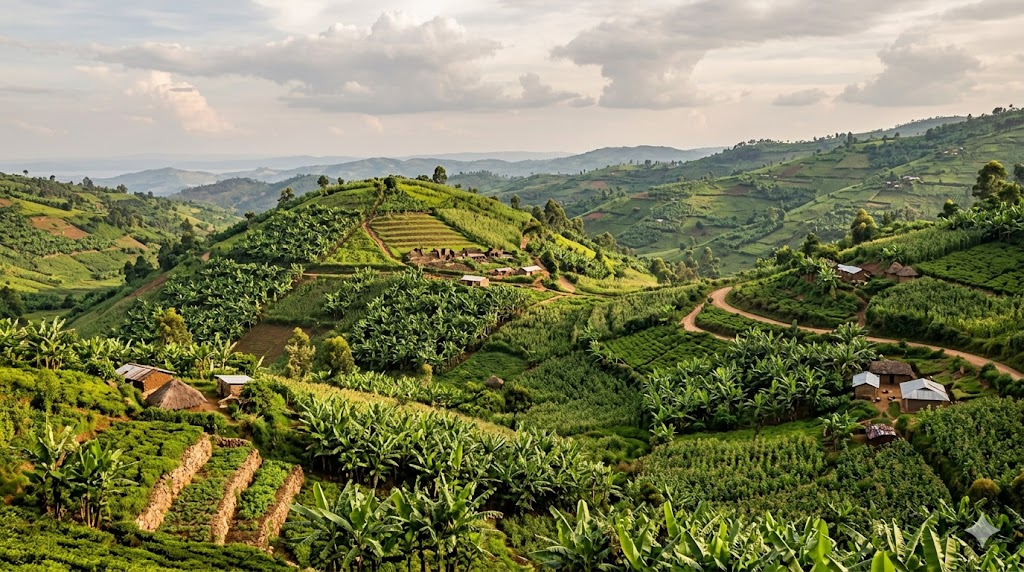
The highlands of southwestern Kenya, where the land rises steeply from the Lake Victoria basin and the annual rainfall exceeds 200 centimetres, are among the most densely populated rural landscapes on the continent. Every ridge is farmed. Every valley floor is planted. The banana groves are so dense and so productive that Kisii bananas have become a byword for quality across Kenyan markets. And beneath the soil of these highlands — specifically in the Tabaka Hills — lies a pale, soft stone that Kisii craftspeople have been carving into objects of beauty for generations, and that now ships to museum shops and tourist markets in every corner of the world.
The people who built this landscape are the Abagusii — known in Swahili as the Kisii, in their own language as Abagusii, and in their homeland as the people of Gusiiland. They are Kenya’s sixth-largest ethnic group, numbering over 2.7 million. They are Bantu-speaking farmers who arrived in their current home after a migration of centuries, pressed into the highlands by more powerful neighbours, and who then proceeded to farm those highlands with such intensity that their county became one of the most productive agricultural zones in East Africa. They are also a community whose history — the long road from Misri, the Luo pressure, the cattle raids, the colonial punitive expeditions, the prophet who foretold the British arrival — is almost entirely unknown outside western Kenya.
This is that history.
The Name and the People
The name Kisii, by which most Kenyans know this community, is not what the Abagusii call themselves. It is a Swahili adaptation used by British colonial administrators who found the original name difficult to pronounce — and it has since become the standard term in Kenyan public life. Among themselves, the people are Abagusii (singular: Omogusii), and their language is Ekegusii. Their homeland is Gusiiland, and the name Kisii refers specifically to the town — Bosongo or Getembe in Ekegusii — that became the colonial administrative centre and is now the county’s largest urban area.
The name Gusii itself has two competing explanations. The more historically grounded traces it to Mogusii — the community’s remembered founder and patriarch, who lived in the late 16th century and is said to have been the great-great-great-grandson of Kintu, the figure credited in oral tradition with leading the original Bantu migration into East Africa from the semi-mythical homeland called Misri. Abagusii means literally “the people of Mogusii.” The alternative explanation derives the name from Gwassi, a place on the Lake Victoria shore where the ancestors of the Gusii are believed to have lived as fishermen before being pushed inland by Nilotic pressure.
Both explanations carry truth. The Abagusii are simultaneously a people with a named founder and a people shaped by displacement — and those two facts together tell you most of what you need to know about who they are.
Origins: The Long Road from Misri
Gusii oral tradition begins in Misri — a place north of Mount Elgon, whose exact location is disputed and perhaps mythologised. Some scholars suggest it was in what is now Sudan or Uganda; others read “Misri” as a memory of Egypt, though this seems more symbolic than geographical. What the tradition preserves with clarity is the experience of that place: a land of hardship, of disease, famine, and drought, from which the ancestors of the Abagusii, together with other Bantu groups including ancestors of the Kikuyu, Kamba, Meru, Embu, and Luhya, were compelled to depart.
The route southward from Misri took the early Gusii through the region of Mount Elgon — the massive extinct volcano on the Kenya-Uganda border — and then, following the River Nzoia, toward the shores of Lake Victoria. Archaeological and linguistic evidence supports this broad outline: the Abagusii are part of the Great Lakes Bantu language family, closely related to communities scattered from Uganda to Tanzania, and their material culture reflects centuries of interaction with the Nilotic peoples they encountered as they moved south and east.
For a period that oral tradition and genealogical reckoning places roughly between 1640 and 1755, the ancestors of the Abagusii lived on the Kano Plains — the broad, humid flatland between present-day Kisumu and the western highlands. Here they were farmers and herders, growing finger millet, sorghum, and bananas, keeping cattle, goats, and sheep, and living in scattered homesteads on the plain’s edge. They were not alone: they shared the lakeshore with other Bantu-speaking agricultural communities, and the interactions of this period left their mark on Ekegusii vocabulary and culture.
What ended their time on the plains was the Luo. The Luo, a Nilotic cattle-herding people who had been migrating southward from the Sudan over several centuries, reached the northeastern shores of Lake Victoria under the leadership of the warrior Ramogi Ajwang’. Mobile, militarily organised, and accustomed to displacing agricultural peoples from fertile land, the Luo advance proved irresistible on the flat lakeshore terrain. Some Bantu groups were assimilated; most fled. The Abagusii, together with the ancestors of the Abakuria, moved eastward into the hills.
But the hills brought their own dangers. The Nandi, who had themselves been displaced westward by Maasai expansion, were raiding the highland margins for cattle. The Kipsigis pressed from the south. The Abagusii were squeezed into the Gusii Highlands — a compact, fertile, high-rainfall zone between roughly 1,200 and 2,100 metres — by the convergence of threats on multiple sides. In another context this might have meant destruction. In the Gusii Highlands it meant survival, because the land they were pushed into was extraordinarily productive, and the Abagusii proceeded to farm it with an intensity that has continued ever since.
The Six Clans and the Structure of Gusii Society
Gusii society is organised around clans — amabeka (singular: egetibi) — that trace patrilineal descent from the six founding ancestors credited as Mogusii’s children. The six major clans are the Abagetutu, Abanyaribari, Abagirango, Abanchari, Abamachoge, and Ababasi. Each clan is an autonomous socio-political and economic entity, providing its members with social identity, access to community resources, and the framework for marriage, inheritance, and collective defence. Within a clan, everyone shares resources and obligations. Between clans, relationships are negotiated through marriage alliances, which require cattle as bride price and create webs of obligation across the community.
Political authority in pre-colonial Gusii society was diffuse rather than centralised — no paramount chief, no kingdom, no single leader who could speak for all the Abagusii. Each ridge and valley was effectively its own autonomous unit, governed by a council of male elders who resolved disputes, managed land allocation, and coordinated responses to external threats. This structure frustrated the British — who wanted a single addressable authority — and contributed to the 1908 resistance, which the existing article on this site covers in detail. But it also meant that no single military defeat could end Gusii resistance, because there was no centralised leadership to capitulate.
The basic household unit was the enyomba — a round, windowless structure of mud walls and conical thatched roof, built at the centre of a homestead that also included cattle pens, granaries, and the cooking fire. A prosperous man had multiple wives, each with her own house, forming a compound that demonstrated his wealth and social standing. Cattle were the primary measure of wealth: bridewealth was paid in cattle, disputes were settled through cattle compensation, and a man’s ability to maintain and grow his herd determined his social standing in ways that were understood by every member of the community.
Sakawa: The Prophet Who Knew the British Were Coming
Among the Abagusii, the British arrival was not entirely a surprise. Oral tradition preserves the memory of Sakawa, a prophet born around 1840 who gathered his followers regularly at the site of present-day Kisii town and described, in precise detail, what was coming. He marked out on the ground where the police lines would be built, where the hospital would stand, where the churches and administrative offices would rise. He lit fires in a long line to show where electric poles and lights would eventually follow. And he told his followers: the white strangers would come, they would disarm the Gusii warriors if there was resistance, they would stay for a long time — and then they would leave, and the Gusii would rule themselves as they had always done.
Sakawa disappeared mysteriously in 1902. His body was never found. The prophecies came true. The British arrived in Gusiiland in 1907, established their administrative centre at exactly the location Sakawa had indicated, and built the hospital, the churches, and the offices in precisely the places he had described. When electric poles eventually arrived decades later, they followed the line of his fires.
The Sakawa tradition is one of the more remarkable examples in Kenyan history of the prophetic genre — a genre found across multiple communities, in which a seer describes the colonial arrival with sufficient accuracy to be remembered as confirmation that resistance, while honourable, was ultimately part of a larger pattern that would resolve itself. The prophet of the Giriama, the prophecy of the Kikuyu — all share this structure. They acknowledge the inevitability of colonial power while preserving the community’s sense that its own trajectory extends beyond the colonial interruption.
The Land and How the Abagusii Farmed It
Gusiiland is physically compact — Kisii and Nyamira counties together cover roughly 3,000 square kilometres — but extraordinarily fertile. Annual rainfall of 150–200 centimetres, deep red volcanic soil, and a temperate highland climate between 1,500 and 2,100 metres combine to produce conditions that support intensive agriculture year-round. The highlands were almost entirely forested when the Abagusii arrived; by the 20th century, virtually all forest had been cleared for cultivation.
The traditional crop base was finger millet — the staple grain used for the traditional ugali (obokima) made from millet or sorghum flour, and for the traditional beer (amarua) brewed for ceremonies and social occasions — alongside sorghum, bananas, sweet potatoes, beans, and arrowroot. Cattle and goats provided milk, meat, and bridewealth. The Abagusii were not primarily pastoralists like their Maasai or Luo neighbours; they were farmers who kept livestock, and the distinction mattered both economically and culturally.
The colonial introduction of tea transformed Kisii’s economy in ways that the coffee introduction transformed the central highlands. The high rainfall and temperatures were ideal for tea cultivation, and from the 1950s onward, Kisii smallholders began growing tea on land that had previously produced food crops. Tea changed the landscape, the income structure, and the relationship between the Abagusii and the market economy. Today Kisii and Nyamira counties produce a significant share of Kenya’s smallholder tea crop, and tea income has funded the education investment that has become one of the community’s defining characteristics.
The population density that results from this productive land and this investment in survival is extraordinary — and is now one of Gusiiland’s central challenges. Kisii County is among the most densely populated rural areas in Kenya. Land holdings have been subdivided across generations to the point where many families farm plots measured in fractions of an acre. The bananas, the tea bushes, and the kitchen gardens are cultivated with a precision born of necessity. The question of what happens when there is no more land to subdivide — when the next generation has no farm to inherit — is one the community is living with in real time.
Soapstone: The Craft That Went Global
In the Tabaka Hills in South Mugirango, there is a stone that forms in the earth through hydrothermal processes and emerges in shades ranging from cream and lavender to grey and near-black. It is soft enough to carve with a knife, hard enough to hold detail, and smooth enough to take a fine polish. The Abagusii have known about it for centuries.
In its traditional use, soapstone served both practical and spiritual purposes. Powdered soapstone was used in divination and healing rituals, in initiation ceremonies, and in the rock engravings found at Goti Chaki in the Tabaka Hills — pre-colonial engravings of animals and geometric patterns carved directly into soapstone outcrops that represent the earliest known artistic tradition in the region. Household tools — bowls, plates, storage vessels — were also carved from the stone’s softer deposits.
The commercial soapstone industry began in the colonial period, when Abagusii carvers recognised that the stone could be traded in the markets that colonial commerce was creating. The industry grew steadily through the 20th century, with Tabaka becoming the centre of a craft economy in which entire families specialised — men in mining and carving, women in sanding, dyeing, and polishing. The figurines, vases, candle holders, animal sculptures, and kitchen objects that emerged from Tabaka workshops found their way into tourist markets, museum shops, and gallery exhibitions across the world. In 2007, master carvers from Tabaka were awarded an exclusive licence by 20th Century Fox to produce hand-carved soapstone figurines of characters from The Simpsons — a moment of commercial absurdity that somehow confirmed the craft’s global reach.
The soapstone trade provides income to thousands of families in South Mugirango and is one of the few craft industries in Kenya that has successfully penetrated international markets without losing its handmade character. The stone itself regenerates in the quarries within five to ten years, making it a genuinely renewable resource. It is, alongside tea and bananas, one of the foundations of Gusiiland’s economy.
Spiritual Life: Engoro, Ancestors, and the Omorogi
The traditional Gusii religious worldview centred on Engoro — a supreme creator god who made the world but did not directly intervene in human affairs. Day-to-day spiritual life was managed through the ancestor cult: the ebirecha, spirits of deceased ancestors, who existed both collectively and individually and who communicated their displeasure through illness, livestock death, crop failure, and misfortune. They were not propitiated through regular ritual but through responsive sacrifice when evidence of their displeasure became apparent.
Witchcraft — obosuma — was and remains a central category in Gusii explanations of misfortune. Death among the Abagusii was traditionally considered never to be natural: it was always the result of malevolent human intervention, either through sorcery or through the actions of a witch (omorogi). Witches were believed to dig up recently buried corpses to use body parts as magical materials and to consume the internal organs of victims through invisible means. Witchcraft was understood as a hereditary art passed from parent to child — a learned practice rather than an innate characteristic.
The community maintained several types of spiritual specialists in response to this reality. The omorgori (diviner) determined the cause of misfortune. The abanyamoriogi (herbalists) treated illness with plant medicines. The ababan (indigenous surgeons) set fractures and performed trephination for headaches and backaches. The omoriori was a witch-smeller who identified witchcraft objects hidden in houses. Each specialist occupied a defined role in a system designed to manage the spiritual risks of communal life.
Witchcraft beliefs remain powerful in contemporary Gusiiland, coexisting with the Christianity that now claims the formal religious allegiance of most Abagusii. When misfortune strikes — a death, a business failure, a prolonged illness — many Gusii consult both the church and the diviner. The spiritual economy of Gusiiland is plural rather than exclusive.
Music, Dance, and the Obokano
The distinctive musical instrument of the Abagusii is the obokano — a large lyre with eight strings, played by men during ceremonies, social gatherings, and storytelling sessions. The obokano produces a deep, resonant sound that carries across the highland valleys, and its playing requires significant skill: the right hand plucks the melody strings while the left hand damps unwanted harmonics against the instrument’s frame. Obokano music is typically accompanied by sung narrative — historical accounts, praise songs, commentary on current events — that made the instrument the primary medium for the transmission of collective memory before literacy.
Gusii celebrations are marked by communal song and dance, with drums providing the rhythmic foundation for ceremonies connected to initiation, marriage, and harvest. The initiation ceremonies — circumcision for boys and clitoridectomy for girls, performed around the ages of 10–12 — are the most socially significant events in Gusii life, transforming children into social adults who know the rules of chinsoni (shame) and ogosika (respect) that govern adult relationships. The ceremonies involve intensive preparation, communal support, and collective celebration that binds the initiates to their age-group cohort for life.
Colonial Rule and Its Consequences
The British established their administration in Gusiiland in 1907. The resistance that followed — the Kisii Riots of 1908, the punitive expeditions, the cattle confiscations — are documented in the existing article on this site. The longer-term consequences of colonial rule shaped Gusii society in ways that are still visible.
The destruction of the ebisarate — the warrior cattle camps that the British identified as threats to colonial order — dismantled the institutions through which young Gusii men had traditionally developed their identity and demonstrated their courage. The hut tax created wage dependency where none had previously existed, forcing men off their land and into labour markets. Land alienation, while less severe in Gusiiland than in the central highlands because the British found the terrain difficult to farm at scale, still transferred some of the best land to European tea estates and to the colonial mission stations that appeared from 1913 onward.
The missions brought both schooling and cultural disruption. Four major denominations established themselves in Gusiiland: the Catholic Church, the Seventh Day Adventist Church, the Swedish Lutheran Mission, and the Pentecostal Assemblies of God. Each brought literacy, healthcare, and education alongside pressure to abandon initiation rites, traditional healing, and the ancestor cult. The Abagusii responded pragmatically — adopting Christianity as their formal faith while maintaining the spiritual practices that Christianity could not replace.
The 1930s brought another form of colonial engineering: the British introduced new populations into Kisii County as soldiers, interpreters, and agricultural labourers — including Nubi soldiers who were settled in Kisii town, and Baganda and Maragoli workers brought to the tea estates. The Nubi community in Kisii town, descendants of Sudanese soldiers who served the British colonial army, has maintained a distinct identity into the present day.
Independence and the Education Investment
The Abagusii approach to independence was shaped by a characteristic that had been building since the first mission schools opened: an extraordinary commitment to education. Families that had farmed small plots for generations directed whatever surplus they could generate toward school fees, recognising that education was the pathway out of land pressure and into the professional economy. The result, over several generations, is a community with a disproportionately high representation in Kenya’s professional and political life relative to its size.
The most celebrated Kisii contribution to the wider world came at the 1968 Mexico City Olympics, when Naftali Temu — born in Kisii in 1945 — won the 10,000 metres, giving Kenya its first-ever Olympic gold medal. Temu ran barefoot in training, came from a farming family, and represented a community that had never previously appeared in international athletics. His victory opened a door that Kisii athletes have walked through ever since, contributing to the broader Kenyan running tradition that the Rift Valley highlands are known for.
Post-independence Kisii has also produced significant national political figures. Simeon Nyachae — son of Senior Chief Musa Nyandusi, who was the most prominent Gusii chief of the colonial period — served in senior government positions under multiple presidents and as a cabinet minister. Fred Matiang’i, born in Kisii, served as one of Kenya’s most consequential Cabinet Secretaries across multiple portfolios in the 2010s, overseeing major reforms in education and internal security. The pattern of Gusii engagement with the Kenyan state has been activist rather than passive.
Gusiiland Today
Kisii and Nyamira counties today face a set of challenges that are the direct consequence of their own success. The productivity that allowed the Abagusii to survive displacement, colonial rule, and independence-era marginalisation has produced a population density that is now approaching the land’s carrying capacity. Average farm sizes have shrunk with each generation of inheritance subdivision. Tea prices — subject to global commodity markets — fluctuate in ways that farmers cannot control. The forest cover that once protected the highlands’ watersheds is essentially gone.
Against these pressures, the community brings the same qualities that got it here: an exceptionally high rate of educational attainment, an entrepreneurial tradition that has spread Kisii businesspeople and professionals across urban Kenya and into diaspora communities in Minnesota, London, and Melbourne, a craft industry in Tabaka that has found global markets without losing its handmade character, and the agricultural intensity of people who have farmed the same hills for three hundred years and know every ridge and valley intimately.
The Abagusii are also a community actively wrestling with questions of cultural continuity. Ekegusii — like many minority languages under pressure from Swahili and English — is spoken less frequently by younger generations. The initiation ceremonies that once marked the transition to adulthood are contested, particularly the female component. The witchcraft beliefs that remain powerful in rural communities sit uncomfortably alongside formal education and Christianity. These are not simple questions, and the Abagusii are not resolving them simply.
What is not contested is the landscape. The Gusii highlands — green, steep, intensively farmed, smelling of banana sap and tea — are one of the most distinctive environments in Kenya. The people who made them this way arrived here fleeing Luo warriors on the lakeshore and Nandi raiders in the hills. They found the highest, most fertile, most defensible ground they could. They stayed. They farmed it until there was not a square metre left uncultivated. And in the soft stone beneath those farms, their hands kept carving.
Further Reading on This Site
- The Kisii Riots of 1908 — the Abagusii’s early armed resistance to British colonial rule
- The Abakuria — the closely related community that shares the Gusii migration history
- The Luo People of Kenya — the Nilotic neighbours whose expansion pushed the Abagusii into the highlands
- The Kipsigis — the Kalenjin neighbours who pressed the Abagusii from the south
- Lords of the Plains: The Maasai at Their Peak — the regional power whose expansion reshaped the highlands the Abagusii eventually settled
- Colonialism in Kenya: Origins, Impact, and Resistance — the wider context of British colonial rule into which Gusii resistance fits
- The History of Coffee and Tea Farming in Kenya — how tea transformed Kisii’s economy
- The Tribes of Kenya — Kenya’s 44 officially recognised ethnic communities
- Why Are Kenyans So Good at Running? — the broader tradition that Naftali Temu’s 1968 gold medal helped establish
